
close

Login

Library
Shopping Cart
Drug DB
Remember Me
Forgot password/Login issues?
loading animation for AJAX calls
 
 
Direct (781) 489-7301,  Toll Free (866) 285-7215

Search

Search

Choose your License

loading animation for AJAX calls

The Global Compound Feed Market: Technology Developments and Market Changes

REPORT HIGHLIGHTS

  • The global market value of feed additives products was $16.1 billion in 2010 and is expected to grow to $27.6 billion in 2017 at an estimated compound annual growth rate (CAGR) of 8.1% from 2010 to 2017.
  • Amino acids are by far the largest feed additive group. This market segment is expected to rise at a CAGR of 10.2% and reach $18.8 billion by 2017, up from $9.6 billion in 2010.
  • Vitamins represent the second-largest ingredient group after amino acids, with a total market value of $2.9 billion in 2010. This segment is expected to grow to $3.8 billion by 2017, increasing at a CAGR of 4.2%.

SUMMARY FIGURE
MARKET VALUE OF FEED ADDITIVES BY REGION, 2010
(%)
MARKET VALUE OF FEED ADDITIVES BY REGION, 2010
Source: BCC Research

REPORT SCOPE

INTRODUCTION

BACKGROUND

This report is an update of the BCC report Development and Changes in the Global Compound Feed Sector (FOD017B) published in 2002.  The interval between that report and this update is long, and many changes in the feed and feed ingredient sector have taken place in the meantime—changes that deal not only with an expansion of meat and livestock production with a subsequent growth of feed consumption, but also with changes in the availability and pricing of macro and micro ingredients for compounded feed. 

Production of the most important cereals for feed, notably wheat and corn, continued to expand over the past decade, but consumption was higher, so that stocks were depleted.  Prices reached levels never seen before, and there is a real danger that shortages, particularly of corn, will develop soon. 

Trends in oil seeds are similar to those of cereals.  Global production of soybeans, which are responsible for about 80% of the global availability of feed proteins, could have been increased until a couple of years ago, but there are now signs that the maximum is reached and all other oil cakes, including those from rapeseed and canola, do not have the potential to fill in possible production gaps.  The consequences will be similar as for cereals: rising prices and a true risk that within the next five years oil cakes will no longer be available to the extent required. 

Dried distillers grains with solids (DDGS), the residue from cereal-based ethanol production and also a rich source for protein in feeding, became important particularly in the U.S. where bioethanol production saw an unprecedented development. 

Such changing demand and supply of macronutrients and the subsequent price adjustments drove the markets of many micro ingredients such as amino acids, vitamins, minerals, yeast and enzymes. 

Amino acids, particularly lysine and methionine, could expand their market position massively and develop into multibillion-dollar products.  In the hope that enrichment with vitamins helps to increase feeding efficiency, many vitamins saw a high demand, particularly from Asian countries, where the compound feed industry and meat production expanded most. 

The largest growth over the past decade was seen in enzymes, which are considered as the products of choice to increase feeding efficiency, to cope with high cereal and oilseed prices and to render industrialized meat production more environmentally friendly and more economical by better utilizing feedstuffs. 

The market of colorants and pigments, products that are added to feed for rendering meat and animal products more appealing and attractive for consumers, grew across all types more than proportionally to the growth of compound feed, indicating that the market penetration rates and inclusion levels increased and that consumers respond to colorations with a higher demand. 

As a result of increasing demand for such feed additives and supported by a consolidated producer community and rising raw material costs, prices for all ingredients increased strongly.  Feeding and the production of livestock products became expensive in general.  Discrepancies in production costs between Western and Asian countries decreased as a consequence of globalization of all feed ingredient markets. 

While macronutrients such as cereals and oil cakes can be sourced locally and their prices are also influenced by local conditions, the most strategically important micronutrients are available only from a limited number of globally operating companies.  As success of animal production depends to a large extent on such micro-ingredients, these companies virtually control the global compound feed business. 

This report focuses on the quantitative description of the latest developments in the raw material markets for compound feed.  It explains how and why the market developed as it did and extrapolates and amalgamates data and information to scenarios for 2017. 

REASONS FOR DOING THE STUDY AND INTENDED AUDIENCE

The report reviews global developments in the compound feed industry and discusses in detail the markets for selected but decisive components of it.  It provides the most up-to-date information on quantities manufactured and used and analyses of prices and market value developments, provides reasons for such changes and suggests scenarios through 2017.  The report’s analyses will enable the reader to understand the current structure and dynamics of the markets of compound feed ingredients and provide insight into the interrelationship and interaction among them.  The report is designed to assist decision makers in the feed industry, the feed ingredient and related industries by providing background information to be considered in strategy formulation, capacity enlargement, decisions on sites for new plants and on research priorities and related issues. 

SCOPE OF REPORT

The report starts by analyzing developments in the global meat and animal product markets.  In a second step the meat and animal product markets are related to compound feed production and to the markets of major feed ingredients such as cereals, protein cakes and other protein sources like DDGS and fish meal.  For such products current production, prices and price patterns are analyzed and amalgamated to provide an outlook for 2017.  In the section of microcomponents a selected number of premix additives are discussed.  These products comprise all feed amino acids, yeasts, minerals, colorants and pigments, vitamins and enzyme products that are believed to capture most of the global market value for additives.  Finally, in conclusion is a review of the most important companies that are active in the preparation and marketing of feed additives. 
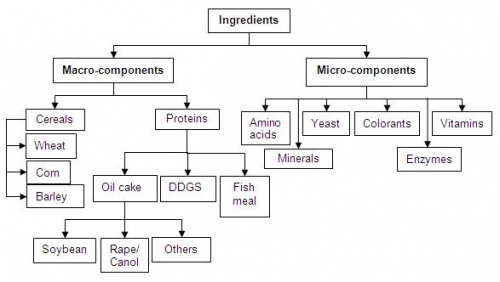
FIGURE A
COMPOUND FEED INGREDIENTS REVIEWED IN THIS REPORT
Source: BCC Research

METHODOLOGY

The methodology of this report is based on:

  • An analysis of the markets for animal products such as meat, milk and eggs, providing the fundamentals for understanding the dynamics of compound feed manufacturing.  The section describes historic developments of cattle, poultry and pork meat, milk and eggs by region and identifies major growth and development drivers.
  • A description of the global compound feed markets, its historic development and the use of compound feed by type of animal and region.
  • A analysis of macronutrients of feed.  Markets and dynamics of cereals and of oil cakes are analyzed and forecasts are given as to how the availability and pricing of such products might develop over the next years.
  • An analysis of micronutrient, providing a detailed description of the market development and forecasts how markets for these products are likely to develop over the next years.
  • In a concluding chapter the global market for micronutrients is summarized and the position of major producers is determined.

INFORMATION SOURCES

There is abundant information on virtually all components of compound feedstuffs and on the global meat markets available.  However, such information is usually disaggregated and does not show any interrelationship between the dynamics of individual markets nor the interaction between meat production, compound feed consumption and additive use.  Understanding such relationships is however perceived to be essential for comprehending the future development of the livestock and of the feed industry.  By exploiting established relationships between relevant companies and industries, the author of the study provides the basis for the high value of this report. 

AUTHOR’S CREDENTIALS

Dr. Ulrich März graduated in 1984 as an agro-economist from the University of Stuttgart, Germany.   After 10 years working in the fine chemical industry, Dr. März began an independent consulting business for the food, feed, and agro-processing industries.  His areas of specialty are the evaluation of the food, feed, and supplement ingredient markets and the design and market introduction of biotechnologically derived products as well as the economics of fermentation processes.   For more than a decade, Dr. März has authored a number of BCC technical market reports.  

BCC ONLINE SERVICES

BCC offers an online information retrieval service.   BCC’s home page, located at www.bccresearch.com, enables readers to:

  • Examine BCC’s complete catalog of Market Research Reports and place direct orders.
  • Subscribe to any of BCC’s many industry newsletters.
  • Read announcements of recently published reports and newly launched newsletters.
  • Register for BCC’s well-known conferences.
  • Request additional information on any BCC product.
  • Take advantage of special offers.

DISCLAIMER

The information developed in this report is intended to be as reliable as possible at the time of publication and of a professional nature.   This information does not constitute managerial, legal, or accounting advice; nor should it serve as a corporate policy guide, laboratory manual, or an endorsement of any product, as much of the information is speculative in nature.   The author assumes no responsibility for any loss or damage that might result from reliance on the reported information or from its use.

REPORT TOC

  Title/Chapter Name Pages Price
The Global Compound Feed Market: Technology Developments and Market Changes 148 $5450
Chapter- 1: INTRODUCTION - Complimentary 5 $0
  Show Details
Chapter- 2: SUMMARY 4 $250
  Show Details
Chapter- 3: OVERVIEW 52 $2872
  Show Details
Chapter- 4: TRENDS IN MAJOR FEED ADDITIVES 77 $4253
  Show Details
Chapter- 5: SUMMARY OF FEED ADDITIVE INDUSTRY STRUCTURE AND KEY COMPANIES INVOLVED 3 $166
  Show Details
Chapter- 6: COMPANIES AND THEIR GLOBAL POSITION IN THE FEED ADDITIVE MARKET 7 $387
  Show Details
 
  List of Tables
  List of Figures