

Food Safety Testing: Technologies and Markets
November 09, 2010
Wellesley, Mass. – According to a new technical market research report, FOOD SAFETY TESTING: TECHNOLOGIES AND MARKETS (FOD011F) from BCC Research (www.bccresearch.com), the U.S. food safety testing market was valued at an estimated $3.4 billion in 2010, and is expected to increase to $4.7 billion by 2015, for a compound annual growth rate (CAGR) of 6.6%.
The pathogens segment has the largest share of the market by far at more than $3 billion in 2010, and is expected to increase by 2015 to nearly $4.2 billion, for a CAGR of 6.7%.
The second-largest segment, toxins, is estimated at $139 million in 2010, and is expected to rise to $199 million in 2015, for a CAGR of 7.4%.
Other segments of the market include residues, genetically modified organisms, and all others. The 5-year CAGRs for each of these segments will be around 4.7% from 2010 to 2015. The largest segment of the three, residues, will reach a value of $166 million in 2015.
Amid continued outbreaks of food-borne illnesses, food safety continues to be a priority for consumers, manufacturers, regulators, and legislators. Recent national outbreaks of food-borne illness include salmonella in foods such as peanut butter (2007 and 2009), alfalfa sprouts (2009), black pepper and hydrolyzed vegetable protein (HVP) (2010). And, in as much as ingredients such as these are all raw materials in many other food products, incidents of contamination often lead to thousands of product recalls, hundreds of illnesses and, not infrequently, deaths.
This report organizes information from diverse sources and market segments into a cohesive unit that includes summary, overview, technologies, contaminants tested, foods tested, industry structure, international aspects, patent activity, and company market shares and profiles.
It offers an in-depth analysis of both the large domestic market for food contaminant testing and significant new global technology developments. There have been dramatic changes in the volume, variety, and complexity of FDA-regulated food products arriving at U.S. ports. This growing international trade in food has stimulated the demand for more food safety testing in the U.S. and has led to technological innovation in areas such as rapid testing and complex sensors.
This study should serve as a valuable basic reference and technology summary for companies interested in entering or expanding their presence in the U.S. food-safety testing market.
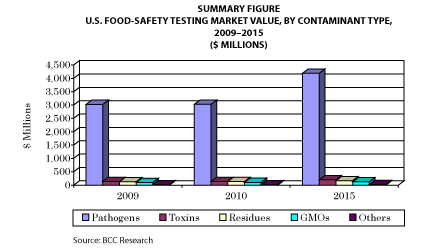
Source: BCC Research
Food Safety Testing: Technologies and Markets( FOD011F )
Publish Date: Sep 2010
Data and analysis extracted from this press release must be accompanied by a statement identifying BCC Research LLC as the source and publisher. For media inquiries, email press@bccresearch.com or visit www.bccresearch.com/media to request access to our library of market research.
BCC Library Membership Benefits
Unlimited Access to Market Research Reports for Academic Institutions and Corporations.
Custom Research
Tailored solutions across industries for your unique business needs.
More in Food
- Precision Farming Market to Grow at 10.6% CAGR
- Halal Food Industry in MENA Region: Projection for Significant Growth
- Carotenoids Market: Rising Demand for Natural Ingredients and Wellness Products Fuels Global Growth
- MENA Cold Chain Market Projected to Hit $41.1 Billion by 2030
- Global Food Traceability Market to Hit $38.5 Billion by 2029
Reports from Food
Recent News
- Wind Turbine Blade Recycling Market to Reach $158.9 Billion by 2030, Driven by Massive Wave of Turbine Decommissioning
- Energy and Sustainability Industry Sees $20+ Billion in Investment Activity as Grid Modernization and Renewable Integration Drive Transformation
- Global Industrial Chain Systems Market to Reach $5.2 Billion by 2030 as Manufacturing Automation and Food Processing Drive Steady Growth
- Hydrogen Fuel Cell Recycling Market to More Than Double, Reaching $762.4 Million by 2030 as Clean Energy Transition Creates Critical Materials Recovery Opportunity
- Solid Oxide Fuel Cells Market to Deliver Robust 24.4% CAGR by 2030