

Medical Automation Technologies, Products And Markets
September 08, 2009
- Automated health assessment and monitoring technologies
- Automated medical imaging and image analysis
- Automated prescription fulfillment devices
- Automated therapeutic (nonsurgical) devices
- Robotic and computer-assisted surgical equipment
- Automated laboratory testing and analysis
- Automated healthcare logistics, resource, and patient tracking
- Automated medical training.
The report is intended especially for healthcare automation suppliers, as well as government agencies, healthcare policy analysts and others seeking to understand the cost and preconditions for success of healthcare automation initiatives. Although the report is structured around specific technologies, it is largely nontechnical in nature.
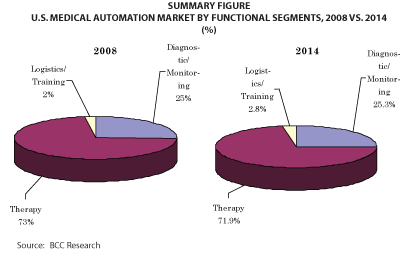
Source: BCC Research
Medical Automation Technologies, Products and Markets( HLC066A )
Publish Date: Jul 2009
Data and analysis extracted from this press release must be accompanied by a statement identifying BCC Research LLC as the source and publisher. For media inquiries, email press@bccresearch.com or visit www.bccresearch.com/media to request access to our library of market research.
BCC Library Membership Benefits
Unlimited Access to Market Research Reports for Academic Institutions and Corporations.
Custom Research
Tailored solutions across industries for your unique business needs.
More in Health Maintenance
- Global Noninvasive Cancer Diagnostics Market to Reach $165.2 Billion by 2030 as Liquid Biopsy, AI-Enabled Screening and Multi-Cancer Detection Tests Transform Oncology
- Long-Term Care and Home Healthcare Technology Market to Reach $64.8 Billion by 2030 as Aging Demographics and Remote Monitoring Reshape Care Delivery
- Thermo Fisher Scientific Inc.: BCC Research Releases Comprehensive 360° Company Analysis
- Healthcare Predictive Analytics Market to Grow at 24.7% CAGR Through 2030
- mHealth Technologies Market Poised for 17.1% CAGR Growth Through 2030
Reports from Health Maintenance
Recent News
- Biometrics as a Service in Medical Devices to Reach $2.7 Billion by 2030, Driven by Remote Patient Monitoring Demand
- Protein Synthesis Research Market to Reach $42.8 Billion by 2031, Driven by Surging CGT Investment
- AI and Advanced Diagnostics Transform Cancer Detection Market Amid Rising Healthcare Investment
- Global Bispecific Antibodies Market to Reach $22.3 Billion by 2030 as Immuno-Oncology Innovation and R&D Investment Accelerate
- Cloud Computing in Cell Biology, Genomics and Drug Development to Reach $15.6 Billion by 2030 as Biological Data Explosion Drives Demand