

Transparent Electronics: Technologies and Global Markets
October 21, 2010
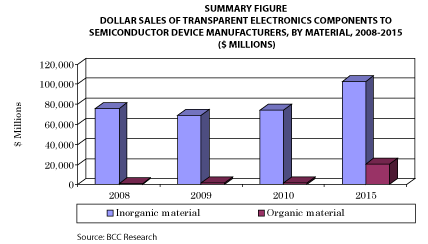
Wellesley, Mass. – According to a new technical market research report, TRANSPARENT ELECTRONICS: TECHNOLOGIES AND GLOBAL MARKETS (IFT065A) from BCC Research (www.bccresearch.com), the value of the global transparent electronics industry was nearly $76.4 billion in 2010, but is expected to increase to $123 billion in 2015, for a 5-year compound annual growth rate (CAGR) of 10%.
The largest segment of the market, inorganic material, is projected to increase at a CAGR of 6.7% to nearly $103 billion in 2015, after being valued at $74.2 billion in 2010.
The other segment, organic material, is estimated at $2.1 billion in 2010, but is expected to increase at a CAGR of 56.9% to reach nearly $20.3 billion in 2015.
Most of the hype surrounding transparent electronics is fueled by the exotic usage scenarios that it will engender: The idea of having electronic circuitry that is invisible to the human eye has few parallels in its appeal. There is an overwhelming popular discourse that this technology is being developed from scratch, when the reality is more mundane and humbling. Transparent electronics has been with us for at least 50 years.
The core of transparent electronics, the transparent conductor, is neither a recent discovery nor is it unexplored vis-à-vis applications. Transparent conducting oxides (TCO), in general, and indium tin oxide (ITO), in particular, have a long history of usage in consumer electronics as well as optical devices. They have been used for low-profile applications such as cathode-ray tubes, electromagnetic shielding and other applications. The demand for these requirements was steady but limited and there were seemingly no supply-side constraints.
This report divides the materials used for constructing transparent electronics components into the following categories: Inorganic material – Indium tin oxide and other inorganic material; and Organic material – Conducting polymers and carbon nanotubes (CNTs).
While an in-depth comparison of the pros and cons of organic and inorganic material is presented in the body of the report, there are two broad advantages that organic materials bring to the table: Better flexibility and malleability, and cost-effectiveness in the long run due to substantial supply side stability.
Transparent electronics is not a uniform science. It is rather a collection of several usage patterns and innovations that have often developed independently of each other. The technology and the market are clearly evolving at large; even among themselves, there are different stages of evolution. Transparent electronics has evolved around a set of usage scenarios: Solar/photovoltaic (PV) cells, touch surfaces, mainstream displays, and unconventional substrates.
Source: BCC Research
Transparent Electronics: Technologies and Global Markets( IFT065A )
Publish Date: Aug 2010
Data and analysis extracted from this press release must be accompanied by a statement identifying BCC Research LLC as the source and publisher. For media inquiries, email press@bccresearch.com or visit www.bccresearch.com/media to request access to our library of market research.
BCC Library Membership Benefits
Unlimited Access to Market Research Reports for Academic Institutions and Corporations.
Custom Research
Tailored solutions across industries for your unique business needs.
More in Information Technology
- Edge AI Market to Grow at 36.9% CAGR Through 2030
- Global Data Center Market to Expand at 10.6% CAGR from 2025 to 2030
- AI Revolutionizes Food Safety and Quality Control Market, Projected to Grow at a CAGR of 30.9%
- Academic & Research Collaboration Across the GCC Building Knowledge Economies
- Global Quantum Computing Market to Grow 34.6% Annually Through 2030
Reports from Information Technology
Recent News
- Machine Vision Market: 2D and 3D MV Systems, Technologies, and Markets to Reach $24.6B by 2030
- Humanoid Robot Market to Grow at 42.8% CAGR Through 2030
- Automotive Cybersecurity Market to Grow at 16.1% CAGR Through 2030
- Smart Machines Market to Grow at 20.8% CAGR Through 2030
- Automotive Battery Management System Market Set to Surge at 16.8% CAGR Through 2030