

Rigid Transparent Plastics
August 23, 2011
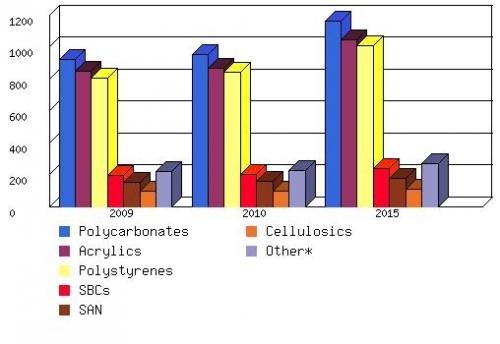
Wellesley, Mass. – In a recent release, RIGID TRANSPARENT PLASTICS (PLS003H) from BCC Research (www.bccresearch.com), the North American market for rigid transparent plastics totaled 3.3 billion pounds in 2010. That number is projected to reach more than 4 billion pounds in 2015 after increasing at a five-year compound annual growth rate (CAGR) of 3.7%.
The North American transparent plastic market can be broken down into seven segments by resin – polycarbonates, acrylics, polystyrenes, styrene block copolymers (SBCs), styrene acrylonitrile (SAN), cellulosics, and other.
The segment comprised of polycarbonates held the largest share of the North American transparent plastics market in 2010 at 950 million pounds. That amount is expected to climb to nearly 1.2 billion pounds in 2015, yielding a CAGR of 4.1%.
The segment made up of acrylics totaled 866 million pounds in 2010 and should grow to more than 1 billion pounds in 2015, a CAGR of 3.8%.
The segment made up of polystyrenes totaled 840 million pounds in 2010 and in 2015 should also total more than 1 billion pounds after growing at a CAGR of 3.7%.
The segment made up of SBCs totaled 200 million pounds in 2010, and in 2015 should total 236 million pounds, a CAGR of 3.4%.
The SAN segment totaled 158 million pounds in 2010 and in 2015 should total 178 million pounds, a CAGR of 2.4%.
The segment made up of cellulosics, totaling 97 million pounds in 2010, should rise to 110 million pounds in 2015, a CAGR of 2.5%.
The last segment, comprised of others, totaled 227 million pounds in 2010 and in 2015 is projected to total 266 million pounds, growing at a CAGR of 3.2%.
Transparent plastics are not new, but new advances have resulted in products that have made them not only tougher but more chemically resistant. This was previously a major disadvantage of clear plastics, but many are now more resistant to heat and abrasion, as well.
Clear plastics find many markets of their own, but they also are replacing glass in a variety of areas. Less weight, impact resistance or less brittleness, and design flexibility are advantages plastics have when compared to glass.
Applications that are weight-driven, such as auto windows and eyeglasses, provide a real incentive for the switch to plastics. Glazing, particularly in autos, may yet provide a huge opportunity for clear plastics, led by polycarbonates. There are areas, however, in which glass will retain its position because it can be made in thicker sheets at lower costs. Sometimes, when the critical thickness of plastics is exceeded, it becomes brittle and less ductile.
Clear plastics will continue to replace glass in many applications over the forecast period. Glass has excellent optical properties, low price, outstanding ultraviolet resistance, and excellent chemical and abrasion resistance; however, glass is heavy, breaks easily into hazardous slivers, and is expensive to form into intricate parts, making clear plastics a superior replacement in many instances.

Rigid Transparent Plastics( PLS003H )
Publish Date: Oct 2010
Data and analysis extracted from this press release must be accompanied by a statement identifying BCC Research LLC as the source and publisher. For media inquiries, email press@bccresearch.com or visit www.bccresearch.com/media to request access to our library of market research.
BCC Library Membership Benefits
Unlimited Access to Market Research Reports for Academic Institutions and Corporations.
Custom Research
Tailored solutions across industries for your unique business needs.
More in Plastics
- CO₂-Based Plastics Market to Grow at 27.8% CAGR Through 2030
- Polymeric Foams Market to Hit $197.8 Billion by 2030
- 2024 Packaging Research Review: Trends That Will Shape the Future
- Global Bioplastics Market Accelerates Toward 5,634.6 Kilotons by 2029
- Global Composites Market to Reach $183.1 Billion by 2029
Reports from Plastics
Recent News
- Materials Industry Sees $216 Billion in Strategic Investments as AI Infrastructure Drives Next-Generation Material Innovation
- Chemical Specialty Markets to Exceed $485 Billion by 2030, Driven by EV Production and Fire Safety Regulations
- Global Flexible PCB Market to Nearly Double, Reaching $41.7 Billion by 2030 on Surging Demand from Consumer Electronics, EVs and 5G Infrastructure
- Global Ion Exchange Materials Market to Reach $5.9 Billion by 2030, Driven by Green Hydrogen, Water Treatment Standards and Energy Security Demands
- Global Bio-Based Surfactants Market Valued at $18.8 Billion, Projected to Reach $27.3 Billion by 2030 as ESG Mandates and Consumer Demand Reshape the Chemicals Sector