

Plastics for Healthcare Packaging
May 03, 2010
Wellesley, Mass. – According to a new technical market research report, PLASTICS FOR HEALTHCARE PACKAGING (PLS007D) from BCC Research (www.bccresearch.com), the U.S. market for plastic healthcare packaging is expected to reach 3.8 billion pounds of products in 2010, which is expected to increase to nearly 5 billion pounds in 2015, for a 5-year compound annual growth rate (CAGR) of 5.6%.
The largest segment of the market, polypropylene, is expected to reach 1.3 billion pounds in 2015, after increasing at a CAGR of 6.3% from the estimated 2010 total of nearly 1 billion pounds.
The second-largest segment, polyvinyl chloride (PVC), is expected to increase from 845 million pounds in 2010 to nearly 1.1 billion pounds in 2015, for a CAGR of 5%.
The third-largest segment of the market, high-density polyethylene (HDPE), is projected to reach 813 million pounds in 2015, after rising at a CAGR of 5.1% from 634 million pounds in 2010.
The smallest segment, which is made up of such substances as polycarbonates, nylons, copolyesters (COPEs), thermoplastic urethanes (TPUs), silicones, and acrylics, is expected to increase at a CAGR of 6.3%, from 240 million pounds in 2010 to 325 million pounds in 2015.
This study looks in detail at the use of plastics in the packaging of healthcare products segmented by pharmaceutical and medical packaging.
- Pharmaceutical products, which are defined as drugs in dosage forms that are purchased and consumed by individual patients, and are either prescribed by a licensed medical practitioner or are drugs that do not require a prescription and are purchased by individuals “over the counter” (OTC). These products are usually packaged in containers, blister packs, bags/pouches, etc.
- Medical products, i.e., those used by medical practitioners themselves, in hospitals, clinics, home healthcare operations, etc. Examples are syringes, blood and intravenous solution bags, diagnostic kits, tubing, trays and other similar items.
In these changing times, with emphasis on healthcare cost control, plastics are increasing their penetration in packaging. This study covers these changes and provides analyses and forecasts for use of different plastics in this packaging market. Since a significant market for the use of plastics is the prime focus of this study, it will be of interest and value to those involved in polymer and polymer processes, from manufacture of bulk resins to converting and other plastics fabrication processes.
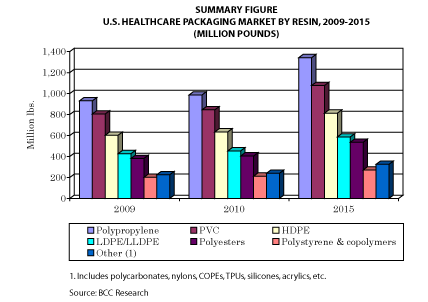
Source: BCC Research
Plastics for Healthcare Packaging( PLS007D )
Publish Date: Apr 2010
Data and analysis extracted from this press release must be accompanied by a statement identifying BCC Research LLC as the source and publisher. For media inquiries, email press@bccresearch.com or visit www.bccresearch.com/media to request access to our library of market research.
BCC Library Membership Benefits
Unlimited Access to Market Research Reports for Academic Institutions and Corporations.
Custom Research
Tailored solutions across industries for your unique business needs.
More in Plastics
- CO₂-Based Plastics Market to Grow at 27.8% CAGR Through 2030
- Polymeric Foams Market to Hit $197.8 Billion by 2030
- 2024 Packaging Research Review: Trends That Will Shape the Future
- Global Bioplastics Market Accelerates Toward 5,634.6 Kilotons by 2029
- Global Composites Market to Reach $183.1 Billion by 2029
Reports from Plastics
Recent News
- Materials Industry Sees $216 Billion in Strategic Investments as AI Infrastructure Drives Next-Generation Material Innovation
- Chemical Specialty Markets to Exceed $485 Billion by 2030, Driven by EV Production and Fire Safety Regulations
- Global Flexible PCB Market to Nearly Double, Reaching $41.7 Billion by 2030 on Surging Demand from Consumer Electronics, EVs and 5G Infrastructure
- Global Ion Exchange Materials Market to Reach $5.9 Billion by 2030, Driven by Green Hydrogen, Water Treatment Standards and Energy Security Demands
- Global Bio-Based Surfactants Market Valued at $18.8 Billion, Projected to Reach $27.3 Billion by 2030 as ESG Mandates and Consumer Demand Reshape the Chemicals Sector