

Plastics in Electronic Components: Technologies and Global Markets
February 24, 2012
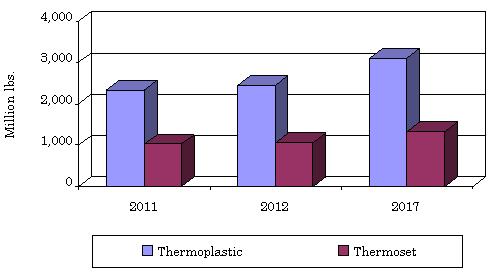
Wellesley, Mass. – According to a new technical market research report, PLASTICS IN ELECTRONIC COMPONENTS: TECHNOLOGIES AND GLOBAL MARKETS (PLS027C) from BCC Research (www.bccresearch.com), the global volume for plastics in electronic components is expected to reach 3.5 billion pounds in 2012 and increase to 4.4 billion pounds in 2017, a five-year compound annual growth rate (CAGR) of 4.7%.
The global market for plastics in electronic components can be separated into two segments: thermoplastic and thermoset.
In 2012, thermoplastics are expected to total nearly 2.5 billion pounds and, in 2017, the volume should reach 3.1 billion pounds, a CAGR of 4.9%.
The thermoset segment is projected to total nearly 1.1 billion pounds in 2012 and, by 2017, the segment should reach 1.3 billion pounds, a CAGR of 4.3%.
Resin consumption in electronic components is made up of a select group of engineering thermoplastics led by nylon and thermoplastic polyesters in volume. Based on value, however, higher performance resins such as polyphenylene sulfide, polyimides, polyketones, and liquid crystal polymers have become more significant factors in the market. Engineering thermoplastics dominate the molded electronic component segment, of which connectors are the most important.
The advantages of using plastics parts as opposed to other materials for electronic components must be weighed against their disadvantages. To decrease already small component sizes, melts used in molding components must possess excellent flow and precise molding, thermal endurance, and dimensional stability due to tight space constraints and relatively high operational temperatures.
While mechanical performance of plastics can be enhanced through reinforcements and filler loadings, higher amounts of these additives often impair processability in the molten state. A better resolution of this dilemma is still an ongoing issue.
There are quite a few resin producers heavily involved in the plastic electronic business and a selected list include some of the following: Ashland Specialties, BASF, Bayer Material Science, Chevron-Phillips Chemical, Cytec, DuPont, Huntsman Specialty Chemicals, Loctite (a unit of Henkel), Mitsubishi Engineering Plastics, Sabic IP, Solvay Advanced Polymers, Ticona, Toray, and Victrex.

Plastics in Electronics Components: Technologies and Global Markets( PLS027C )
Publish Date: Feb 2012
Data and analysis extracted from this press release must be accompanied by a statement identifying BCC Research LLC as the source and publisher. For media inquiries, email press@bccresearch.com or visit www.bccresearch.com/media to request access to our library of market research.
BCC Library Membership Benefits
Unlimited Access to Market Research Reports for Academic Institutions and Corporations.
Custom Research
Tailored solutions across industries for your unique business needs.
More in Plastics
- CO₂-Based Plastics Market to Grow at 27.8% CAGR Through 2030
- Polymeric Foams Market to Hit $197.8 Billion by 2030
- 2024 Packaging Research Review: Trends That Will Shape the Future
- Global Bioplastics Market Accelerates Toward 5,634.6 Kilotons by 2029
- Global Composites Market to Reach $183.1 Billion by 2029
Reports from Plastics
Recent News
- Materials Industry Sees $216 Billion in Strategic Investments as AI Infrastructure Drives Next-Generation Material Innovation
- Chemical Specialty Markets to Exceed $485 Billion by 2030, Driven by EV Production and Fire Safety Regulations
- Global Flexible PCB Market to Nearly Double, Reaching $41.7 Billion by 2030 on Surging Demand from Consumer Electronics, EVs and 5G Infrastructure
- Global Ion Exchange Materials Market to Reach $5.9 Billion by 2030, Driven by Green Hydrogen, Water Treatment Standards and Energy Security Demands
- Global Bio-Based Surfactants Market Valued at $18.8 Billion, Projected to Reach $27.3 Billion by 2030 as ESG Mandates and Consumer Demand Reshape the Chemicals Sector