

Nucleic Acid Aptamers For Diagnostics And Therapeutics: Global Markets
April 26, 2010
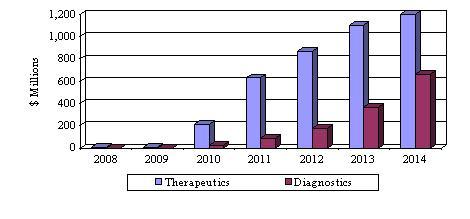
Wellesley, Mass. – According to a new technical market research report, NUCLEIC ACID APTAMERS FOR DIAGNOSTICS AND THERAPEUTICS: GLOBAL MARKETS (BIO071A) from BCC Research (www.bccresearch.com), the global market value for nucleic acid aptamers is an estimated $236 million in 2010, but is expected to increase to nearly $1.9 billion in 2014, for a 4-year compound annual growth rate (CAGR) of 67.5%.
The largest segment in the market, therapeutics, is expected to increase at a 4-year CAGR of 54.6%, from $210 million in 2010 to $1.2 billion in 2014.
The other segment, diagnostics, is expected to reach $659 million in 2014. The market in 2010 is estimated to be $26 million. Thus, the 4-year CAGR is projected to be a hefty 124.4%.

The goal of this study is to determine and describe the specific applications and global market demand for nucleic acid aptamers. In addition to a breakdown by therapeutic or diagnostic applications, markets are further divided by major disease type addressed, or diagnostic application (i.e., clinical, environmental, biodefense, etc.).
The report also identifies emerging technology growth opportunities in aptamer use as adjuvants for siRNA delivery, vaccines, and antisense technologies.
Although aptamers and their directed selection in the laboratory were described in 1990, their widespread acceptance in therapeutics and diagnostics is still being realized. Aptamers have a number of advantages over their antibody counterparts, which are discussed in detail within the report. Perhaps most important in the therapeutic context, as nucleic acids, aptamers are readily chemically synthesized and therefore are easier to characterize than antibodies produced by recombinant means. For similar reasons, aptamers are readily developed and used by boutique developers of novel diagnostics and biosensors, and larger firms are beginning to take notice.
The report will be useful for the ever-increasing number of diagnostic and biosensor development start-ups interested in the unique aspects of aptamers as inexpensive, synthetic ligands for molecular recognition.
Nucleic Acid Aptamers for Diagnostics and Therapeutics: Global Markets( BIO071A )
Publish Date: Mar 2010
Data and analysis extracted from this press release must be accompanied by a statement identifying BCC Research LLC as the source and publisher. For media inquiries, email press@bccresearch.com or visit www.bccresearch.com/media to request access to our library of market research.
BCC Library Membership Benefits
Unlimited Access to Market Research Reports for Academic Institutions and Corporations.
Custom Research
Tailored solutions across industries for your unique business needs.
More in Cell Biology
- Biometrics as a Service in Medical Devices to Reach $2.7 Billion by 2030, Driven by Remote Patient Monitoring Demand
- Protein Synthesis Research Market to Reach $42.8 Billion by 2031, Driven by Surging CGT Investment
- AI and Advanced Diagnostics Transform Cancer Detection Market Amid Rising Healthcare Investment
- Cloud Computing in Cell Biology, Genomics and Drug Development to Reach $15.6 Billion by 2030 as Biological Data Explosion Drives Demand
- Decentralized Clinical Trials Market to Reach $18.8 Billion by 2030 as Digital Health Infrastructure Reshapes Drug Development
Reports from Cell Biology
Recent News
- Global Bispecific Antibodies Market to Reach $22.3 Billion by 2030 as Immuno-Oncology Innovation and R&D Investment Accelerate
- Global Noninvasive Cancer Diagnostics Market to Reach $165.2 Billion by 2030 as Liquid Biopsy, AI-Enabled Screening and Multi-Cancer Detection Tests Transform Oncology
- Neuroprotective Agents Market to Reach $60.9 Billion by 2030 as Neurological Disease Burden and Aging Populations Drive Pharmaceutical Investment
- Long-Term Care and Home Healthcare Technology Market to Reach $64.8 Billion by 2030 as Aging Demographics and Remote Monitoring Reshape Care Delivery
- Radioligand Therapeutics Market to More Than Double to $4.8 Billion by 2030 as Targeted Cancer Treatments Gain Regulatory Momentum