

Disabled and Elderly Assistive Technologies
September 20, 2011
Wellesley, Mass. – In a recent release,DISABLED AND ELDERLY ASSISTIVE TECHNOLOGIES (HLC047C) from BCC Research (www.bccresearch.com), the U.S. market for assistive technologies totaled $41.1 billion in 2011. That value is projected to reach $55 billion in 2016 after increasing at a five-year compound annual growth rate (CAGR) of 6%.
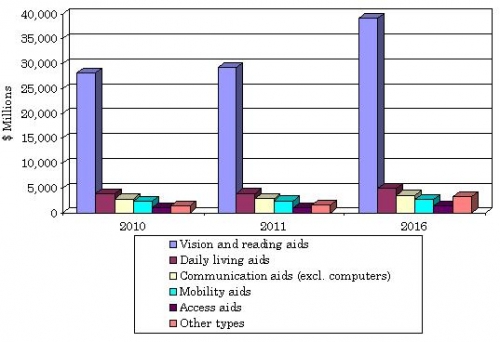
U.S. assistive technology sales can be broken down into six segments – vision and reading aids, daily living aids, communication aids, mobility aids, access aids, and other types of assistive technologies.
Vision and reading aids, which account for almost 75% of the total assistive technologies market, were valued at $29.3 billion in 2011. This segment is expected to grow at a CAGR of 6% and reach $39.2 billion in 2016.
Daily living aids totaled almost $4 billion in 2011, and in 2016 should be worth nearly $5 billion, a CAGR of 4.9%.
Communication aids, excluding computers in this report, totaled nearly $2.9 billion in 2011, and in 2016 that number should reach $3.5 billion, a CAGR of 4%.
The mobility aids segment, valued at $2.4 billion in 2011, should exceed $2.7 billion in 2016 after growing at a CAGR of 2.6%.
The access aids segment, worth almost $1 billion in 2011, should be worth $1.3 billion in 2016, a CAGR of 6.2%.
The other types of assistive technologies totaled $1.6 billion in 2011, and in 2016 the segment should surpass $3.2 billion, a CAGR of 15%.
Assistive technology encompasses a broad range of devices, from “low-tech” products such as eyeglasses and large-print books to technologically sophisticated products such as voice synthesizers, Braille readers, and wireless monitoring devices.
As a result of progress in medical science and technology and in healthcare, societal evolution and changing attitudes, many disabled and elderly people are not only living longer lives but are living longer independently or semi-independently. They may now expect to be gainfully employed, participate in the political process, and attend cultural and social events, to name only some of the possibilities.
These individuals need to perform activities such as shopping, personal hygiene, and communications that once might have been performed by a family member or institutional caregiver. For these reasons, the disabled and elderly assistive devices market can expect to see healthy growth through the rest of the decade.
The report has been written explicitly for those with an interest in disabled and elderly care issues, including healthcare professionals, manufacturers and distributors of assistive devices, regulators and health insurers, investors, and the financial and analyst communities. It also can be useful to readers with an interest in the marketing, financial, and management dimensions of the assistive technologies industry. Readers with a more general interest in disabled and elderly care may find it useful as well.

Disabled and Elderly Assistive Technologies( HLC047C )
Publish Date: Jul 2011
Data and analysis extracted from this press release must be accompanied by a statement identifying BCC Research LLC as the source and publisher. For media inquiries, email press@bccresearch.com or visit www.bccresearch.com/media to request access to our library of market research.
BCC Library Membership Benefits
Unlimited Access to Market Research Reports for Academic Institutions and Corporations.
Custom Research
Tailored solutions across industries for your unique business needs.
More in Health Maintenance
- Global Noninvasive Cancer Diagnostics Market to Reach $165.2 Billion by 2030 as Liquid Biopsy, AI-Enabled Screening and Multi-Cancer Detection Tests Transform Oncology
- Long-Term Care and Home Healthcare Technology Market to Reach $64.8 Billion by 2030 as Aging Demographics and Remote Monitoring Reshape Care Delivery
- Thermo Fisher Scientific Inc.: BCC Research Releases Comprehensive 360° Company Analysis
- Healthcare Predictive Analytics Market to Grow at 24.7% CAGR Through 2030
- mHealth Technologies Market Poised for 17.1% CAGR Growth Through 2030
Reports from Health Maintenance
Recent News
- Biometrics as a Service in Medical Devices to Reach $2.7 Billion by 2030, Driven by Remote Patient Monitoring Demand
- Protein Synthesis Research Market to Reach $42.8 Billion by 2031, Driven by Surging CGT Investment
- AI and Advanced Diagnostics Transform Cancer Detection Market Amid Rising Healthcare Investment
- Global Bispecific Antibodies Market to Reach $22.3 Billion by 2030 as Immuno-Oncology Innovation and R&D Investment Accelerate
- Cloud Computing in Cell Biology, Genomics and Drug Development to Reach $15.6 Billion by 2030 as Biological Data Explosion Drives Demand