

Environmental Sensing and Monitoring Technologies: Global Markets
October 19, 2011
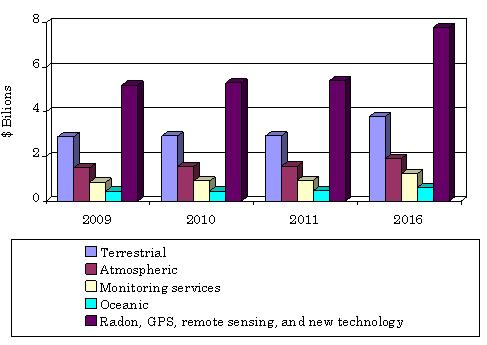
Wellesley, Mass. – In a recent release, ENVIRONMENTAL SENSING AND MONITORING TECHNOLOGIES: GLOBAL MARKETS (IAS030B) from BCC Research (www.bccresearch.com), the global market for environmental sensing and monitoring technologies was valued at $11.3 billion in 2011 and is forecast to be $15.3 billion in 2016, a compound annual growth rate (CAGR) of 6.5%.
The global market for environmental sensing and monitoring can be broken down into five segments – terrestrial, atmospheric, monitoring services, oceanic, and the segment composed of radon, GPS, remote sensing, and new technology.
The terrestrial segment was worth $2.9 billion in 2011 and in 2016 should be worth nearly $3.8 billion, a CAGR of 5.3%.
The atmospheric segment, worth nearly $1.6 billion in 2011, should be worth $1.9 billion in 2016, a CAGR of 4%.
The segment comprised of monitoring services was worth almost $1 billion in 2011 and in 2016 is expected to be worth $1.2 billion, a CAGR 5.5%.
The oceanic segment, worth $470 million in 2011, should be worth $610 million in 2016, a CAGR of 5.2%.
The segment composed of radon, GPS, remote sensing, and new technologies totaled $5.4 billion in 2011 and in 2016 is expected to be worth $7.8 billion, a CAGR of 7.5%.
There are two principal trends of note in the environmental sensing and monitoring business. The first is a technological revolution in the design and engineering of individual sensors and sensor components – miniaturization. Making sensors smaller lowers material costs and energy requirements and makes large distributed networks possible. The second principal trend is the development of environmental sensor and monitoring networks themselves.
Environmental sensors are made in literally thousands of forms and types based on a wide range of physical and chemical principles with various types of usable outputs. Typical contaminants monitored are metals, volatile organic compounds, biological contaminants, and radioisotopes. The field applications of sensors are also extremely varied. Areas of environmental focus include vehicular emissions, combustion of fossil fuels, agricultural runoff, industrial and mine waste disposal, ocean spills and dumping, and climate change and weather monitoring.
With its broad scope and in-depth analyses, this study will prove to be a valuable resource for anyone involved with or interested in environmental sensors. It will be particularly useful for researchers; laboratory and government personnel working in research or company settings; and business professionals, such as marketing managers, strategic planners, forecasters, and new product and business developers who are involved with most aspects of the sensors industry. It will also be valuable to potential investors and members of the general public who are interested in acquiring a business-oriented view of the use of sensors in environmental monitoring.

Environmental Sensing and Monitoring Technologies: Global Markets( IAS030B )
Publish Date: Oct 2011
Data and analysis extracted from this press release must be accompanied by a statement identifying BCC Research LLC as the source and publisher. For media inquiries, email press@bccresearch.com or visit www.bccresearch.com/media to request access to our library of market research.
BCC Library Membership Benefits
Unlimited Access to Market Research Reports for Academic Institutions and Corporations.
Custom Research
Tailored solutions across industries for your unique business needs.
More in Instrumentation and Sensors
- Machine Vision Market: 2D and 3D MV Systems, Technologies, and Markets to Reach $24.6B by 2030
- Humanoid Robot Market to Grow at 42.8% CAGR Through 2030
- Automotive Cybersecurity Market to Grow at 16.1% CAGR Through 2030
- Smart Machines Market to Grow at 20.8% CAGR Through 2030
- Automotive Battery Management System Market Set to Surge at 16.8% CAGR Through 2030
Reports from Instrumentation and Sensors
Recent News
- Edge AI Market to Grow at 36.9% CAGR Through 2030
- Global Data Center Market to Expand at 10.6% CAGR from 2025 to 2030
- AI Revolutionizes Food Safety and Quality Control Market, Projected to Grow at a CAGR of 30.9%
- Academic & Research Collaboration Across the GCC Building Knowledge Economies
- Global Quantum Computing Market to Grow 34.6% Annually Through 2030