

Nanofibers: Technologies and Developing Markets
July 01, 2010
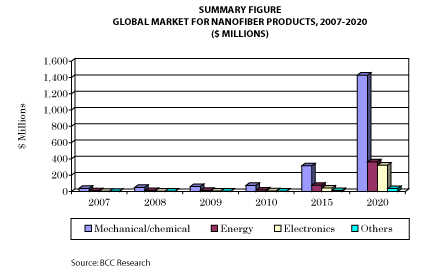
Wellesley, Mass. – According to a new technical market research report, NANOFIBERS: TECHNOLOGIES AND DEVELOPING MARKETS (NAN043B) from BCC Research (www.bccresearch.com), the global market for nanofibers is an estimated $102 million in 2010, but is expected to increase to $442.7 million in 2015, for a 5-year compound annual growth rate (CAGR) of 34.3%.
The largest segment of the market, made up of mechanical/chemical products, is expected to reach $314 million in 2015, after increasing at a CAGR of 33.4% from the estimated 2010 value of $74.3 million.
The second-largest segment, energy products, is estimated to be worth $16.7 million in 2010, and is expected to increase at a CAGR of 35.3% to reach $75.8 million in 2015.
The electronics segment of the market is projected to increase at a hefty CAGR of 45.3%, from an estimated $6.4 million in 2010 to $41.5 million in 2015.
The segment that includes all other products is expected to reach $11.1 million in 2015, after rising at a CAGR of 22% from the estimated 2010 value of $4.1 million.
Nanofibers are traditionally defined as cylindrical structures having an outer diameter below 1,000 nanometers and an aspect ratio (the ratio between length and width) greater than 50. Over the years, several types of nanofibers have been developed: polymeric, carbon, ceramic, glass, metallic, and composite.
BCC has identified nine main sectors where nanofibers have current and potential use: automotive and aerospace, consumer, defense and security, electronics, energy, mechanical/chemical, medical/biological/pharmaceutical, sensors and instrumentation, and thermal and acoustic insulation.
This study details the latest developments in nanofiber technology, including material types, properties, and fabrication processes. It also reviews current and emerging applications of these materials, and discusses current technical issues affecting nanofiber production and commercialization.
This study is mainly directed toward executives, directors, operations managers, sales and marketing managers, and strategic planners working within the above-named industries. Universities and research facilities may find this study to be a good source of technical information regarding nanofiber technology, materials, equipment, and applications, which can be used as a baseline for new or expanded R&D activities. Librarians of technical information and research centers can use this report also to provide critical data to product managers, market analysts, researchers, and other professionals needing detailed and updated insights into the nanofiber industry.
Source: BCC Research
Nanofibers: Technologies and Developing Markets( NAN043B )
Publish Date: Jun 2010
Data and analysis extracted from this press release must be accompanied by a statement identifying BCC Research LLC as the source and publisher. For media inquiries, email press@bccresearch.com or visit www.bccresearch.com/media to request access to our library of market research.
BCC Library Membership Benefits
Unlimited Access to Market Research Reports for Academic Institutions and Corporations.
Custom Research
Tailored solutions across industries for your unique business needs.
More in Nanotechnology
- Lead-Free Piezoelectric Ceramics Market to Grow 12.3% Annually Through 2030
- Advanced Ceramics and Nanoceramics Lead the Way in a Market Positioned for Long-Term Growth
- Carbon Nanotubes Market Set to Surge at 20.6% CAGR Through 2029, Driven by Emerging Technologies and Global Demand
- Nanofibers Industry Poised for Exponential Growth: 26% CAGR Anticipated from 2023 to 2028
- Global Nanotechnology Market Poised to Reach $183.7 Billion by 2028, According to BCC Research Analysis
Reports from Nanotechnology
Recent News
- Materials Industry Sees $216 Billion in Strategic Investments as AI Infrastructure Drives Next-Generation Material Innovation
- Chemical Specialty Markets to Exceed $485 Billion by 2030, Driven by EV Production and Fire Safety Regulations
- Global Flexible PCB Market to Nearly Double, Reaching $41.7 Billion by 2030 on Surging Demand from Consumer Electronics, EVs and 5G Infrastructure
- Global Ion Exchange Materials Market to Reach $5.9 Billion by 2030, Driven by Green Hydrogen, Water Treatment Standards and Energy Security Demands
- Global Bio-Based Surfactants Market Valued at $18.8 Billion, Projected to Reach $27.3 Billion by 2030 as ESG Mandates and Consumer Demand Reshape the Chemicals Sector