

Ophthalmic Therapeutic Drugs: Technologies and Global Markets
May 07, 2010
Wellesley, Mass. – According to a new technical market research report, OPHTHALMIC THERAPEUTIC DRUGS: TECHNOLOGIES AND GLOBAL MARKETS (PHM031C) from BCC Research (www.bccresearch.com), the value of the market for ophthalmic therapeutic drugs was an estimated $15.5 billion in 2009, but is expected to increase to nearly $20.1 billion in 2014, for a 5-year compound annual growth rate (CAGR) of 5.9%.
The largest segment of the market, anti-glaucoma drugs, is projected to increase at a CAGR of 3.6% to $6.6 billion in 2014, after being valued at an estimated $5.8 billion in 2009.
Revenues for disease treatments for wet age-related macular degeneration, which make up the second-largest segment, are estimated at more than $2.4 billion in 2009, and are expected to increase at a CAGR of 10% to reach nearly $4 billion in 2014.
The third-largest segment, dry-eye disease therapeutics, is expected to have a 5-year CAGR of 8.4%, with values of nearly $1.9 billion in 2009 and $2.8 billion in 2014.
The segment made up of anti-infectives is projected to have a CAGR of 9.5%, rising from more than $1.3 billion in 2009 to $2.1 billion in 2014.
Annual growth rates in the ophthalmic sector are twice that of the overall pharmaceutical industry, driven by new developments in ophthalmic therapies that have emerged during the past 5 years. These advancements have transformed this historically slow-growth, generic-centric, and price-competitive market segment into a high-growth sector fueled by technology and characterized by increasing opportunity.
Market growth has been spurred by the introduction of differentiated therapies due to novel mechanism of action, such as ranibizumab, a vascular endothelial growth factor (VEGF) inhibitor that ameliorates the progression of age-related macular degeneration. Ranibizumab is now the single-largest revenue generator in the ophthalmic segment, despite its introduction only a few years ago.
This report is an invaluable tool for business planners, acquisitions specialists, licensing strategists, product managers, market research analysts, investors, investor consultants, and anyone interested in the ophthalmic market, its products, its industry participants, and its future.
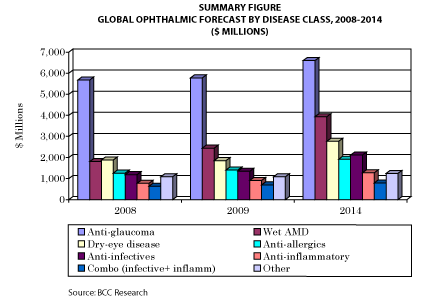
Source: BCC Research
Ophthalmic Therapeutic Drugs: Technologies and Global Markets ( PHM031C )
Publish Date: Apr 2010
Data and analysis extracted from this press release must be accompanied by a statement identifying BCC Research LLC as the source and publisher. For media inquiries, email press@bccresearch.com or visit www.bccresearch.com/media to request access to our library of market research.
BCC Library Membership Benefits
Unlimited Access to Market Research Reports for Academic Institutions and Corporations.
Custom Research
Tailored solutions across industries for your unique business needs.
More in Pharmaceuticals
- Global Bispecific Antibodies Market to Reach $22.3 Billion by 2030 as Immuno-Oncology Innovation and R&D Investment Accelerate
- Neuroprotective Agents Market to Reach $60.9 Billion by 2030 as Neurological Disease Burden and Aging Populations Drive Pharmaceutical Investment
- Radioligand Therapeutics Market to More Than Double to $4.8 Billion by 2030 as Targeted Cancer Treatments Gain Regulatory Momentum
- Global GLP-1 Analogues Market to Reach $268.4 Billion by 2030
- AI in Clinical Trials Poised for Rapid Growth with a 22.6% CAGR Forecast
Reports from Pharmaceuticals
Recent News
- Biometrics as a Service in Medical Devices to Reach $2.7 Billion by 2030, Driven by Remote Patient Monitoring Demand
- Protein Synthesis Research Market to Reach $42.8 Billion by 2031, Driven by Surging CGT Investment
- AI and Advanced Diagnostics Transform Cancer Detection Market Amid Rising Healthcare Investment
- Global Noninvasive Cancer Diagnostics Market to Reach $165.2 Billion by 2030 as Liquid Biopsy, AI-Enabled Screening and Multi-Cancer Detection Tests Transform Oncology
- Cloud Computing in Cell Biology, Genomics and Drug Development to Reach $15.6 Billion by 2030 as Biological Data Explosion Drives Demand