

Composites: Resins, Fillers, Reinforcements, Natural Fibers & Nanocomposites
July 08, 2011
Wellesley, Mass. – In a recent release, COMPOSITES: RESINS, FILLERS, REINFORCEMENTS, NATURAL FIBERS & NANOCOMPOSITES (PLS029C) from BCC Research (www.bccresearch.com), the North American market of fiber-reinforced plastics was nearly 2.7 billion pounds in 2010. That value is projected to be 3.1 billion pounds in 2015, after increasing at a five-year compound annual growth rate (CAGR) of 2.8%.
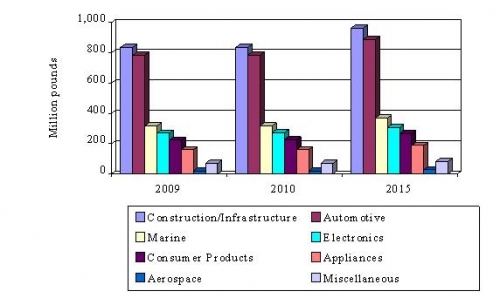
The North American market for fiber-reinforced plastics can be broken down into eight segments by application – construction/infrastructure, automotive, marine, electronics, consumer products, appliances, aerospace, and miscellaneous.
The segment made up of construction/infrastructure totaled 836 million pounds in 2010, and in 2015 should total 963 million pounds, yielding a CAGR of 2.9%.
The automotive segment, totaling 785 million pounds in 2010, should rise to 888 million pounds in 2015 at a CAGR of 2.5%.
The marine segment constituted 318 million pounds in 2010 and should reach a value of 369 million pounds in 2015, a CAGR of 3%.
The segment made up of electronics was 273 million pounds in 2010 and in 2015 should be 307 million pounds, growing at a CAGR of 2.4%.
The segment made up of consumer products was 226 million pounds in 2010 and in 2015 should increase to 267 million pounds, a CAGR of 3.4%.
The segment made up of appliances totaled 160 million pounds in 2010, and should reach a total of 188 million pounds in 2015, a CAGR of 3.3%.
The aerospace segment totaled 20 million pounds in 2010 and in 2015 should total 28 million pounds, growing at a CAGR of 7%.
The miscellaneous segment totaled 70 million pounds in 2010, and in 2015 should total 83 million pounds, a CAGR of 3.5%
The report will provide current and projected quantitative market estimates for all appropriate thermoset and thermoplastic fiber-reinforced resins, along with detailed descriptions of the major types of reinforcements. Fillers will be discussed as well, but will not be considered in the quantitative analysis of reinforced plastics/composites.
Years ago, the industry realized that fillers could improve performance as well as reduce costs and for many years enjoyed steady growth. This market, as were many others, was expected to be relatively flat through 2010 as the recession bottomed out. In many of the applications, the fiber-reinforced plastics market is not expected to grow at prerecession levels.

Composites: Resins, Fillers, Reinforcements, Natural Fibers & Nanocomposites( PLS029C )
Publish Date: Jan 2011
Data and analysis extracted from this press release must be accompanied by a statement identifying BCC Research LLC as the source and publisher. For media inquiries, email press@bccresearch.com or visit www.bccresearch.com/media to request access to our library of market research.
BCC Library Membership Benefits
Unlimited Access to Market Research Reports for Academic Institutions and Corporations.
Custom Research
Tailored solutions across industries for your unique business needs.
More in Plastics
- CO₂-Based Plastics Market to Grow at 27.8% CAGR Through 2030
- Polymeric Foams Market to Hit $197.8 Billion by 2030
- 2024 Packaging Research Review: Trends That Will Shape the Future
- Global Bioplastics Market Accelerates Toward 5,634.6 Kilotons by 2029
- Global Composites Market to Reach $183.1 Billion by 2029
Reports from Plastics
Recent News
- Materials Industry Sees $216 Billion in Strategic Investments as AI Infrastructure Drives Next-Generation Material Innovation
- Chemical Specialty Markets to Exceed $485 Billion by 2030, Driven by EV Production and Fire Safety Regulations
- Global Flexible PCB Market to Nearly Double, Reaching $41.7 Billion by 2030 on Surging Demand from Consumer Electronics, EVs and 5G Infrastructure
- Global Ion Exchange Materials Market to Reach $5.9 Billion by 2030, Driven by Green Hydrogen, Water Treatment Standards and Energy Security Demands
- Global Bio-Based Surfactants Market Valued at $18.8 Billion, Projected to Reach $27.3 Billion by 2030 as ESG Mandates and Consumer Demand Reshape the Chemicals Sector