

Biodegradable Polymers
June 15, 2011
Wellesley, Mass. – According to a new technical market research report, Biodegradable Polymers (PLS025D) from BCC Research (www.bccresearch.com), the global market for biodegradable polymers will amount to an estimated 932 million pounds in 2011 but is expected to increase to more than 2.5 billion pounds in 2016, for a five-year compound annual growth rate (CAGR) of 22%.
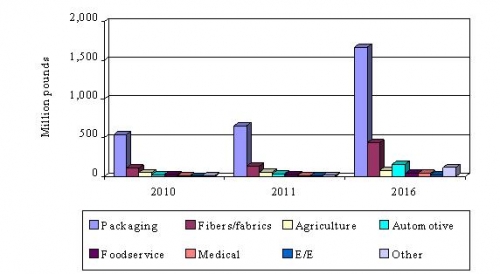
The largest segment of the market, packaging, is expected to reach nearly 1.7 billion pounds in 2016. The market in 2011 is to be an estimated 656 million pounds. Thus, the five-year CAGR is projected to be 20.5%.
The second-largest segment, made up of fibers/fabrics, is expected to increase in volume from an estimated 134 million pounds in 2011 to 435 million pounds in 2016, for a five-year CAGR of 26.6%.
The agriculture segment is estimated to be 54 million pounds in 2011 and to increase at a CAGR of 8.2% to reach 80 million pounds in 2016.
The automotive segment is expected to be 160 million pounds in 2016, rising from 33 million pounds in 2011 at a CAGR of 37.1%.
The food service segment is estimated to be 25 million pounds in 2011 and will increase to 40 million pounds in 2016 at a CAGR of 9.9%.
The medical segment is projected to be 41 million pounds in 2016, increasing from an estimated 10 million pounds in 2011 at a CAGR of 32.6%.
The electronic/electrical segment is estimated at 6 million pounds in 2011 and is expected to reach a volume of 24 million pounds in 2016 at a CAGR of 32%.
The “other” segment is projected to amount to 66 million pounds in 2016 after rising at a CAGR of 36.4% from its 2011 volume of 14 million pounds.
The biodegradable polymer market, although commercial for more than 20 years, is still very early in its product life cycle. This market is still beset with several major problems, the most important of which are relatively high prices and lack of an infrastructure for effective composting – an extremely critical aspect for biodegradable polymer market success.
New biodegradable polymers are being introduced, accompanied by a continuing withdrawal of other products. As well, key companies are entering and leaving this market, with more of the former rather than the latter.
The industry has been characterized by new technologies, tightening environmental restraints, and very unstable oil prices among other issues. This combination of factors necessitates a realistic appraisal of the impact of these polymers over the next five years. High oil prices are said to be a major driver for biodegradable polymers.

Biodegradable Polymers( PLS025D )
Publish Date: May 2011
Data and analysis extracted from this press release must be accompanied by a statement identifying BCC Research LLC as the source and publisher. For media inquiries, email press@bccresearch.com or visit www.bccresearch.com/media to request access to our library of market research.
BCC Library Membership Benefits
Unlimited Access to Market Research Reports for Academic Institutions and Corporations.
Custom Research
Tailored solutions across industries for your unique business needs.
More in Plastics
- CO₂-Based Plastics Market to Grow at 27.8% CAGR Through 2030
- Polymeric Foams Market to Hit $197.8 Billion by 2030
- 2024 Packaging Research Review: Trends That Will Shape the Future
- Global Bioplastics Market Accelerates Toward 5,634.6 Kilotons by 2029
- Global Composites Market to Reach $183.1 Billion by 2029
Reports from Plastics
Recent News
- Materials Industry Sees $216 Billion in Strategic Investments as AI Infrastructure Drives Next-Generation Material Innovation
- Chemical Specialty Markets to Exceed $485 Billion by 2030, Driven by EV Production and Fire Safety Regulations
- Global Flexible PCB Market to Nearly Double, Reaching $41.7 Billion by 2030 on Surging Demand from Consumer Electronics, EVs and 5G Infrastructure
- Global Ion Exchange Materials Market to Reach $5.9 Billion by 2030, Driven by Green Hydrogen, Water Treatment Standards and Energy Security Demands
- Global Bio-Based Surfactants Market Valued at $18.8 Billion, Projected to Reach $27.3 Billion by 2030 as ESG Mandates and Consumer Demand Reshape the Chemicals Sector