

Polymeric Foams
October 13, 2010
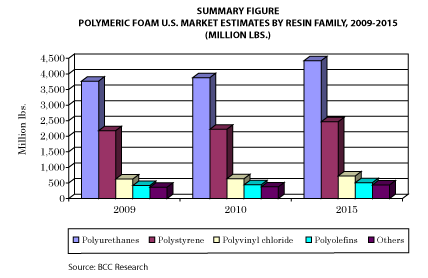
Wellesley, Mass. – According to a new technical market research report, POLYMERIC FOAMS (PLS008G) from BCC Research (www.bccresearch.com), the U.S. market for polymeric foams will amount to an estimated 7.6 billion pounds in 2010, but is expected to increase to nearly 8.6 billion pounds in 2015, for a 5-year compound annual growth rate (CAGR) of 2.5%.
The largest segment of the market, made up of polyurethanes, is expected to reach 4.4 billion pounds in 2015, after increasing at a CAGR of 2.6% from the estimated 3.9 billion pounds in 2010.
The segment made up of polystyrenes is projected to increase from an estimated 2.2 billion pounds in 2010 to 2.5 billion pounds in 2015, for a CAGR of 2.1%.
The polyvinyl chloride segment is expected to increase from 638 million pounds in 2010 to 725 million pounds in 2015, for a CAGR of 2.6%.
The polyolefins segment is projected to be at 509 million pounds in 2015, after increasing at a CAGR of 2.8% from 443 million pounds in 2010.
The segment made up of all other foams is expected to amount to 376 million pounds in 2010 and to rise to 436 million pounds in 2015 for a CAGR of 3%.
In the roughly 8 years since BCC Research’s last study on the polymeric foams industry, significant changes have continued to occur in this major segment of the plastics production and processing industry. Products and markets change as technology and society change. Polymer foams find their primary applications in consumer products, such as cushioning for furniture and automobiles, thermal insulation for construction and packaging, and similar end uses that are driven by the business cycle.
Most of the markets for plastic foams are the same ones that existed a few years ago; however, there have also developed some newer markets, such as cross-linked polyolefin foam in leisure and sports goods and foamed PVC in house siding, windows/doors, and other construction shapes. A more recent development is work on foams made from biopolymers and biodegradable polymers, work done in concert with efforts to reduce the country’s dependency on petroleum and natural gas, the feedstocks for the plastics that are currently foamed.
This report is intended to assist those involved in several different segments of the U.S. industrial and commercial business sectors, primarily those professionals whose main interest is in thermal insulation (construction, appliances, and the like), comfort cushioning (furniture, auto seats, and other uses), transportation (other automotive parts, such as protective cushioning and bumpers), as well as packaging applications.
Source: BCC Research
Polymeric Foams( PLS008G )
Publish Date: Aug 2010
Data and analysis extracted from this press release must be accompanied by a statement identifying BCC Research LLC as the source and publisher. For media inquiries, email press@bccresearch.com or visit www.bccresearch.com/media to request access to our library of market research.
BCC Library Membership Benefits
Unlimited Access to Market Research Reports for Academic Institutions and Corporations.
Custom Research
Tailored solutions across industries for your unique business needs.
More in Plastics
- CO₂-Based Plastics Market to Grow at 27.8% CAGR Through 2030
- Polymeric Foams Market to Hit $197.8 Billion by 2030
- 2024 Packaging Research Review: Trends That Will Shape the Future
- Global Bioplastics Market Accelerates Toward 5,634.6 Kilotons by 2029
- Global Composites Market to Reach $183.1 Billion by 2029
Reports from Plastics
Recent News
- Materials Industry Sees $216 Billion in Strategic Investments as AI Infrastructure Drives Next-Generation Material Innovation
- Chemical Specialty Markets to Exceed $485 Billion by 2030, Driven by EV Production and Fire Safety Regulations
- Global Flexible PCB Market to Nearly Double, Reaching $41.7 Billion by 2030 on Surging Demand from Consumer Electronics, EVs and 5G Infrastructure
- Global Ion Exchange Materials Market to Reach $5.9 Billion by 2030, Driven by Green Hydrogen, Water Treatment Standards and Energy Security Demands
- Global Bio-Based Surfactants Market Valued at $18.8 Billion, Projected to Reach $27.3 Billion by 2030 as ESG Mandates and Consumer Demand Reshape the Chemicals Sector