

Early Detection of Rare Disorder: The AI-Driven Revolution in Neonatal Screening
January 27, 2026
Tailored research built around your exact strategic priorities.
Newborn screening for rare genetic and metabolic conditions, usually performed within 48 hours of birth, is a major public health success that saves lives by identifying diseases early and providingtreatment. However, a significant challenge of these success stories is that the majority of rare diseases are not included in birth screening. Many infants born with rare diseases initially appear healthy, but develop irreversible symptoms after days or months. It leads to delayed treatment, prolonged diagnostic journeys and preventable mortality resulting from the failure to recognize these disorders early.
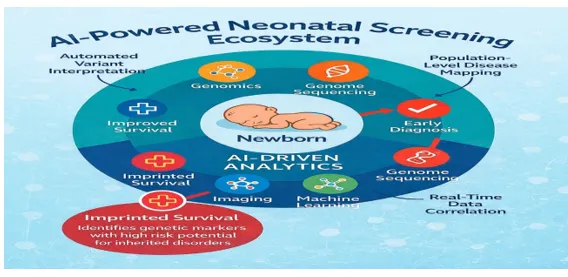
The use of artificial intelligence (AI) is now one of the next-generation neonatal screening methods and changes the diagnostic landscape. The AI system, powered by data biology on genomic and clinical data, can learn subtle disease symptoms that the traditional test can overlook. With the integration of genomics, machine learning (ML) and advanced data analytics, neonatal screening is redefining a future in which early detection of rare disorders can become the standard rather than the exception.
Source: BCC Research
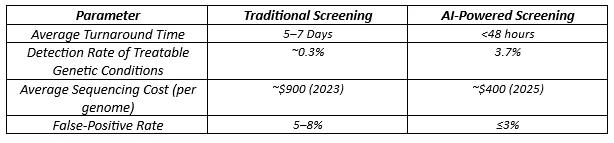
Table: Clinical and Operational Impact Metrics
Source: BCC Research Analysis
Need deeper insight for your specific market?
BCC Research can tailor custom research by region, application, technology segment, competitor set, customer group, or investment priority.
Discuss a Custom Research NeedThe Emergence of AI in Neonatal Diagnostics
The implementation of AI in neonatal diagnostics is transforming infant screening by improving the accuracy, speed and accessibility of diagnoses for rare neonatal disorders through its ability to process complex genomic, metabolomic and imaging datasets. Its predictive ability enables clinicians to identify screening patterns often missed by traditional methods. Genomic data analysis tools such as DeepVariant by Google Health and Fabric Genomics' automated variant interpretation system offer near-instant results, significantly reducing diagnostic timelines.
A research article in npj Digital Medicine in June 2025 illustrated the use of the machine learning-based prioritization of sequencing for the evaluation of newborns (MPSE) model. The model was used to determine which infants in critical condition would obtain the most benefit from fast whole-genome sequencing within 48 hours of their arrival at the Neonatal Intensive Care Unit (NICU). The study was a collaboration between Rady Children's Institute for Genomic Medicine and its partnering institutions, supported by grants from the U.S. National Institutes of Health (NIH). The study verified that AI-driven triage with MPSE significantly enhances diagnostic efficiency by prioritizing the most probable genetic cases. It significantly speeds up the clinical decision-making process as well as allows for an earlier-stage intervention, in comparison with a manual review.
The interaction between biotech companies, research institutions and AI innovators is a clear indication of the industry's readiness and willingness to this change. For example, in May 2025, Alexion Pharmaceuticals, a division of AstraZeneca Rare Disease, and the Rady Children’s Institute for Genomic Medicine announced a collaboration under the BeginNGS newborn genome-sequencing program. The alliance applies AI to analyze large-scale, multi-ancestry genomic datasets, enabling early detection of rare disorders while reducing false-positive rates by as much as 97%.
These systems are expected to drive industry-wide change, shifting from reactive testing to proactive, AI-led neonatal health management, thus defining the next phase of newborn diagnostic innovation.
Challenges and Ethical Considerations in Neonatal Screening
Although neonatal screening is the main preventive healthcare strategy, traditional methods are still limited both scientifically and systemically. The heel-prick blood test, which remains the most common method, usually detects only a few dozen metabolic and endocrine disorders. As a result, most of the + 7,000 rare diseases go unrecognized at birth. In many cases, the same biochemical markers are present in different conditions, which makes the interpretation more difficult and slows down the treatment. After test confirmation, the time between sample collection, laboratory testing and confirmatory analysis can be several days or even weeks. This remains true even in advanced healthcare systems, where time is especially limited for infants who are in critical condition. Developing countries with poor infrastructure and poorly integrated data systems experience worsened problems. Thus, the extent and performance of screening programs are very low. AI-powered genomic platforms are increasingly needed to provide faster, more accurate and more detailed diagnostic insights.
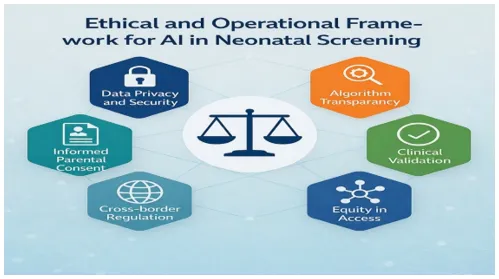
However, the transition to AI-based genome-wide screening still entails some additional ethical and operational challenges. This was a step toward figuring out the practicality of a large-scale genomic newborn screening. The report noted that while sequencing throughput has been highly successful, significant concerns about data governance, parental consent frameworks and, in particular, the interpretation of genetic variants of uncertain significance, which can confuse both clinicians and families. The research also found that anxiety-provoking, uncertain or incidental discoveries may place additional pressure on a healthcare system already affected by workforce shortages and diagnostic backlogs.
These sorts of results signal that detailed consent methods, a solid data system and well-trained healthcare staff should be in place before any big rollout. The use of AI in newborn screening needs to be ethically guided from a caring perspective, ensuring that the benefits of early diagnosis are available to all babies on an equal basis.
Source: BCC Research
Clinical and Strategic Opportunities in AI-Enabled Neonatal Screening
AI adoption in neonatal testing enhances patient care as well as healthcare system efficiency. From a clinical point of view, AI-powered platforms are now capable of detecting rare genetic and metabolic diseases at an early stage and with higher accuracy, thereby enabling doctors to intervene at the right time and increase the chances of patient survival. Automatized interpretation of genomics and metabolic data shortens the diagnostic turnaround time, lessens the risk of human errors in interpretation, and opens up the possibility of more individualized treatment regimens for neonates. Besides, by facilitating the collection of large-scale health data, AI-enabled screening tools are opening up new avenues for epidemiological research on disease prevalence and progression—thus giving healthcare decision-makers the power to develop more data-driven public health strategies. In fact, these developments are turning neonatal screening into a proactive, data-led lifelong health management model.
On the market side, AI integration at various stages of the neonatal screening journey is an indicator of a value-based, tech-driven healthcare model in the making. Digital infrastructures that facilitate scalable, affordable screening measures are capturing the interest of governments, research institutions and healthcare providers, who are committing more resources to their development. Part of that work entails setting up connections between data networks to support the exchange of medical records, creating avalidation environment for algorithms and launching physician training programs to standardize the use across various healthcare systems.
On an economic level, AI-powered early detection is a key factor in the dramatic reduction of healthcare costs resulting from situations where diseases are left untreated or misdiagnosed over a long period, as a result of preventing permanent developmental or neurological damage. The use of AI in neonate screening represents a major step forward in global preventive healthcare, as it is a key factor in driving medical innovation and ensuring the sustainability of health systems through clinical accuracy, data analytics and operational efficiency.
Future Outlook: The Road Ahead
The next-generation genomic AI will be transformative for newborn screening, enabling the immediate detection and treatment of rare diseases. As the number of genomic sequencing tests grows rapidly and prices continue to decline, AI becomes increasingly indispensable in handling the vast amount of data generated by these tests. The predictive power of AI, which enables correlating genetic variants, metabolic markers and clinical histories, is expected to completely replace the currently used screening panels with integrated systems that will be able to detect rare conditions in thousands of cases simultaneously.
One of the most promising cases of this revolution is Screen4Care, a five-year plan that was introduced in October 2021, running until September 2026 under the EU’s Innovative Medicines Initiative, which intends to apply AI-driven genetic newborn screening on 25,000 infants. By combining genomic and electronic health record data, the approach not only helps identify rare diseases early — particularly those that are treatable — but also addresses ethical, consent and privacy issues, informing responsible AI usage in healthcare.
GUARDIAN, a study funded by Columbia University introduced in September 2022, was focused on the integration of genome sequencing and AI algorithms into newborn screening. In January 2025, the results published in JAMA showed that more than 4,000 infants had their whole genomes sequenced. About 3.7% of them were identified as having a treatable genetic condition, indicating that the identification rate is more than 10 times higher than that of biochemical screening, which is approximately 0.3%. The results emphasize the use of AI-driven genomic screening as a diagnostic and preventive tool, especially for rare diseases that are actionable. The scientists pointed out that the use of federated learning systems and interoperable health-data infrastructures will be indispensable for the worldwide expansion of this model. Thus, they believe, it may be the beginning of an era when this type of screening is a routine postnatal procedure that is comprehensive, fair and accurate.
Conclusion
The adoption of AI-powered neonatal screening is essentially a shift in care from identifying diseases to foreseeing and preventing them. With the help of AI, which combines genomic insights with advanced analytics, clinicians can now identify rare disorders in a way that is both earlier and more accurate than ever before. The effects, therefore, are not only about extending life but also about improving its quality, lowering healthcare costs and ensuring a future free of the loss of any child's potential due to late diagnosis.
The field of neonatal medicine is expanding, and the reality that can be seen through it is that AI is not replacing human skills, but rather, it is enhancing them. Thus, doctors are empowered to provide patients with precision care from the very first moments of their lives.