

Pulse: AI-Driven Predictive Biomarkers from Multimodal Data
Tailored research built around your exact strategic priorities.
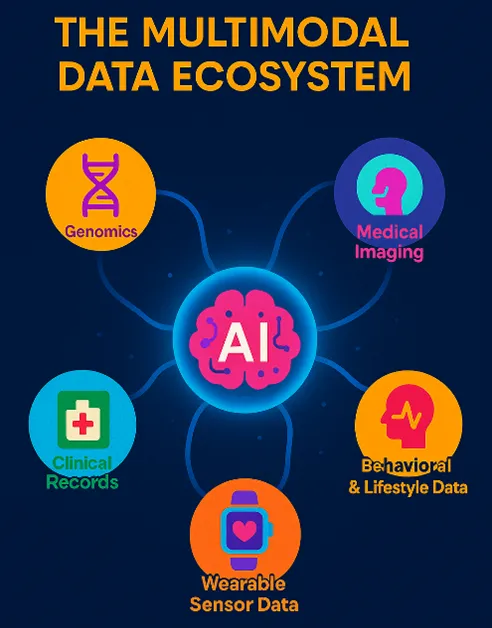
In the era of precision medicine, the "pulse" of human biology is no longer limited to the heartbeat or blood test; it is a rhythm understood through genes, images, behaviors and electronic footprints. AI-powered predictive biomarkers are changing how we understand, identify and cure illnesses by connecting multimodal data such as genomics, imaging, clinical records and sensor inputs to provide practical insights. Predictive biomarkers, as opposed to conventional biomarkers, which indicate the existence of a disease, point to upcoming events, enabling doctors to decide on interventions before the event takes place.
AI is a tool that provides the necessary support for analysis, enabling it to connect the different biological clues into a single, understandable picture. The objective is to recognize the disease in an early stage, or better yet, to anticipate it, thereby providing the possibility of early intervention, personalized therapies and better patient outcomes.
From Discovery to Prediction
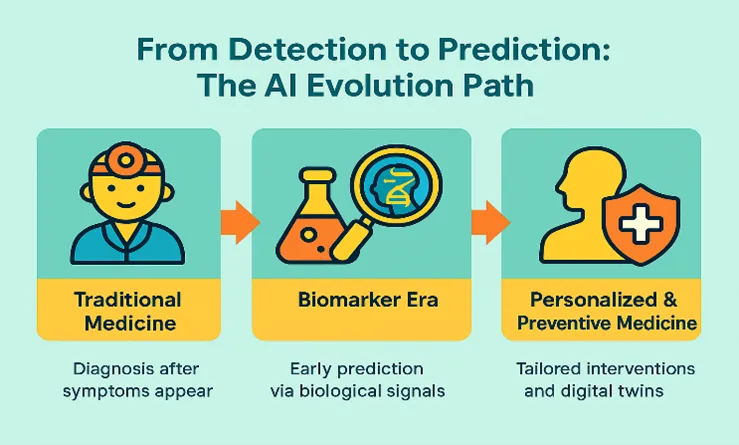
Traditionally, medicine has followed a simple model: symptoms appear, doctors diagnose, and treatment follows. This was a process entirely based on reaction rather than anticipation. Traditional biomarkers made the whole diagnosis process faster, but these were still retrospective. These informed doctors about what had happened, not what was going to happen. Artificial Intelligence (AI) has completely altered this problem. The technology now identifies the earliest traces of disease long before it arrives by not only connecting but also integrating the seemingly unrelated fragments of biological data, genetic codes, protein patterns, medical images, electronic health records, and even subtle lifestyle changes. What was once considered pure biological noise has now become a clear signal, a coded message that machines have learned to decipher.
Research conducted by the University of California in February 2024 demonstrated that AI could detect the signs of Alzheimer’s disease much earlier, by interpreting the multimodal data, a combination of imaging, cognitive tests and genetics, than traditional scans. The algorithm can identify molecular and structural patterns that are not visible to human specialists; thus, it marks a turning point in predictive healthcare.
When paired with MRI textures, metabolic alterations and behavioral patterns, a deeper intelligence emerges. A single biomarker, such as a mutation or protein surge, may reveal the truth. With each new piece of information, a living model of human biology that learns, adapts and makes predictions is revealed, rather than merely a diagnosis.
AI as the Interpreter of Life
Modern medicine generates numerous biological data from genomics, scans and sensor readings to digital health records. However, these data streams have long been separated, offering only a partial view of the human body. Artificial intelligence is now bridging those gaps and integrating them into a single framework of interpretation that shows the true progression of diseases.
Deep learning systems can simultaneously examine thousands of biological variables and reveal the patterns that connect molecular signals to physiological behavior. These can help determine how the genetic makeup of a tumor affects its cellular structure, how a change in metabolism reflects a change in the brain, or how a very small change in heart rhythm and sleep pattern could be the first steps of cardiovascular stress. For instance, a research published by Mount Sinai Hospital in January 2024 demonstrated the ability of a multimodal AI model to forecast cardiac events weeks before symptoms manifested by combining imaging, wearable sensor readings and ECG data. Even seasoned medical professionals were unable to detect the micropatterns in the data that this AI model was able to identify, enhancing patient outcomes and early prediction.
Instead of being a substitute for clinical expertise, AI is an enhancer of clinical expertise. It is the only tool that integrates molecular, structural and behavioral data, thereby changing biology from a collection of discrete facts to a dynamic system that can be understood. It is, therefore, the connection between complexity and simplicity—the one that decodes life, enabling the field of medicine to not only understand what is going on but also to predict what is going to happen.
Strategic Shifts in the Industry
The healthcare and life sciences sector is undergoing a fundamental shift with the increasing use of AI in biomarker discovery and clinical decision-making. Besides pharmaceutical companies and technology developers, healthcare institutions are reorganizing their strategies to build a data-driven ecosystem that facilitates predictive, preventive and personalized medicine. For instance:
- In January 2025, IQVIA and NVIDIA entered a partnership to leverage IQVIA's extensive healthcare data and analytics with NVIDIA's cutting-edge AI Foundry platform to revolutionize healthcare and life sciences. By creating AI agents, these companies aim to simplify intricate workflows, speed up research and clinical development and make patient outcomes better worldwide in a precise and scalable manner.
- In April 2025, Flagship Pioneering introduced Etiome, which launched a new AI-driven platform called Temporal Biodynamics. This platform is capable of detecting disease progression at a very early stage and even anticipating it. It combines multimodal clinical, cellular, molecular and single-cell omics data with AI to predict disease stages, recognize stage-specific biomarkers ("Biostage Markers") and generate targeted drugs for stopping or reversing the disease, saving the patient from becoming debilitated.
Future Outlook
Future trends, including the rapid expansion of edge AI and federated learning models for secure data privacy, as well as the emergence of digital twins that imitate the disease and treatment paths of specific patients, will be further merged to create AI-assisted predictive biomarkers that integrate multi-omics, imaging and clinical data. At the same time, the governing bodies of industries are running toward clearly defined frameworks for validating AI-based biomarkers, shedding light on the importance of transparency, reproducibility and fairness.
Unique partnerships between pharmaceutical companies, AI developers and healthcare institutions will, in addition, rapidly facilitate discovery and commercialization, while establishing the connection between the framework of research and the real-world application. For Instance, as per a news article published by MedPath Inc. in October 2025, five pharmaceutical and biotechnology companies, Bristol Myers Squibb, Takeda, Astex, AbbVie, and Johnson & Johnson, combined five sets of proprietary data for OpenFold3 and used federated learning to enhance AI predictions of protein-small molecule interactions in a secure manner. These companies simultaneously protected their IP and accelerated drug discovery.
Furthermore, companies are focusing on implementing interoperable data ecosystems, developing AI tools that people can readily summarize, and structuring ethical governance systems that guarantee the responsible use of innovation. In essence, the integration of technology and biology will shape the future of precision medicine, which will eventually move healthcare from the current procedure of detection to accurate predictions.
Conclusion
AI-powered predictive biomarkers are heralding a new era of precision medicine, which is transforming medicine from a reactive approach to early prevention. The application of machine learning technology in synthetic biology, such as genomics, imaging, blood analysis and the use of wearable sensors, which are multiplexing and the coupling of these systems, helps AI find difficult biological patterns that are hard or perhaps impossible for humans to detect. These multimodal data insights enable quicker disease detection, tailored therapy and trial patients with a lower risk of failure.
Nonetheless, the expedition comes with its own set of challenges—including the interoperability of data, provisions that protect the privacy of individuals, proof of models and their transparency—as key elements that will ensure the establishment of algorithms for reliable and trustworthy clinical use. With technology becoming increasingly sophisticated, biosensors will find their way into the mainstream, alongside the Internet of Things (IoT) and personal digital assistants, such as Siri and Google Assistant, making the paradigms of health being observed, managed and kept “predictive” the new standard of care.