

AI-Driven Voice Biomarkers: Emerging Solution for Disease Management
Expert guidance to accelerate your market and strategy decisions.

AI-Driven Voice Biomarkers: Revolution in Non-Invasive Healthcare Diagnostics
The AI-driven voice biomarkers market is an emerging healthcare category that utilizes artificial intelligence (AI) and machine learning (ML) to analyze voice characteristics such as pitch, tone, cadence and speech patterns to identify, monitor and manage the early onset of disease (e.g., Parkinson’s, Alzheimer’s, depression, diabetes and cardiovascular disease). This non-invasive and low-cost technology enables remote diagnostics and personalized health solutions that are particularly beneficial in areas such as telemedicine and chronic disease management. The increasing prevalence of chronic diseases drives the growth of voice biomarkers, the growing volume of AI and natural language processing (NLP) development and increased adoption of digital health solutions.
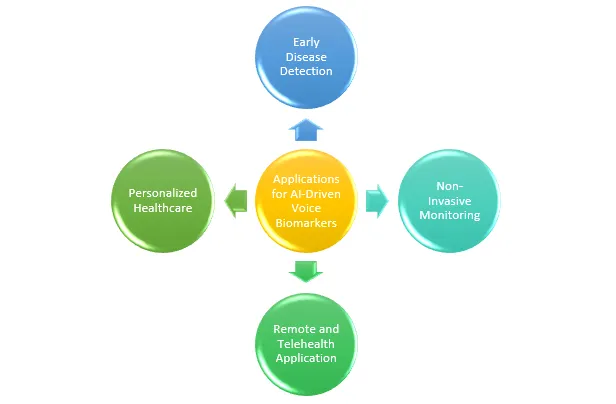
Applications for AI-Driven Voice Biomarkers
Source: BCC Research
- Early Disease Detection: AI-driven voice biomarkers are used for the identification of changes in speech patterns associated with neurological, respiratory and cardiopulmonary disease conditions.
- Non-Invasive Monitoring: AI-driven voice biomarkers provide a completely non-invasive analysis, which helps to make patients comfortable and suitable for repeated monitoring.
- Remote and Telehealth Application: AI-driven voice biomarkers are used for remote patient monitoring. It also helps in telemedicine initiatives.
- Personalized Healthcare: AI-driven voice biomarkers are used to analyze the voice patterns of patients, which helps to support precision medicine approaches.
Innovative Pathways for AI-Driven Voice Biomarkers
AI tools are introducing a novel paradigm for monitoring individual health through non-invasive digital biomarker technology. Voice biomarkers can be used to track an individual's health status by recording and analyzing vocal signals, such as cadence, pitch, tone and possibly even breath rate. The sophistication of these systems enables us to detect physical and mental health changes in people with illnesses such as Parkinson's or Alzheimer's disease and cardiovascular disease, as well as other health conditions like mental illness. The ability of these systems to provide personalized treatment and early diagnosis will transform many aspects of healthcare by enabling us to conduct screenings through a myriad of healthcare facilities and globally. Novel approaches for voice-assisted health tracking are providing a new pathway toward the development of more precise medicine and for expanding the range of healthcare options that would otherwise be unavailable due to financial, geographical, and technological l
Expanded Clinical Applications
AI-driven voice biomarkers are now being applied beyond their original application in neurodegeneration to cover a much wider range of health conditions. Recent studies and pilot programs have focused on voice analysis for detecting respiratory (e.g., COPD and asthma), cardiovascular and even certain cancers, as well as other health issues. Emerging clinical applications are driving market growth and generating new interest in diagnostics among healthcare providers. The expansion of applications is also driving collaboration in the field, leading to collaborations among AI developers, healthcare providers and pharmaceutical companies. Therefore, broader clinical applications of AI-driven voice biomarkers are expected to support market growth in the future.
Expansion of Telemedicine, Remote Consultation and Non-Invasive Solutions
Healthcare models are evolving toward remote care models, making them an ideal fit for AI-based voice biomarkers. Remote, continuous and non-invasive patient monitoring can be achieved using smartphones, wearables or telehealth system dynamics, providing a safeguard against in-office visits. This capability is particularly important for elderly patients or those in rural areas or regions with limited resources, where regular medical monitoring can be a challenge. Hospitals and telehealth companies are embedding voice biomarker systems into virtual care to help track patients’ mental health, chronic disease conditions, and adherence to treatment plans. Thus, the rapid expansion of telemedicine and remote monitoring is expected to drive market growth.
Recent Development
In October 2025, Medsi AI launched a new voice analysis tool capable of detecting mental and cognitive health conditions using only a smartphone microphone. The tool captures and analyzes acoustic and linguistic patterns from a 40-second voice recording to detect early signs of depression, anxiety and neurodegenerative disorders such as Alzheimer’s and Parkinson’s.
What is Powering the Adoption of AI-Driven Voice Biomarkers?
AI-driven voice biomarkers are quickly becoming a popular choice for scaling non-invasive, cost-effective diagnostic methods in many healthcare systems, as these systems seek methods that can be easily scaled, minimally invasive and affordable. ML technology has improved significantly in recent years, along with an increase in demand for remote care management (RCM). Research has also shown that an individual's vocal patterns are indicative of health issues affecting the body's physiology and/or neurology. The ongoing clinical validation of these biomarker data models, combined with the increasing ability to implement digital health infrastructure, enables the use of voice biomarkers for early detection, ongoing monitoring and the provision of personalized treatment plans utilizing voice biomarkers.
Rising Prevalence of Neurological Disorders:
AI-driven voice biomarkers are used to detect neurological disorders such as Parkinson’s disease, Alzheimer’s disease, and depression. The rising incidence of Alzheimer’s disease is driving the demand for AI-driven voice biomarkers for early disease diagnosis. According to the WHO, 1 in 3 people are affected by neurological conditions. Thus, the rising prevalence of neurological disorders is propelling the demand for AI-driven voice biomarkers.
Increasing Adoption of Telemedicine and Remote Care:
Healthcare systems have adopted telemedicine and virtual health platforms at an accelerated pace, opening up a beneficial window in the ecosystem of voice-based diagnostics. AI-driven voice biomarkers are being integrated into mobile applications and into tele-consultative platforms to provide non-invasive, real-time monitoring of health status. Companies such as Sonde Health and Cogito are incorporating these solutions into mobile device-based health monitoring methods to promote increased accessibility and utilization. Therefore, growing adoption of telemedicine and remote care is propelling market growth.
Growing Focus on Personalized Medicine:
The increasing focus on developing personalized medicine approaches is driving the growth of the AI-driven voice biomarkers market. AI-driven voice biomarkers align well with the shift from reactive to proactive treatments, facilitating individualized health assessments through continuous voice monitoring. They help provide early warning signals to clinicians and personalize interventions to prevent diseases from worsening, contributing to improved patient outcomes and reduced rates of hospitalization. Thus, growing focus on personalized medicines is boosting market growth.
Future Outlook
The adoption rate of AI-driven voice biomarkers is expected to increase due to advancements in AI telehealth and personalized medicines. The growth in AI-driven voice analysis technology for early disease detection will also facilitate increasingly practical use in daily life via wearables, smartphone applications or telehealth platforms that can monitor patients remotely in real-time. The growing interest in new multimodal AI systems will also enhance market adoption. Emerging markets will also see rapid adoption of AI-driven voice biomarkers for the detection of neurological, respiratory and cardiovascular conditions.
Strategic Takeaways for Industry Leaders
AI-driven voice biomarkers are used for early disease detection, telemedicine and remote monitoring. Industry leaders should adopt AI-driven voice biomarkers for the detection of neurological, respiratory and cardiovascular conditions. Industry leaders should focus on clinical validation and regulatory compliance to ensure the accuracy of AI-driven voice biomarkers. AI-driven voice biomarkers aid clinicians in remote consultations. Thus, growing adoption of telemedicine and remote consultation will boost the market for AI-driven voice biomarkers. The future will be defined by how rapidly clinical professionals adopt AI-driven voice biomarkers.
Conclusion
The AI-driven voice biomarkers market is expected to transform the future of healthcare diagnostics. Advances in artificial intelligence, machine learning, and speech analytics will further align with the growth of telehealth and digital health ecosystems, leading to a rapid surge in applications across neurological, cardiovascular, respiratory and mental health areas. Realizing this potential will rely on overcoming challenges associated with clinical validation, data diversity, privacy assurance and regulatory alignment. With growing investments, collaborations across sectors and an increased focus on ethical AI, voice biomarkers will become an important aspect of an increasingly personalized, preventive and accessible healthcare approach.