

AI-Enhanced Low-Cost Stethoscope: Solution for Early Detection of Cardiopulmonary Diseases
Expert guidance to accelerate your market and strategy decisions.

AI-Enhanced Low-Cost Stethoscopes: Revolutionizing Cardiopulmonary Diagnostics
The market for AI-enhanced low-cost stethoscopes for cardiopulmonary disease screening is growing rapidly due to advancements in artificial intelligence and increasing demand for early and accurate diagnosis. AI-enhanced stethoscopes can rapidly and accurately detect heart failure, atrial fibrillation and valvular heart disease. Clinical trials have demonstrated that AI-enhanced stethoscopes are both acceptable and considerably more accurate than traditional methods, and they can be readily integrated into primary care practice. Regulatory approval and clinical validation are also businesses supporting the transition of AI-enhanced stethoscopes into clinical practice. The market for AI-enhanced low-cost stethoscopes is well-positioned for rapid growth as a viable option for improving early detection and diagnosis of cardiopulmonary diseases.
An AI-enhanced low-cost stethoscope is a medical device that integrates digital auscultation with artificial intelligence to detect cardiopulmonary abnormalities, such as heart murmurs, reduced ejection fraction, arrhythmias and lung sound deviations. This device combines the functionality of a traditional stethoscope with the screening capabilities of intelligent diagnostics, empowering healthcare workers, telemedicine providers and community health programs. It enables more timely diagnoses, reduces missed diagnoses and connects communities to high-quality cardiopulmonary care on a larger scale.
Significance of AI-Enhanced Low-Cost Stethoscope
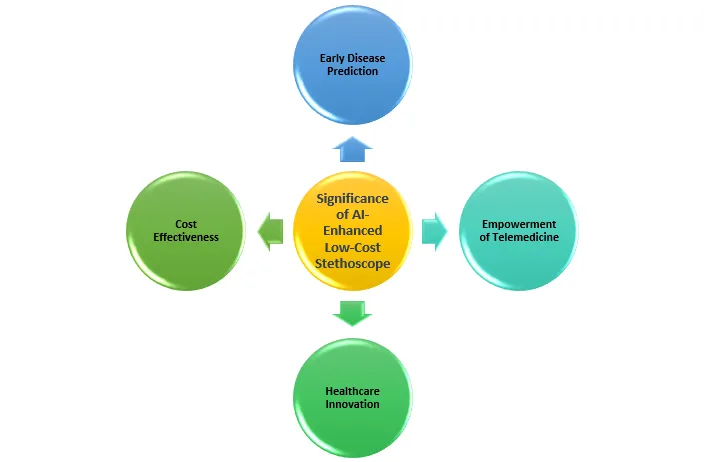
Source: BCC Research
- Early Disease Prediction: An AI-enhanced low-cost stethoscope is used for early signs of cardiopulmonary abnormalities such as heart murmurs, abnormal lung sounds and reduced ejection fraction, which helps to detect the disease at an early stage.
- Empowerment of Telemedicine: An AI-enhanced stethoscope offers real-time data for sound and automated telehealth analysis. Automated analysis and digital connectivity help to enhance remote health consultation.
- Cost Effectiveness: An AI-enhanced low-cost stethoscope can be used for government health checkup programs, NGOs and health initiatives due to its cost-effectiveness.
- Healthcare Innovation: An AI-enhanced low-cost stethoscope provides a gateway for AI-driven primary care and point-of-care diagnostics.
Future Pulse of AI-Enhanced Stethoscope
As we move forward, the AI-enhanced stethoscope will integrate traditional auscultation with smart diagnostics, evolving this classic medical tool into a means for finer precision care within the next generation of health technology and patient care. Machine learning and high-fidelity acoustics are combined to develop these AI-enhanced devices, enabling them to detect subtle differences in patients’ hearts, lungs, and vascular systems that are not currently audible to the human ear during a traditional physical examination. Clinical decision support systems are advancing in tandem with remote monitoring and telehealth, offering tools for earlier identification, enhanced accuracy in patient triage and a greater ability to create a treatment path based on data rather than subjective physician observations.
Early Detection and Enhanced Diagnostic Accuracy:
AI-enhanced stethoscopes offer early detection of cardiopulmonary diseases. The growing demand for early disease detection and improved diagnostic accuracy is driving market growth. A study involving approximately 13,000 patients was conducted, which indicated that an AI-powered stethoscope could identify significant cardiovascular conditions, including heart valve disease, heart failure and atrial fibrillation, in 15 seconds, increasing diagnostic accuracy by two to three times, on average, compared to the standard diagnosis. Therefore, the growing demand for early detection of cardiopulmonary diseases is driving the adoption of AI-enhanced stethoscopes.
Expansion of Remote Consulting and Telemedicine:
The increased use of telemedicine and remote patient consulting is driving a positive demand for AI-augmented lower-cost stethoscopes. These devices enable healthcare providers to remotely analyze heart and lung sounds, leading to diagnosis and consultation without requiring patients to visit a hospital. Thus, increasing adoption of telemedicine and remote consulting is anticipated to boost market growth.
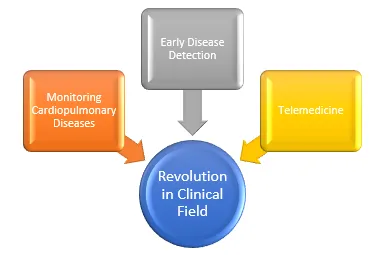
Revolution in the Clinical Field
AI-enhanced low-cost stethoscopes help revolutionize the clinical field by enabling the monitoring of cardiopulmonary diseases and the early detection of these conditions. It is also enhancing the field of telemedicine and remote consulting. The growing demand for AI-integrated medical devices is contributing to the revolution of the clinical field.
Traditional Stethoscope: Timeless Tool with Modern Limitations
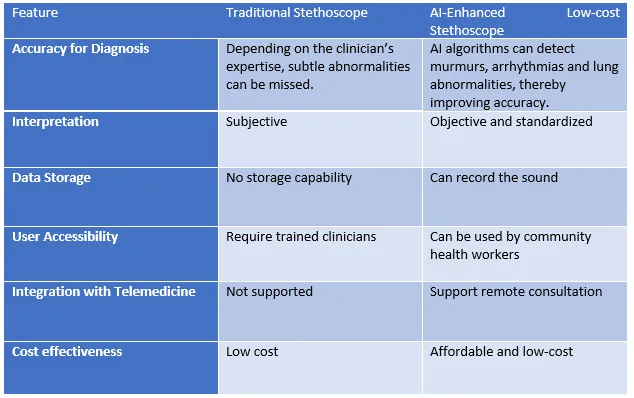
A traditional stethoscope is a simple acoustic device that clinicians use to listen to internal body sounds, such as heartbeats and breath sounds. These are easy to use, cost-effective and one of the most basic yet important devices used in clinical practice. However, traditional stethoscope has limitations such as, it relies on the ability and experience of the clinician to make accurate diagnostic decisions, it could easily miss subtle differences, it does not have a digital recording option or any data storage for later analysis, it is difficult to integrate into telemedicine, and its interpretation of the information is subjective, which creates variability and leads to misinterpretation of symptoms and diagnosis.
Comparison of the Traditional Stethoscope and AI-Enhanced Low-Cost Stethoscope
Acceleration in the Adoption of AI-Enhanced Low-Cost Stethoscopes
Many healthcare systems are rapidly adopting new, low-cost stethoscopes with AI capabilities for intelligent diagnostic technology, which can be utilized in various healthcare delivery environments. These AI-enhanced stethoscopes utilize machine learning algorithms combined with affordable hardware to provide a more accurate method for determining whether a patient has a cardiac or respiratory problem. By using AI to develop a stethoscope that can detect cardiac and respiratory conditions without the need for purchasing expensive traditional advanced equipment, healthcare systems are making these devices more accessible to patients in primary care, telehealth and resource-limited areas and transforming frontline diagnostic capabilities, improving the ability for providers to detect disease earlier and supporting equitable access to high-quality care by helping to lessen the workload for specialists.
Growing Incidence of Cardiopulmonary Diseases:
The prevalence of cardiopulmonary diseases such as heart failure is rising rapidly. For instance, according to the Heart Failure Epidemiology and Outcomes Statistics (HF Stats) 2024, approximately 6.7 million Americans have heart failure, the rate is expected to rise to 8.7 million by 2030, 10.3 million by 2040 and 11.4 million by 2050. Thus, the rapidly increasing rate of cardiopulmonary diseases is driving the adoption of AI-enhanced low-cost stethoscopes for early detection of these diseases. The need for advanced diagnostic solutions is expected to boost market growth in the future.
Increasing Demand for Telemedicine and Digital Health:
The growing demand for telemedicine is promoting market growth. Telemedicine and remote healthcare services have propelled the demand for portable and digitally integrated diagnostic tools. An AI-enhanced low-cost stethoscope can record and analyze heart and lung sounds for remote consultation, facilitating accurate diagnosis. Thus, increasing demand for telemedicine and digital health is expected to propel market growth in the coming years.
Need for Cost-Effective Devices for Large-Scale Screening:
The growing need for cost-effective diagnostic solutions is propelling market growth. AI-enhanced low-cost stethoscopes provide a cost-effective option for mass screening programs. It can minimize the need for expensive diagnostic interventions such as echocardiography for initial assessments. An AI-enhanced low-cost stethoscope can be used for government programs, NGOs and public health initiatives. Thus, the growing need for cost-effective diagnostic devices for large-scale screening is expected to drive market growth.
Technological Developments: Recent Example
An AI-enhanced, low-cost stethoscope integrates AI with electrocardiography (ECG) and auscultation. AI-enhanced stethoscope, including FDA-approved Eko CORE 500, offers a sophisticated diagnostic protocol that combines conventional auscultation with a built-in 3-lead ECG and audio technologies, such as TrueSound. The stethoscope features enhanced audio and real-time visualizations for early detection of diseases. It helps to monitor patient health over time by allowing the storage of sound data for future reference and tracking purposes.

Case Study
A study conducted by Mayo Clinic in September 2024 stated that an AI-enabled stethoscope helped clinicians detect twice as many cases of pregnancy-related heart failure.
Description: The study was conducted in Nigeria, where women experience pregnancy-related heart failures. The study included 1,200 participants who were screened for heart conditions using AI-enhanced solutions.
Result: The study's results indicated that AI-enabled digital stethoscopes were 12 times more likely than traditional screening to flag heart pump weakness when evaluated at an ejection fraction threshold lower than 45%, which is the cutoff for peripartum cardiomyopathy.
Future Outlook:
The adoption rate of AI-enhanced low-cost stethoscopes for screening cardiopulmonary diseases is expected to increase due to growing technological advancements, the rising need for advanced solutions for early detection of cardiopulmonary diseases and the growing adoption of telemedicine. Advancements such as digital integration, sound data recording and real-time analysis give a boost to the enabled stethoscope. Regulatory approvals for the AI-integrated stethoscope are anticipated to support market growth. Emerging markets will also experience rapid adoption of digitally integrated solutions for early disease diagnosis.
Strategic Takeaways for Industry Leaders
AI-enhanced low-cost stethoscopes used for cardiopulmonary disease screening provide real-time analysis, as well as sound data storage for future examination and tracking processes. Industry leaders should adopt an AI-enhanced stethoscope as an advanced digital solution for cardiopulmonary disease screening and to keep track of sound abnormalities through the sound data storage feature. An AI-enhanced stethoscope aids clinicians in remote consultations. Thus, growing adoption of telemedicine and remote consultation will boost the market for AI-enhanced stethoscopes. The future of the AI-enhanced stethoscope will be defined by how rapidly clinical professionals adopt digital solutions for diagnostic purposes.
Conclusion
The AI-enhanced low-cost stethoscope market is expected to grow at a faster rate due to advancements in AI technology, the increasing prevalence of heart and lung diseases and the global demand for early diagnosis and accuracy. These devices enable the causal chain of traditional stethoscopes to be overcome, providing an objective, standardized and rapid method for recognizing acute and chronic cardiopulmonary conditions, while also facilitating data storage, telemedicine and usability for non-specialists. Changes to primary care and screening practices are anticipated with the widespread adoption of AI-enhanced low-cost stethoscopes. With the ongoing innovation of these technologies and increased healthcare digitization, these solutions will be instrumental in advancing patient care through improved patient outcomes, minimizing diagnostic and clinical risks and paving the way for more affordable, accessible and efficient cardiopulmonary healthcare.