

Bio-Based Propylene Glycol: Driving Green Innovation and Low-Carbon Solutions
In-depth market intelligence to support growth and planning.
Evolution of Bio-Based Propylene Glycol
|
Year |
Key Milestone |
|
1997 |
Ø Some initial studies recognized copper chromite catalysts as more effective for glycerol hydrogenolysis to propylene glycol under moderate conditions. |
|
2007 |
Ø Comparative analysis of ruthenium (Ru) and platinum (Pt) carbon-supported catalysts in aqueous glycerol hydrogenolysis. Ø Exploration of how base additives impact selectivity between propylene glycol and ethylene glycol. |
|
2011 |
Ø Archer Daniels Midland (ADM) started its first commercial production of bio-based propylene glycol at its Decatur, Illinois, U.S. plant. The facility began startup operations in late March and started producing industrial-grade, biobased propylene glycol. |
|
2012 |
Ø Oleon has started a new manufacturing plant to produce bio–based PG from glycerin in Ertvelde, Belgium. This is the first plant to have glycerine to propylene glycol via liquid-phase hydrogenolysis over a copper catalyst process. This process was developed and licensed by BASF and jointly realized with Oleon. |
|
2015 |
Ø Research explored generating hydrogen in situ, from aqueous phase reforming glycerol to feed hydrogenolysis, decreasing external H₂ needs and simplifying plant utilities. This line of work aimed to lower operating costs and H₂ risks. |
|
2021 |
Ø Research pushed Catalytic Transfer Hydrogenolysis (CTH) and aqueous-phase reforming approaches (using glycerol as both H₂ source and substrate) to reduce external H₂ demand and energy intensity, which is essential for plant economics and footprint. |
|
2022 |
Ø Various groups issued papers or articles mentioning new Cu–Zn–Mg/La oxide supports, promoted metals and bimetallic catalysts that achieved very high reported yields. Papers also documented improved resistance to deactivation and leaching, a key factor in longer commercial runs. |
Key Factors that Accelerate the Adoption of Bio-Based Propylene Glycol
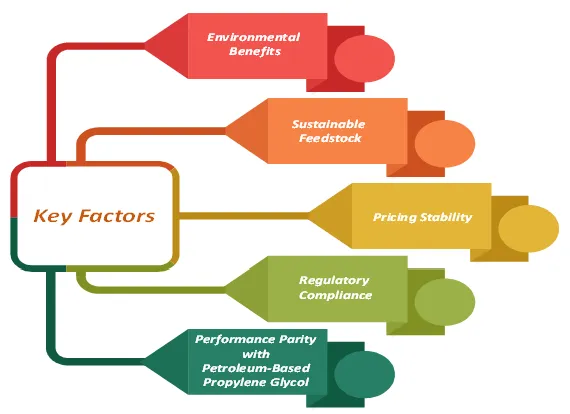
- Environmental Benefits: The manufacturing process of bio-based propylene glycol emits nearly 60% fewer greenhouse gases than petroleum-based propylene glycol. This helps reduce industrial carbon emissions and supports global climate targets.
- Sustainable Feedstock: Bio-based propylene glycol is produced from renewable feedstock such as glycerin, glucose and sorbitol, decreasing reliance on fossil fuels and promoting a circular economy. The production of bio-based propylene glycol can valorize waste glycerol from biodiesel production, offering a sustainable chemical route and supporting the bioeconomy.
- Pricing Stability: Derivatives of crude oil can experience significant price fluctuations in the event of major global events. Prices for bio-based products tend to be more reliable.
- Regulatory Compliance: Government regulations supporting the bio-based economy have led to an increase in biodiesel production, resulting in an abundance of waste glycerol available as a low-cost feedstock for producing bio-based propylene glycol.
- Performance Parity with Petroleum-Based Propylene Glycol: Bio-based propylene glycol exhibits similar safety, stability and functional performance to its petroleum-derived counterpart, making it a suitable substitute across various end-use industries, including food, pharmaceutical and care, without compromising functionality.
Industry-Wise Applications of Bio-Based Propylene Glycol
|
Industry |
Application |
Benefits |
||
|
Pharmaceuticals |
Solvent, stabilizer and carrier in oral, topical and injectable medications |
Enhances drug solubility and bioavailability, ensuring consistent delivery of active ingredients. |
||
|
Cosmetics and Personal Care |
|
|
||
|
Food and Beverages |
|
|
||
|
Automotive and Industrial Fluids |
|
|
||
|
Marine and Transportation |
|
|
||
|
Construction and Coatings |
Adhesives, sealants and coatings |
Enhances product performance while supporting sustainability. |
||
|
Unsaturated Polyester Resins (UPR) |
|
|
Technological Advances and Innovations in Bio-Based Propylene Glycol
- In 2024, researchers from Dalian University developed a cobalt-on-alumina catalyst promoted with silver (CoAg/Al₂O₃) that does not require prereduction treatment. Silver (Ag) promotes the in situ decrease of Cobalt (II,III) oxide (Co₃O₄) and generates oxygen vacancies, which facilitate hydrogenolysis under high glycerol concentrations. This simplifies catalyst preparation and maintenance.
- In 2024, a new method was developed using 12-crown-4 ether during impregnation to prepare copper on silicon dioxide (Cu/SiO₂). The catalyst yields more than 97% of propylene glycol with low carbon–carbon bond cleavage (C–C cleavage) side products in vapor-phase glycerol conversion under ambient hydrogen gas (H₂) flow. It maintains performance over ~98 hours of time-on-stream. Mega-high selectivity and stability are innovative, where stability refers to the catalyst’s ability to maintain its high activity and selectivity over long operational periods without degradation or loss of performance