

Building a Sustainable Healthcare Infrastructure: Transforming Care for a Greener Future
Advancing Eco-Friendly Healthcare Systems: Paving the Way for a Greener Tomorrow

Traditionally, hospitals were the only institutions where science and empathy were integrated to improve patients’ conditions. However, this has always represented a certain ecological impact, which has been recognized over time. The healthcare sector is a large consumer of energy. It generates complex waste and is one of the biggest emitters of greenhouse gases. As the Earth is experiencing climate change, healthcare needs to play a crucial role in safeguarding humanity and ensuring the planet’s safety.
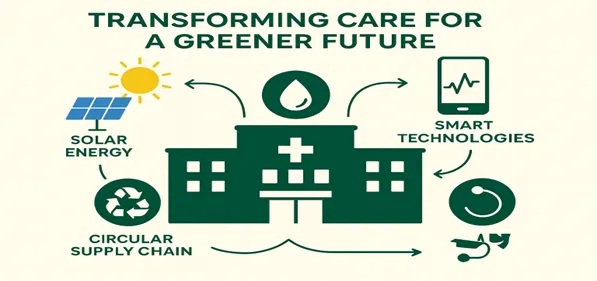
The concept of green healthcare facilities is transforming healthcare systems globally through their construction and operation, utilizing clean energy, circular supply chains and data-driven energy management, among other techniques. Innovative care, once considered a distant future, is now a necessity: it is tomorrow's care that is being changed into one that is eco-friendly, smart, and crisis resistant.
Source: BCC Research
Transforming Healthcare Spaces
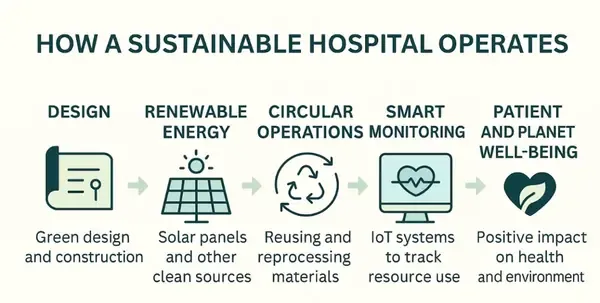
The shift toward sustainable healthcare is a fundamental change in healthcare design. Energy-guzzling hospitals, which were once the norm, are now transforming into smart and efficient systems that not only save energy but also provide it. Green architecture, including natural ventilation, passive cooling and daylight optimization, has become an integral part of the standard healthcare infrastructure. It has replaced energy-dependent systems, offering better comfort and air quality. For instance, the Twinsburg Family Health Center at the Cleveland Clinic in Ohio is utilizing smart lighting and insulation to reduce energy consumption. On the other hand, the entire Apollo Hospitals network in India has solar-integrated campuses and water recycling systems. Fortis Healthcare, another Indian hospital network, has decided to equip its new hospitals with water collection and air systems that utilize eco-efficient technology, thereby making it possible for sustainability and patient care to be compatible.
As a result of the design change, hospitals have developed a new way to operate: the single-use and waste-heavy approach used in the past has been replaced with circular operations, where products and devices are reused, refurbished and recycled. Medtronic and Stryker, in collaboration with OSF HealthCare, are remanufacturing surgical instruments previously disposed of in landfills, thereby reducing waste and the cost of procurement. Philips Healthcare has taken it a step further by establishing global take-back and refurbishment programs for imaging systems, aiming to extend product lifecycles and reduce e-waste. With AI-powered infrastructure systems provided by Siemens Healthineers and GE HealthCare, hospitals can now monitor energy, water and air quality data in real-time. This resulted in them achieving the highest efficiency automatically. This is the primary reason why hospitals are becoming responsive ecosystems, as patient healing occurs without harming the planet.
Source: BCC Research
Need deeper insight for your specific market?
BCC Research can tailor custom research by region, application, technology segment, competitor set, customer group, or investment priority.
Discuss a Custom Research NeedMomentum in the Industry: Setting the Standard
Big healthcare companies around the world are embedding eco-friendliness into their plans to meet growing demand and launch groundbreaking ideas from scratch. The following are a few notable examples.
- Kaiser Permanente, in the U.S., is now a model of what environmentally friendly healthcare can be on a large scale. Through its investments in green energy, rethinking the use of materials and integrating sustainability KPIs into every operational layer, Kaiser managed to achieve carbon neutrality, thereby becoming the first primary healthcare system to do so. What it has put in place is an example of how long-term environmental commitments can be a source of both operational resilience and financial performance.
- Johnson & Johnson redesigned its value chain through its Healthy Future 2025 plan. The company has been ambitious in setting its climate targets for the next five years. It is making changes to reduce its environmental footprint. It is becoming the benchmark for other companies in the same industry in the field of responsible production, where energy-neutral, eco-friendly packaging and sustainable transportation are increasingly recognized as essential parts of the solution.
- Philips Healthcare, by the same token, has struck a deal with complete circularity. It has launched take-back and refurbishment programs for imaging equipment, which have enabled it to prolong product lifecycles and tackle the issue of waste reduction on a large scale.
- Siemens Healthineers has adopted a green technology strategy to address the sustainability challenge. The company's plants in Germany are now fully supplied with green energy. Also, Siemens has introduced low-energy medical imaging equipment that can cut hospitals' energy consumption. The company demonstrates that combining clean technologies with precise diagnostics can be both profitable and environmentally beneficial.
These changes do not merely have a symbolic value. They indicate the existence of an increasing number of voices that agree with the point of view expressed throughout the healthcare industry. Sustainability is the source of innovation, brand credibility and long-term savings. Transparency and the design of products with a clear purpose attract both patient loyalty and investors’ support. The world’s leading hospitals have stopped considering clinical excellence as their only measure of success; instead, they are competing on climate leadership.
Future Outlook: The Path Ahead
Healthcare sustainability encompasses not only the conservation of natural resources and reduction of waste but also the innovative care of people. A hospital that has incorporated environmental responsibility into its priorities has ensured that even its employees can enjoy the benefits. Research indicates that patients can recuperate faster when they are placed in rooms bathed in natural light. Staff may feel less tired when they work in an energy-balanced setting, and members of the local community may perceive institutions that are leaders in ecological practice as trustworthy.
It is already the case that the road toward environmentally friendly healthcare infrastructure is still being built, but it is clear that the direction is not going to change. Several governments have already incorporated green building certifications into their building codes, while many financial institutions have made commitments to provide environmentally friendly loans for hospital projects. The supply chains of numerous companies have also become more transparent by default. For instance, in March 2024, four hospitals under the Hackensack Meridian Health network were certified as the first medical facilities in the U.S. to receive The Joint Commission's Sustainable Healthcare Certification, a symbol of their environmental leadership, which is demonstrated by meeting stringent standards to reduce greenhouse gas emissions, waste and environmental footprint. These achievements reflect large-scale trends related to ecologically certified buildings, the green financing of hospital facilities, and the increa
All in all, these initiatives are collectively shaping a healthcare system that is not just about treating diseases but also about preventing those diseases that may have originated due to environmental causes. The hospital of the future is no longer the one of the present. Fueled by clean energy, supported by closed-loop supply chains and managed with data, it sends a clear message that caring for human beings and caring for the Earth are the same mission.
Conclusion
The transformation to sustainable healthcare infrastructure is not merely a change of the healthcare technology system; it is a change of their values. It challenges hospitals, firms, and policymakers to reconceptualize what "healing" really means. A sustainable hospital is not just a healing place; it is a lifepath in all aspects: human, environmental and time-wise.
While health systems worldwide are adopting renewable energy, implementing circular supply chains, and embracing intelligent design, they show that sustainability and caring are not separate virtues but complementary ideals. The hospitals of the future will be more environmentally friendly, less costly and more healing, representing a future where acts of care extend not only to patients but also to the Earth.
After all, a healthy Earth is the foundation of healthy people, and that is the future healthcare must strive for.