

Carnot Battery: Transforming Energy Storage in the Future
Carnot Battery Technology: Powering the Next Generation of Energy Storage
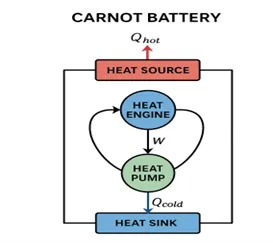
A Carnot battery stores electricity and converts it into thermal energy. During charging, energy powers different technologies like heaters and heat pumps and creates a temperature differential between a high temperature (HT) and a low temperature (LT) reservoir. Heat flows from the HT reservoir to the LT reservoir during discharge, driving a heat engine that partially transforms the stored energy into electrical power.
At first glance, it might sound a bit roundabout, but why not just store electricity directly in a battery, like a lithium-ion battery? The magic of the Carnot battery lies in its large-scale efficiency, flexibility and cost-effectiveness, especially when dealing with renewable energy sources.
Comparison of Different Grid Electricity Storage Technologies
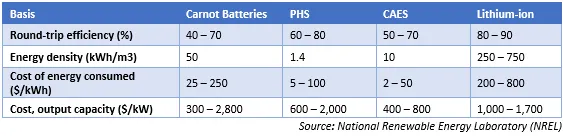
Based on cost, energy density and efficiency, the table contrasts four grid electricity storage technologies: lithium-ion, compressed air energy storage (CAES), pumped hydro storage (PHS) and Carnot batteries. Lithium-ion batteries are the most expensive but have the highest round-trip efficiency (80%–90%) and energy density (250–750 kWh/m³), which makes them perfect for small, quick-reaction applications. PHS and CAES are appropriate for large-scale, long-duration storage due to their low energy costs and moderate efficiency (50%–80%). Carnot batteries are a promising alternative for grid-scale thermal storage, as they strike a balance between cost and energy density (50 kWh/m³), despite their lower efficiency (40%–70%).
Evolution of the Carnot Battery: From Theoretical to Practical
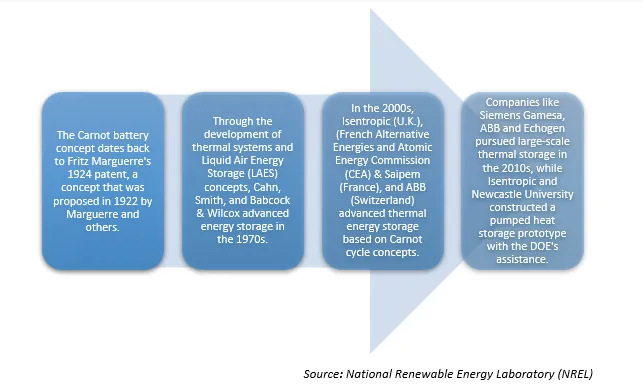
From early conceptual ideas to a workable energy storage solution, the Carnot battery has undergone significant development. Research and development have undergone several stages over the years, and interest in modern energy storage technologies has grown. It has gained global attention recently, resulting in the development of advanced systems, prototypes, and expanding commercial applications.
Research and Development Initiatives
Some of the recent research and development initiatives are:
- In January 2025, the REPTES project showcased innovative research at the Carnot 2024 Belgian Symposium of Thermodynamics, held in December 2024, at the University of Liège, Belgium. The University of Cagliari team showed “optimizing hybrid off-grid energy systems and reverse osmosis (RO) desalination with Carnot battery technology and model predictive control.” The research achieved a 69.4% reduction in the Levelized Cost of Storage (LCOS), underscoring the economic feasibility of RES-PTES systems for agricultural applications.
- In 2024, the International Energy Agency (IEA) published a report showing the importance of international collaboration, such as the IEA Task 36, which explores the potential of Carnot batteries. At the 93rd ExCo meeting in May 2022 (Rome), 15 countries and one Spanish sponsor expressed interest in the Task. The meeting highlighted the challenges associated with Carnot batteries, such as high temperature and high-pressure (non-standard conditions), which pose challenges to system components, especially compressors. It also highlighted the need for policy support, collaboration with large companies to experiment with innovative management systems/control systems and the development of a storage management system using AI, machine learning (ML) and big data technologies.
- In 2023, the German Research Foundation (DFG) funded a new research project at the University of Bayreuth, with an investment of around $345,200 (€ 298,000). The project was launched on July 1, 2023, at the Chair of Technical Thermodynamics and Transport Processes (LTTT) in the Center of Energy Technology (ZET) and aimed at developing Carnot batteries.
Why is the Carnot Battery Gaining Momentum?
- Growing Interest in Long Duration Storage: Carnot batteries are gradually being considered for grid-scale energy storage, particularly to support the integration of renewable energy sources like solar and wind. Their ability to store and discharge large amounts of energy over lengthy periods makes them suitable for balancing intermittent renewable generation. In recent years, Carnot battery technology has advanced with projects like Newcastle University’s 150-kilowatt (KW) pumped heat demonstration, the European Union (EU) CHESTER 10 kW prototype, and Malta Inc.'s 100-megawatt (MW) system. Originally for electric energy storage, Carnot batteries now support multi-vector applications such as combined cooling, heating and power (CCHP).
- Decarbonization Goals: Governments worldwide have set ambitious decarbonization targets to solve the climate crisis. For instance, the EU aims to achieve net-zero emissions by 2050, and Germany aims to do the same by 2045. By storing electricity as heat and delivering power or heat when needed, Carnot batteries contribute to the electrification of energy use in homes and businesses. They help solve the challenges of energy transition and resilience simultaneously by enabling variable renewable energy (VRE) to provide reliable power, reduce reliance on fossil fuels and support heating for both homes and businesses.
Future Outlook: Carnot Battery in Driving the Green Transition
The energy shift and a future dominated by fluctuating renewable energies require affordable and decentralized storage solutions that save energy resources on a scale of gigawatt-hours (GWh). Carnot batteries are key storage solutions that can contribute to this challenge due to the following factors:
- High potential to effectively incorporate various energy sources, including industrial waste heat and renewable energy, into the electrical and heating sectors.
- The ability to store and supply thermal and electrical energy, independently of particular geographic areas.
- The integration of renewable heat and power into applications, such as residential and commercial settings, and back into the grid, by using an appropriate set of components.
- The ability to use noncritical materials to store energy at a low cost and with significant energy and power capabilities.
- Involvement of non-critical materials for the whole power-to-heat-to-power cycle.
Conclusion
Carnot battery technology is in the nascent stages of development, but it is experiencing rapid growth and evolution, driven by the growing demand for flexible, large-scale, cost-effective electricity storage and ancillary grid services. Carnot battery is playing an important role as a key component of future renewable-based energy systems.
As technology matures and overcomes challenges, potential customers of Carnot batteries are generally required to select the most cost-competitive solutions to their needs, which often takes priority over meeting climate goals or supporting the development of new, clean technologies. To address this, vendors can work on the high cost of the Carnot battery through government grants, collaborations with research institutions and investments in research and development. Through continued research, they can advance system design and increase the energy density of the Carnot batteries compared to the lithium batteries.