

Empowering Smarter Healthcare: Growth in CDSS
January 20, 2026
Expert guidance to accelerate your market and strategy decisions.
A clinical decision support system is an intelligent tool in healthcare that helps clinicians make patient-focused, evidence-based decisions using electronic health records (EHRs) and medical databases. A CDSS consists of knowledge bases, inference engines and a user interface that accelerates a clinician's care process by offering alerts, recommendations and diagnostic support, developed to optimize patient outcomes and improve accuracy, safety and efficiency in the process of care.
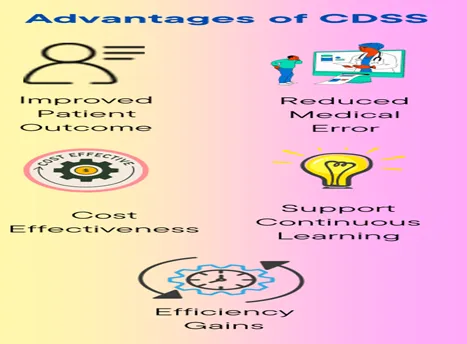
CDSS can be divided into rule-based systems or the emerging group of artificial intelligence (AI) tools, including medication management, disease diagnosis and chronic care management. CDSS is geared toward improving clinical outcomes and reducing errors and adverse outcomes. Factors challenging the CDSS adoption include clinician alert fatigue, poor medical data quality, difficulty integrating evidence-based knowledge and factors impacting patients into practice, and regulatory hurdles in developing or revising clinical justification. Ongoing advances in AI, cloud computing and interoperability standards indicate that CDSS is moving to individualized, predictive and explainable decision support systems. These systems will also provide clinicians with evidence, frameworks for clinical decision-making, and the Analytics, Collaboration, and Context (ACC) approach to focus on data-driven healthcare.
The CDSS market is a fast-growing sector of digital health, established to support the rising need for data-driven, evidence-based clinical decisions. Growth is driven by the increasing adoption of EHRs, the transition to value-based healthcare, and the implementation of AI and machine learning (ML) into clinical workflows. CDSS programs, from drug interaction alerts to AI-supported diagnostic reasoning, are changing how clinicians interact with large amounts of patient information and make decisions in real time. Although there are challenges in implementing CDSS — interoperability of data, alert fatigue and regulations — there is a strong market potential as health systems everywhere turn to automation, personalized medicine and predictive analytics to improve healthcare results and lessen clinical errors.
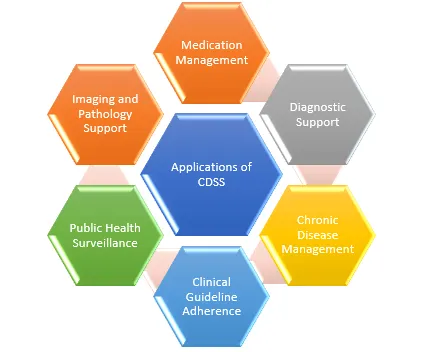
Applications of CDSS
Source: BCC Research
Source: BCC Research
Need deeper insight for your specific market?
BCC Research can tailor custom research by region, application, technology segment, competitor set, customer group, or investment priority.
Discuss a Custom Research NeedNext-Generation Movements in Clinical Decision Support Systems
Integration of AI and ML
The use of AI and ML in clinical decision support systems expands the methodology of clinical decision-making from static rule-based recommendations to a predictive, data-driven paradigm. Traditional CDSS systems have been dependent on predefined "if-then" logic. In contrast, AI-driven models learn from real-world clinical data to predict disease risks, provide personalized treatment recommendations and detect anomalies/preconditions to maintain early detection. For example, AI-based CDSS tools such as IBM Watson Health analyze unstructured patient data, medical literature and genomic data to provide recommendations for personalized treatment options in oncology. Likewise, Epic Systems and Oracle Health have incorporated ML algorithms in their CDSS modules, integrated with EHR systems that flag high-risk patients for sepsis or readmission. The utilization of such AI-enhanced CDSS systems improves clinical diagnostic accuracy while reducing the cognitive burden placed on clinical providers. Therefore, integration of AI and ML is expected to support the market growth in future.
Cloud-Based and Interoperable CDSS Platforms
Switching from on-premises systems to cloud-based CDSS enables improved scalability, flexibility and facilitation of integration across healthcare systems. Cloud-based deployment enables real-time updates to medical and clinical knowledge bases, ease of access for remote clinicians, and lower IT maintenance and overhead. Interoperability frameworks like HL7 FHIR (Fast Healthcare Interoperability Resources) are also paving the way for CDSS to seamlessly integrate with EHRs, laboratory platforms and telehealth platforms. For example, Wolters Kluwer's UpToDate and Elsevier's ClinicalKey both provide cloud-based decision support integrated with an application programming interface (API), providing clinical teams across multiple facilities with consistent evidence-based recommendations. Additionally, cloud delivery enables healthcare providers in developing countries to implement CDSS without the need for costly infrastructure. Thus, increasing demand for cloud-based and interoperable CDSS platforms is anticipated to propel the market growth.
Shift Toward Personalized and Precision Medicine
Modern CDSS are changing to enable personalized and precision medicine. By integrating genomic, molecular and lifestyle data, CDSS is narrowing its focus to individualized patient treatment recommendations. Instead of general protocols for all patients, precision-focused CDSS systems now offer personalized treatment pathways that take genetic markers, comorbidities and medication response into account. For instance, many patients visit Tempus Labs or Foundation Medicine, both of which offer CDSS platforms that integrate molecular diagnostic data into the clinical encounter, helping oncologists select targeted treatment regimens for their patients based on tumor genomics. There are now even tools that utilize AI in cardiology and pharmacogenomics to determine dosage adjustments and identify adverse drug reactions specific to each patient's genetic background. Therefore, a shift toward personalized and precision medicine is expected to support the market growth.
Future Outlook
The CDSS market is primed for growth, spurred by advances in AI, ML and cloud-based healthcare. Factors such as increasing adoption of EHRs, the shift to value-based care, and the growing need for error reduction and clinical efficiency are all key growth drivers of the market. Developments such as AI-based predictive analytics, interoperable cloud infrastructure and personalized medicine applications have all created new ways of interacting with clinical decision support systems, establishing them as critical components of modern healthcare ecosystem. However, there are still significant challenges ahead, such as issues surrounding data interoperability, clinician alert fatigue, and complex regulatory and compliance issues. Nonetheless, the overall outlook for CDSS is bright, particularly with the increase in funding focused on digital health infrastructure and AI-driven clinical insights, as CDSS has become a central component in global healthcare delivery.
Strategic Takeaways for Industry Leaders
Stakeholders across the industry should prioritize the integration of AI and ML to enhance predictive capability, automate use cases in workflows, and develop personalized, clinical recommendations. Stakeholders should also consider cloud-based deployment models for scaling implementations, reducing costs, and increasing interoperability with EHRs and hospital information systems (HIS). Group collaboration with various stakeholders, including technology developers, healthcare providers, and regulators, will be critical to supporting compliance, data security and verification of deployed algorithms or applications. Vendors should focus on user-centered design in the interface of applications to limit clinician alert fatigue and improve overall clinician adoption. In addition, stakeholders should invest in real-world evidence generation and prove clinical and economic value in the use of AI-driven clinical decision support tools. This adds to market justification for the product. Stakeholders should consider the potential for growth in emerging markets through digital health iteration and telemedicine expansion. Gaining a competitive advantage and ensuring long-term growth in the digital health market will require effort in establishing partnerships, a strong cybersecurity framework, and continued innovation in the use of AI and clinical decision support.
Conclusion
The CDSS market is becoming a cornerstone in the next-generation healthcare ecosystem, by bringing together technology and clinical experts to facilitate better decision-making, more patient safety and greater efficiency of care. The convergence of technologies, such as AI, big data analytics and cloud computing, is enhancing the CDSS space with streamlined, proactive and intelligent capabilities through its real-time functionality. CDSS are transitioning from preprogrammed static tools to evolving decision support. While barriers remain— including data interoperability, systems integration and regulatory pressures — the healthcare field, in partnership with policymakers and IT developers, continues to innovate and advance, propelling the field forward. As healthcare systems around the world pay closer attention to digital transformation and evidence-based practice, the future will favor CDSS, enabling them to be indispensable for the advancement of smarter, safer and more efficient healthcare systems.