Cold-Chain and Traceability Solutions for Biologics and Vaccines

January 20, 2026

In-depth market intelligence to support growth and planning.
Custom Research Article
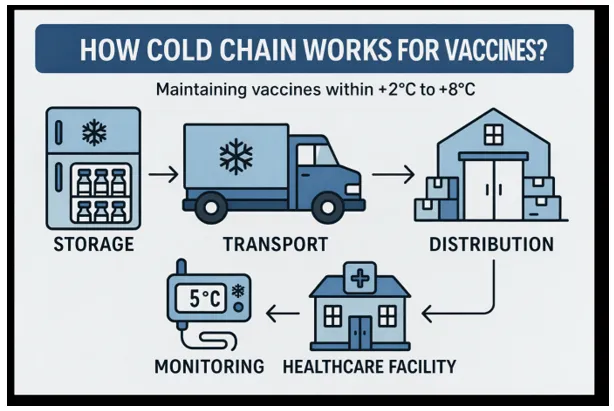
The biologics category includes various products such as vaccines, gene therapy and recombinant therapeutic proteins. Biologics and vaccine delivery need a temperature control system that maintains temperature control from storage to transportation and delivery to maintain their effectiveness. It spans calibrated equipment, trained personnel, documented processes and monitoring technologies that keep vaccines within strict ranges (+2°C to +8°C), with colder ranges for some products. UNICEF describes it as a chain of precisely coordinated, temperature-controlled events that enable millions of doses across countries every year through various means of transport, such as air transport or road transport. For example, every year, two billion vaccine doses are distributed by UNICEF, which provides immunization protection to approximately 50% of worldwide children. The organization shipped 500,000 doses of pneumococcal 13-valent conjugate vaccine via sea transport to Abidjan, Ivory Coast, in July 2025. The refrigerated cargo ship completed its journey from Belgium to Abidjan without incident, which established sea transport as a viable option for future vaccine delivery operations.

bcc
Source: UNICEF, 2025  
The implementation of traceability solutions becomes essential for vaccine and biologic products because it enables companies to monitor product movement through the supply chain by linking specific product identifiers to manufacturing and shipping, and receipt and administration events for authenticity verification and product recall management, and counterfeiting prevention. The process of traceability enables tracking, which leads to product tracing and authentication and maintains ownership records, and supports product returns and recall procedures.
 bcc

Current Market Trends

The supply of vaccinations is limited in some places due to a lack of vaccines or in-house manufacturing of certain medicines, as these are biologics that are inherently unstable and require cold chain storage. This is where traceability and cold chain solutions are useful. Since the COVID-19 pandemic, biologics and mRNA platforms have experienced rapid growth. However, stability limitations and increased value density boost the potential of quality and cost issues when temperature control fails. The promise of mRNA is accompanied by stringent handling requirements, highlighting the necessity of strong cold chains and serialized traceability to preserve potency and confidence.
Factors Driving the Growth of Cold-chain and Traceability Solutions for Vaccines and Biologics:
  • Digitization and real-time monitoring: Markets for cold-chain monitoring and real-time visibility solutions are growing double-digits, driven by regulatory requirements and demand for continuous data, including temperature, location and shock. For example, in September 2025, Tive partnered with AstraZeneca FluMist Home to insert its Tive Tag on each at-home FluMist vaccine shipment so the recipient can confirm in-transit temperature compliance via phone scan - practical proof of consumer-level, real-time monitoring.
  • Unit-level serialization and scanning: The Drug Supply Chain Security Act (DSCSA) in the United States started its serialized interoperable item-level phase (2023 onward) while stakeholders exchanged Electronic Product Code Information Services (EPCIS) events through GS1-specified 2D barcodes. The Centers for Disease Control and Prevention (CDC) supports using GS1-based 2D barcodes for vaccine tracking to achieve precise administration data capture.
  • Anti-falsification and supply integrity: WHO and partners warn that substandard/falsified medical products persist in low- and middle-income countries. Traceability (serialization, verification) is a critical countermeasure embedded in global and national strategies. In July 2025, Antares Vision Group (rfxcel) partnered with LedgerDomain to harden DSCSA compliance and system security (credentialing, tamper resistance) - directly aimed at preventing illegitimate product entry. 
  • Platform innovations: WHO/Gavi prequalify and guide the adoption of solar direct-drive (SDD) refrigerators and advanced passive devices to harden last-mile reliability. The latest performance, quality and safety (PQS) program and cold chain equipment (CCE) guidance stress temperature performance, autonomy (≥3 days), and reduced freeze risk. Sustainability (solarization) is now a practical cold-chain lever, not just a pilot. For example, in February 2024, in order to give end-to-end insight over the vaccine path from manufacture to patient, Controlant created Saga Card in partnership with other partners. The new, tiny IoT gadget is a big improvement over the pallet-level real-time visibility available today. It will offer real-time visibility at the national, regional and local levels, down to secondary packaging such as cases and cartons, when paired with Controlant's platform.

Market Players


Company

Description

Berlinger & Company (acquired by Sensitech)

The company offers fridge-tag® for continuous monitoring of sensitive vaccines stored in medical refrigerators and freezers for up to three years.


In August 2024, Carrier’s Sensitech acquired the Monitoring Solutions business of Berlinger & Company, which specializes in innovative and customized solutions for monitoring temperature-sensitive goods in the pharmaceutical and life science, clinical trial, and global health. This strategic move strengthens Sensitech’s cold chain monitoring and visibility solutions for the pharma and life sciences industry.

DHL Group

DHL Group is one of the largest logistics networks in the world, serving the life sciences sector, including vaccines and biologics.


In March 2025, DHL acquired CRYOPDP, strengthening DHL’s life sciences logistics. CRYOPDP focuses on clinical trials, biopharma, and cell and gene shipments.

GS1

GS1 issues Unique Device Identification (UDI) barcodes to record data throughout the healthcare supply chain. GS1 enables the precise and effective identification, collection and sharing of the data required for vaccination administration.

It improves the speed and accuracy of data capture, enables clinical decision support, and improves traceability and recall of medical products.

Several vaccine and biologics manufacturers in the European Union, Brazil, China, Egypt, Saudi Arabia, Singapore, South Korea, Taiwan, Türkiye and the U.S. use the GS1 standards to comply with UDI requirements.

UPS Healthcare

UPS Healthcare offers UPS Premier, a sensor-based logistics solution designed for critical healthcare products, alongside full cold-chain management services.


UPS acquired Frigo-Trans and BPL in Germany during January 2025 to enhance its European cold-chain delivery capabilities. The company announced its plan to acquire Andlauer Healthcare Group (AHG) in Canada for $1.6 billion in April 2025 to enhance its temperature-controlled logistics services.

Cencora

Cencora’s World Courier offers cryogenic, ultra-cold and direct-to-patient services logistics.


World Courier shipped its first 300,000 mpox vaccine doses to the Democratic Republic of Congo (DRC) and Nigeria in September 2024 to fight the mpox outbreak across Africa.

Envirotainer

The company develops active temperature-controlled air cargo containers (example, Releye® family) are widely used for vaccines/biologics.


In February 2025, the company launched Releye RKN (lighter, >130 hours autonomy transport solution) and was recognized by the WHO 2025 vaccine shipping guidelines as an “Advanced Active” solution.

Controlant


The company offers a real-time visibility platform, IoT devices, control-tower services, and has supported Pfizer’s COVID-19 vaccine distribution.


In November 2024, the company raised $35 million to scale market expansion in the digital transformation of pharma supply chains.

Growth Areas in Near Short-term (three to five years):

From monitoring to prediction: Next-gen platforms will fuse device data (loggers, sensors), lane risk, and weather/handling signals to predict excursions and automate mitigations (lane re-routes, dry-ice replenishment and site alerts). Vendors are already commercializing predictive modules and live shipment analytics, indicating a shift toward closed-loop, exception-led operations. 
Deeper serialization at the point of care: DSCSA-driven EPCIS exchanges and 2D scanning at administration will migrate from pilots to routine practice, improving inventory accuracy, recall execution and wastage reduction. The net effect: fewer stockouts, better demand signals and stronger pharmacovigilance linkages from vial to patient record. 

Hardening the last mile sustainably: Expect broader deployment of solarized equipment with multi-day autonomy, freeze-free carriers and long-hold passive devices, especially in hot, off-grid geographies. The sustainability case (lower energy and diesel dependence) now aligns with reliability and TCO, supported by WHO/Gavi guidance and growing field evidence. 

Anti-falsification by design: With falsified medicines still pervasive in some markets, more countries will codify unit-level verification in tendering and reimbursement, leveraging GS1 identifiers and interoperable data exchange to secure public programs and humanitarian supply. Expect stronger multi-agency collaboration coming out of World Health Assembly (WHA) deliberations and related partner initiatives. 

New operating models: Outbreak-ready networks (pre-positioned assets, drone-enabled micro-fulfilment and flexible capacity reservations) will support regular immunization operations by providing additional capacity to manage increased demand without requiring significant capital expenditures. The pandemic experience with dry-ice packaging and direct-to-site delivery, and micro-batch distribution will become permanent standards in operational procedures and contractual agreements.

Conclusion:

The vaccine and biologic supply chain now develops into an intelligent system that predicts delivery while maintaining security to guarantee product quality throughout the entire distribution process. The growing adoption of biologics and mRNA, and gene therapies requires absolute control of temperature and product authenticity because these elements have become essential for success. The combination of real-time monitoring with serialization and anti-falsification technologies creates transparent data-based logistics systems. DHL and UPS, along with Sensitech and Controlant, lead the industry through their implementation of IoT-based tracking systems and their development of sustainable solar-powered storage solutions. The upcoming phase of vaccine supply chain development will concentrate on predictive analytics and sustainable logistics, and digital tracking systems to create resilient and fair vaccine distribution networks.

Looking for Consulting & Advisory Projects

AI Sentiment