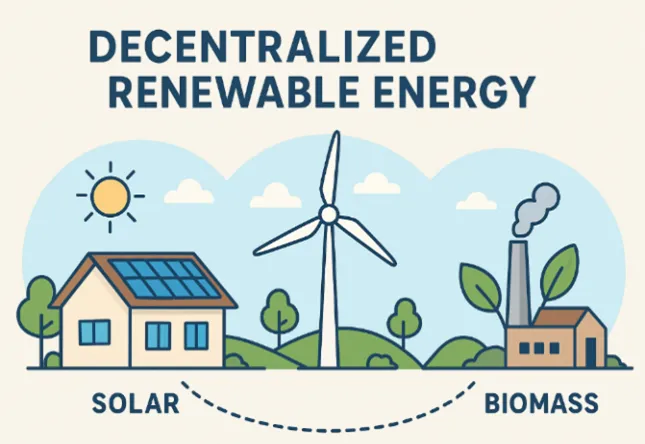
Decentralized renewable energy (DRE) refers to energy produced near the point of consumption, rather than at a large, centralized power plant. DRE is often associated with relatively small-scale systems such as rooftop solar panels, small wind turbines, biomass facilities or mini-hydro power facilities that deliver clean electricity directly where it is needed.
The generation of DRE helps reduce dependence on long-distance transmission lines, associated energy losses, and, when properly implemented, strengthens grid resilience, especially in rural or remote communities.
Source: BCC Research
Need deeper insight for your specific market?
BCC Research can tailor custom research by region, application, technology segment,
competitor set, customer group, or investment priority.
Discuss a Custom Research Need
Why is DRE Crucial for the Global Energy Transition?
There have been significant progress in expanding electricity access, with 90% of the global population connected to power by 2020. However, significant disparities prevail, particularly in vulnerable regions such as sub-Saharan Africa, which remain far from achieving the universal energy access targets set for 2030.
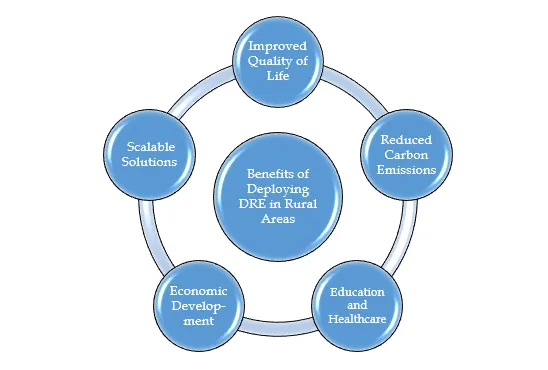
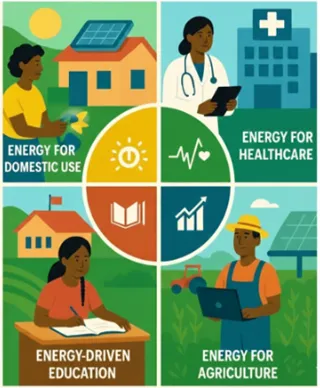
DRE provides electricity for residential, commercial and institutional needs, thus playing a pivotal role in advancing multiple Sustainable Development Goals (SDGs). Furthermore, DRE is instrumental in delivering affordable and reliable electricity to low-income communities in remote regions, where energy poverty has been worsened by COVID-19, thereby promoting equitable access to energy.
Source: BCC Research
According to the Council on Energy, Environment and Water (CEEW) report, published in 2023, around 12 to 15% of health facilities have reliable sources of energy in Sub-Saharan Africa and South Asia, resulting in hampered health outcomes and compromised patient safety. DRE deployment enables critical healthcare services in low- and middle-income countries (LMICs) supporting essential functions such as immunizations, safe deliveries, and prenatal and postnatal care. Furthermore, improved electricity access through DRE plays a vital role in attracting students and teachers to schools. By providing reliable power, DRE has boosted school attendance and transformed schools into community centers, offering clean water, nutritious food, medical care, and enhanced learning environments.
Government Initiatives to Promote the DRE
Some of the initiatives taken by the government are:
|
Countries
|
Intiatives
|
Impact
|
|
The U.S.
|
Both the U.S. federal government
and state governments have implemented their own set of policies to assist
public-private partnerships in energy, notably the Investment Tax Credit
(ITC) and the Production Tax Credit (PTC).
These incentives for investment
have substantially supported DRE. Likewise, California has rolled out
policies such as the Self-Generation Incentive Program (SGIP) that fund
projects dedicated to distributed energy resources.
|
It permits investors to deduct a
fraction of the expenses in establishing renewable energy projects from their
federal taxes. It also enables private
investors to finance small renewable energy projects in coordination with or
in support of government initiatives.
|
|
China
|
The 14th Five-Year
Plan also sets a goal for renewables to supply 33% of all electricity by
2025, and supports not just large-scale projects but also distributed
solutions such as rural rooftop solar.
|
Decentralized
solutions are particularly effective in rural and underserved areas of the
grid and can power small businesses, homes and farms. This can lead to local
economic growth, improved access to education and healthcare, and a better
overall quality of life.
|
|
Spain
|
In Spain, recent initiatives
highlight the country's commitment to DRE. The draft of Royal Decree-Law
7/2025 outlines urgent measures to improve both stability and flexibility in
the electricity supply, while also accelerating the deployment of renewable
energy, including photovoltaic solar and secondary battery storage.
|
DRE projects enhance local energy
security and reduce community reliance on centralized plants by supporting
small-scale generation and energy storage projects.
|
|
Nigeria
|
In May 2024,
Nigeria’s Rural Electrification Agency (REA) entered a partnership with the U.S.-based
company Husk Power Systems to implement up to 250 MW of DRE initiatives in
alignment with the Federal Government’s goals for energy access, energy
transition and energy security.
The DRE initiatives
aim to build and implement the $750 million Distributed Access through
Renewable Energy Scale-up (DARES) project, a World Bank-funded project
managed by REA.
|
By providing clean,
renewable energy, DRE is contributing to economic growth and improving living
standards. It is also cutting down on fossil fuel use and supporting
Nigeria’s broader clean energy and climate goals.
|
Source: Company websites
Industry Challenges Driving the Need for Change
Source: BCC Research
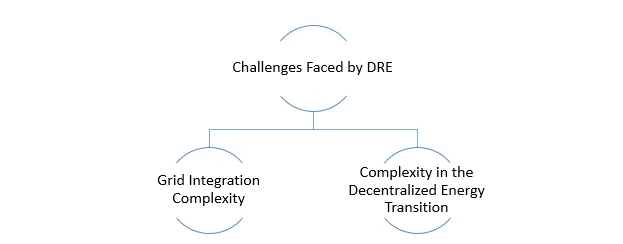
- Grid Integration Complexity: Integrating distributed generation creates significant technical challenges because of the variability of renewable energy resources, including wind and solar. Renewable energy output depends on weather conditions, making it challenging to balance supply and demand, especially when deployed at small scales, unlike traditional dispatchable sources such as fossil fuel power plants. Integrating distributed generation successfully requires some form of energy storage, reliable energy forecasting or management of flexible demand.
- Complexity in the Decentralized Energy Transition: The shift to decentralized energy systems introduces complex economic, social and regulatory challenges related to consumer efficiency. When consumers generate their own power, utility revenues decrease, prompting a reconsideration of cost recovery or payments to the electric system, including the retention of fixed costs without corresponding revenue. This is where the phrase “utility death spiral” is used, not to describe the absence of innovation in utility business models, but to motivate changes in the studies on pricing and/or a consideration of fixed or demand charges. However, pricing models such as these can raise concerns regarding cost, fairness, equity and affordability. Decentralized energy systems will also require new market structures, fair participation, regulatory adjustments, and equitable distribution of benefits among all consumers.
Key Companies Operating in the DRE Market
The companies operating in the DRE market include major players specializing in innovation, technology and market-driven solutions. These include:
NextEra Energy Resources (NEERU): The company was incorporated in 2000 and is headquartered in Florida, the U.S. The company’s product offerings include Grid-Scale Renewables, Energy Storage and Microgrids. In October 2025, NextEra and FasterCapital announced a strategic partnership through the EquityPilot program to accelerate NextEra’s deployment of decentralized clean energy, smart-grid and EV charging solutions across Zimbabwe and Sub-Saharan Africa.
ReNew: The organization was established in 2011, and its headquarters are located in Gurugram, India. The company's product offerings include solar PV, utility-scale wind, utility-scale solar and hydropower. In May 2025, ReNew secured $100 million marquee investment from British International Investment (BII) to boost India’s solar manufacturing ecosystem.
1KOMMA5°: Founded in Hamburg, Germany, in 2021, the company operates across 80 locations in seven markets worldwide, serving as the one-stop shop for intelligent, integrated energy solutions such as PV, energy storage systems (ESS), heat pumps and EV charging stations. In May 2025, the company connected four markets with around 50,000 decentralized energy systems, such as solar systems, battery storage or heat pumps, which have generated savings of $41.06 million (36.6 million euros) in electricity costs for the connected households.
Future Outlook
A promising future outlook for the DRE market is evident from increased technological development and policy support for transitioning to resilient, local systems. The in-progress technological advances include:
AI-Optimized Energy Management: AI allows DRE sources to contribute extra energy to the grid and schedule stored energy to be used in homes, buildings and vehicles. In this way, letting energy flow when demand or generation is variable. The second component of DRE management is real-time control and forecasting. Here, AI serves as the composer of DRE, allowing rapid control and optimization, creating a grid that is much more flexible, resilient and adaptable to unexpected challenges.
Blockchain-based Peer-to-Peer Trading: The blockchain technology is changing energy management by improving both transparency and efficiency. Consumers may trade energy with one another through peer-to-peer trading, where consumers can buy and sell their excess renewable energy directly. Blockchain notably improves the traceability of renewable energy certificates or "green certificates," which increases trust and accountability in trading. The use of a decentralized ledger helps manage the electricity grid by tracing energy generation and consumption.
Furthermore, the International Energy Agency’s (IEA) Renewables 2024 report, which shows that solar is expected to account for almost 80% of global renewable capacity growth through 2030, both through utility-scale and distributed rooftop systems, highlights the growing role of decentralized systems in the global energy transition.
Conclusion
DRE is in a phase of rapid technological growth. This growth is driven by a variety of factors: the increasing need for sustainable energy solutions, meeting SDG goals, reduced reliance on centralized grids, and government support. However, scaling DRE to worldwide markets can be difficult due to barriers, such as high upfront cost, limited technical knowledge and regulatory barriers. Overcoming those challenges will require government support, incentives and public-private partnerships. Hybrid systems, for example, which incorporate solar, wind, and energy storage can provide additional reliability and emissions reductions compared to traditional diesel generators.
Awareness of rooftop solar energy and opportunities to sell surplus energy remain relatively low in markets such as India, and South Africa, and other developing countries. Manufacturers and stakeholders should pursue educational programs and organize seminars, especially in rural areas, to promote DRE. DRE systems are increasingly viewed as a critical mechanism to meet local demand sustainably, enabling rural and remote communities to meet future energy demands.