

Digital Phenotyping in Psychiatry: Data-Driven Mental Health Insights
January 20, 2026
Tailored research built around your exact strategic priorities.
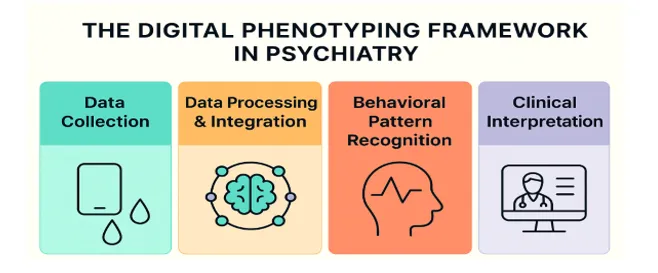
Psychiatry has traditionally been dependent on subjective assessments, clinical observations and patients' self-reports to comprehend and treat mental disorders, largely dependent on people being capable of recalling and clarifying their ideas and emotions. These are methods that provide only a partial view of the patient's emotional condition, which is always affected by the surroundings and relations. However, the discipline has transformed with the advent of digital phenotyping, which refers to collecting and processing the data obtained from the use of mobile phones, wearables and other internet-connected devices to identify and explicate the behavioral and physiological patterns.
By looking at the movement, speech, sleep patterns and digital device usage of a person, mental health professionals are now able to find even the faintest signals of change in a person's psychological well-being with a stunning accuracy that was never possible before. Hence, this method efficiently bridges the gap between clinical assessment and the patient's real life, thus transforming psychiatry into a continuous, data-driven understanding rather than one that is merely observational.
Source: BCC Research
The Science Behind Digital Phenotyping
Basically, digital phenotyping is a mix of behavioral science, neuroscience and artificial intelligence (AI). In other words, the data about the individual's mental and emotional health is obtained from both passive and active data collection of their digital devices. Passive data — such as location tracking, screen time or communication frequency — records normal behaviors in a nonintrusive way. Active data — such as speech samples, short cognitive tasks or mood inputs — provides more targeted insight into psychological states. A single machine-learning algorithm does this analysis of the multidimensional datasets to identify the correlations between digital behavior and mental health outcomes.
For Instance, a drop in movement, sleep irregularity or lack of social contact may become signs of a depressive episode, whereas increased typing speed or erratic speech may point to anxiety or mania symptoms. Clinicians, through decoding these behavioral signatures, can therefore intervene at the psychological shifts even before traditional assessments would recognize them. Moreover, the use of physiological signals such as heart rate variability or skin conductance has broadened the scope of digital phenotyping over time, so psychiatry can now not only measure how patients behave but also how their bodies react to mental strain.
Emerging Market Trends in Digital Phenotyping
The growing integration of digital technologies in psychiatry is a clear reflection of a broader market trend that is moving towards continuous, data-driven mental health monitoring. The concept of the “digital phenotype” is being unfolded in a comprehensive review published in Frontiers in Digital Health in October 2023. It includes a person's entire digital footprint from the use of a smartphone to the data of a wearable device, and these patterns are frequently associated with psychiatric states like anxiety, bipolar disorder and depression. In the same vein, a study by Breitinger et al., published in the Journal of Medical Internet Research in January 2023, showed the practicability of using a combination of active and passive smartphone data to keep an eye on mood disorder patients, thus indicating how in-the-moment digital signals can be a valuable addition to clinical assessments. These works signal a shift in psychiatry toward continuous, evidence-based observation that underpins data-driven diagnostic models, moving away from episodic evaluations.
Meanwhile, the healthcare and technology ecosystems are evolving to support this transition. All these attempts signal the emerging market trend of precision psychiatry, which combines behavioral analytics, sensor fusion and AI-based models that are capable of changing the identification and management of mental health conditions worldwide.
Strategic Collaborations and Industry Initiatives
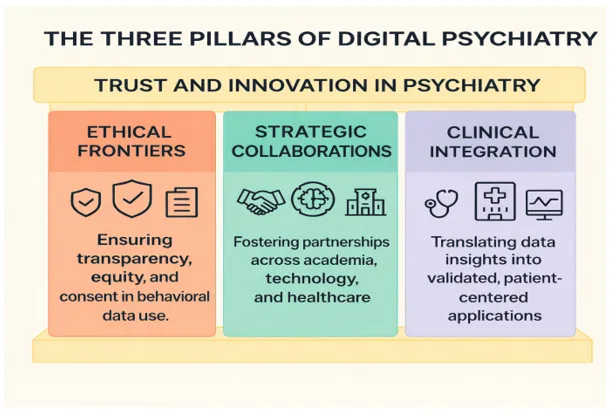
The triad of technology innovators, clinical researchers and digital health companies has been one of the major component collaborations that have significantly propelled the change of digital phenotyping in psychiatry to the next level. In August 2023, Karger AG demonstrated how the Apple SensorKit could be utilized to gather data from a user's phone in a non-intrusive manner, such as ambient light, device usage and mobility patterns, to locate depressed moods at their very first stages. This is just a part of the company's larger plan to confirm the validity of digital biomarkers through collaboration with academic teams.
Large-scale research programs at the institutional level have remained a major force in the establishment of clinical credibility for digital phenotyping. The EU-funded RADAR-CNS consortium, which is a project led by King’s College London, is still the most influential and the leading worldwide collaboration that works on using smartphone and wearable data to monitor depression and bipolar disorder in different populations. Besides that, the pharmaceutical industry players are actively engaged in establishing partnerships with digital analytics companies to come up with mental health companion apps that integrate real-world behavioral data into treatment plans. Combining all these efforts, they signal the coming of age when the academic, industry and healthcare sectors will be working hand-in-hand to make digital phenotyping not only a research concept but also a practical, clinically relevant frontier of modern psychiatry.
Challenges and Ethical Frontiers
Integrating digital phenotyping into clinical practice not only entails the practical application of the technology but also in handling its ethical aspects in a way that would secure its approval by the patients and physicians. In January 2024, the researchers at the University of Oxford signaled that anonymized data from smartphone sensors might, due to a leak, expose personal habits and even mental health patterns without the user's knowledge. Such a condition means that the encryption has to be made stronger, the consent has to be more transparent, and the authority supervision has to be increased. However, a report from Harvard Medical School in February 2024 revealed that a large number of platforms lacked clear consent mechanisms and were vague about sharing data with third parties. The findings of these revelations uncover a large ethical gap: technology has outstripped policy, but psychiatry's ethical commitment to patient trust remains.
Along with privacy being a matter of concern, inconsistency of clinical methods and algorithmic bias are factors that delay clinical translation. The research conducted between 2022 and 2023 reveals that discrepancies in data gathering and algorithmic processing may bring out different clinical insights even when the same behavioral patterns are utilized for the analysis. For instance, a Springer Nature Limited study, published in November 2023, used smartphones and wearables to track patients with unipolar depression, but cautioned that inconsistent sampling frequencies and device types reduced the accuracy of depression severity assessments. Removing these barriers requires global standards, diverse datasets and accessible AI that is fair, reproducible and clinically trustworthy in digital psychiatry.
Source: BCC Research
Need deeper insight for your specific market?
BCC Research can tailor custom research by region, application, technology segment, competitor set, customer group, or investment priority.
Discuss a Custom Research NeedFuture Outlook: The Path Ahead
Digital phenotyping is revolutionizing psychiatry in a way that allows for personalized, integrated and patient-centered care. Later on, methods could implement multi-modal phenotyping through fusing behavioral, physiological and genetic data to draft intricate mental health profiles. A holistic understanding like this could not only change the whole idea of prevention but also make it feasible to identify disorders at a very early stage or even prior to the manifestation of symptoms.
Research institutions, mental health start-ups and health-tech companies are actively collaborating to implement digital phenotyping in the clinical setting. The U.S. and Europe are the two major contributors that are implementing digital phenotyping through hospital pilots and public health programs, while the Asia Pacific is emerging as a new center for digital-health projects and government facilitation.
AI, along with machine learning, will be instrumental in further enhancing the predictive capabilities, making it possible to have mental health real-time alerts as well as therapy adaptive suggestions being directed to the behavioral patterns of each individual. At the same time, innovative technology such as blockchain may enable the data to be owned in a decentralized manner, whereby the patients will have maximum control over their information, while also ensuring security and transparency. The government and insurance systems will also be at a stage where they will recognize and facilitate the use of digital phenotyping in the healthcare system as a legitimate way of delivering healthcare. Such a breakthrough will redefine psychiatry as it is going to be a field that is continuously and personally engaged with the patients rather than the periods of assessment.
Conclusion
Digital phenotyping is revolutionizing psychiatry by making the behaviors of people measurable, which were previously very subtle. These new measurable data give clinicians a more holistic view of patients, and allow them to intervene at a stage that is even earlier than before. Psychiatry is evolving into a science that observes the patterns of movement, communication and physiology, as a result of the interplay of technology, neuroscience and analytics.
However, the process must entail the ethical use of data and strict validation. Intelligent machines/care would change the current model of intervention from a mere reactive to a proactive one by detecting the first symptoms of emotional distress, thus providing patients and therapists with a tool to manage mental health and well-being.