

Digital Twins in Surgery: Clinical Applications, Enabling Tech and Market Outlook
February 03, 2026
Expert guidance to accelerate your market and strategy decisions.

The surgical field is entering a new phase characterized by precision, minimally invasive techniques and predictive, data-informed decision-making. Digital twins, dynamic virtual representations of patients, surgical settings or complete health care systems, are swiftly changing the methods used for surgical planning, training and intraoperative assistance.
Digital twins will serve as the link between surgical automation, robotic systems and artificial intelligence (AI) as these technologies develop further. This will provide a feedback loop between real surgical data and virtual simulations that are continuously learning and improving. For medtech businesses, the outcomes are clear: the health care industry is being shaken to an unprecedented extent by the mix of sensor integration, AI modeling and simulation technologies.
The Evolution of Digital Twins in Health Care
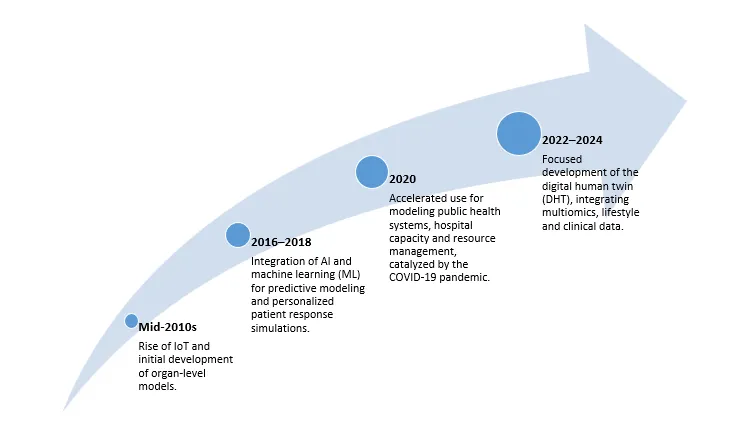
Originally developed for industry, digital twin concepts began entering health care in the early 2010s through radiology and biomechanical modeling. After the COVID-19 pandemic and the surge of AI-driven simulation tools, the technology has become deeply ingrained in the surgical environment. It now spans digital twin for visualization before surgery, guidance during operations and training for surgeons, as well as optimization of postoperative outcomes.
Modern digital twins in surgery are classified into four primary types:
|
Type |
Example |
Application |
|
Static Twin |
3D anatomical replica for preoperative evaluation |
Planning and patient education |
|
Functional Twin |
Finite element analysis (FEA) for biomechanical simulations |
Predicting stress, fracture or tissue response |
|
Shadow Twin |
Real-time, sensor-linked anatomical models, e.g., Twin-S |
Dynamic intraoperative assistance |
|
Intelligent Twin |
AI-powered adaptive systems such as the DLR’s MiroSurge system |
Anticipatory surgical guidance and risk prediction |
What sets health care apart is its complexity. Every patient’s anatomy, physiology and disease trajectory differ. Hence, the patient-specific digital twin acts as a continuously updated computational sibling derived from real-time imaging, hemodynamic monitoring and even molecular data.
Clinical Applications: Where Virtual Meets Reality
Preoperative Planning
One of the most revolutionary effects of digital twins is the complete change in presurgical mindset and approaches. The exact 3D replica of the patient's organism created allows surgeons to run operation simulations, which include selecting the safest method, identifying areas that are most at risk, as well as performing feasibility tests of forthcoming interventions on the virtual model. Orthopedic, cardiac and liver surgeries are some of the fields where this technology is already in use. To demonstrate, Boston Children’s Hospital employs heart digital twins in valve replacement optimization, meanwhile orthopedic pioneers create joint replacement scenarios to perfect implant positioning.
Intraoperative Guidance
Twin-S, a system for skull base surgery, is an excellent example of how reality and a virtual synchronized model can be optimally fused. The precision of the model in reflecting the surgical alterations is less than one millimeter and this is guaranteed by optical tracking and AI-based segmentation. The digital duo is continuously updated on the progress of the operation in the neurosurgery department, and therefore, it never fails to indicate the regions at risk, changing the plans of the approach. Thus, the virtual model turns into the surgeon's onboard assistant.
Surgical Training and Simulation
For surgeons in training, digital twins stand as the most realistic and versatile educational tools. Immersive training using data sets taken from patients allows the mastering of skills on real bodies without risky trials on actual living or dead ones. In this way, doctors get a chance to work on their incisions, instrument grasp and outcome forecasting - all in a secure, ever-adapting virtual setting.
Outcome Prediction and Postoperative Monitoring
These twins are no longer just surgical tools. They have been transformed by ML and data analytics to enable prediction. They forecast the time needed for wound healing, evaluate implant load and anticipate postoperative complications. When combined with wireless sensors, these models continuously update based on recovery stages and are extremely helpful for doctors in creating post-care plans.
Enabling Technologies: The Digital Twin Ecosystem
It takes a plethora of converging technologies, such as an orchestra, to build a digital twin for surgery:
1. Advanced Medical Imaging
MRI, CT, 3D ultrasound and intraoperative recording are combined to build a highly detailed patient-specific dataset. AI-powered segmentation algorithms then convert them into three-dimensional, interactive anatomical models that can be updated in real time.
2. Artificial Intelligence and Machine Learning
AI is the link between simulation and prediction. Deep learning models can determine tissue characteristics, facilitate segmentation and forecast intraoperative risk factors such as bleeding or nerve damage. In the case of an intelligent twin, AI continually adjusts the twin's reaction based on real-time surgical feedback.
3. High-Fidelity Sensing and IoT
The digital twin apparatus works in harmony with force sensors, robotic arms and optical trackers, which capture every surgical tool movement. Thus, a feedback loop is formed between surgeon, machine and model, which is the virtual twin reflecting the real-world operation at every instance.
4. Augmented and Extended Reality (AR/XR)
Using AR headsets, doctors can directly superimpose digital twin models on the surgical field to gain greater spatial awareness and accuracy. The use of this immersive visualization technology is equally beneficial for minimally invasive techniques and robotic-assisted surgeries.
5. Computational Infrastructure
Such a backend requires significant computing power. Cloud and edge computing enable real-time processing, while federated learning protects patient privacy across connected data networks.
Opportunities and Emerging Frontiers
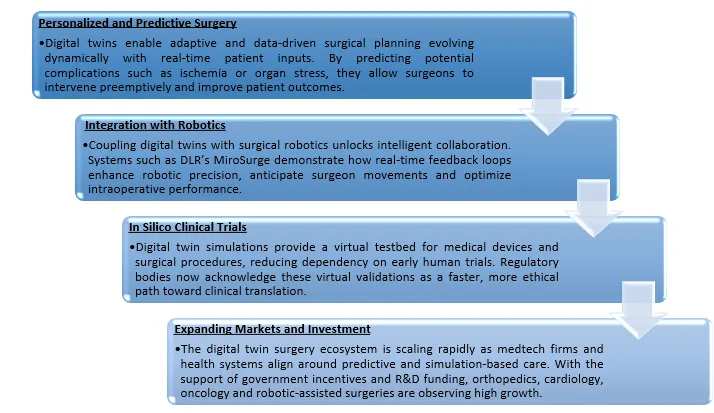
Challenges on the Horizon
Despite its huge potential, few digital twin applications have been slowed by the following issues:
- Data Integration and Interoperability: Systems that are fragmented and data in different formats make it difficult to synchronize in real time.
- Computational Cost: Detailed simulations need a lot of computational power.
- Ethics and Privacy: Patient-specific models require informed consent, protected health information (PHI) minimization, encryption, access logging and data-sharing, and retention policies across edge or cloud components. Governance must define human-in-the-loop overrides and permissible use.
- Regulatory Validation: Most surgical-twin functions remain investigational. Clinical use should rely on FDA-cleared or authorized software for defined indications and follow Institutional Review Board or Quality Assurance (IRB/QA) procedures for validation and post-market monitoring.
Future Outlook
An intelligent digital twin ecosystem will be the harmonious convergence of the medtech, simulation software and AI-driven innovation. Such adoption is anticipated to be facilitated rapidly through vendor collaboration and cross-disciplinary integration. Within the next three years, hospitals are expected to integrate digital twin modules in the already existing robotic and AR-assisted surgical platforms, thus, turning them into “learning operating rooms” where each surgery is continuously refined by the one before it.
Eventually, operating rooms will essentially be teams made up of surgeons, robots and intelligent digital twins working together in harmony. These digital twins are expected to not only serve as models but also as learners and optimizers—improving every cut, decision and surgical outcome through their ongoing feedback and intelligence.