

Direct Air Capture (DAC): Paving the Way to a Net-Zero Future
Expert guidance to accelerate your market and strategy decisions.
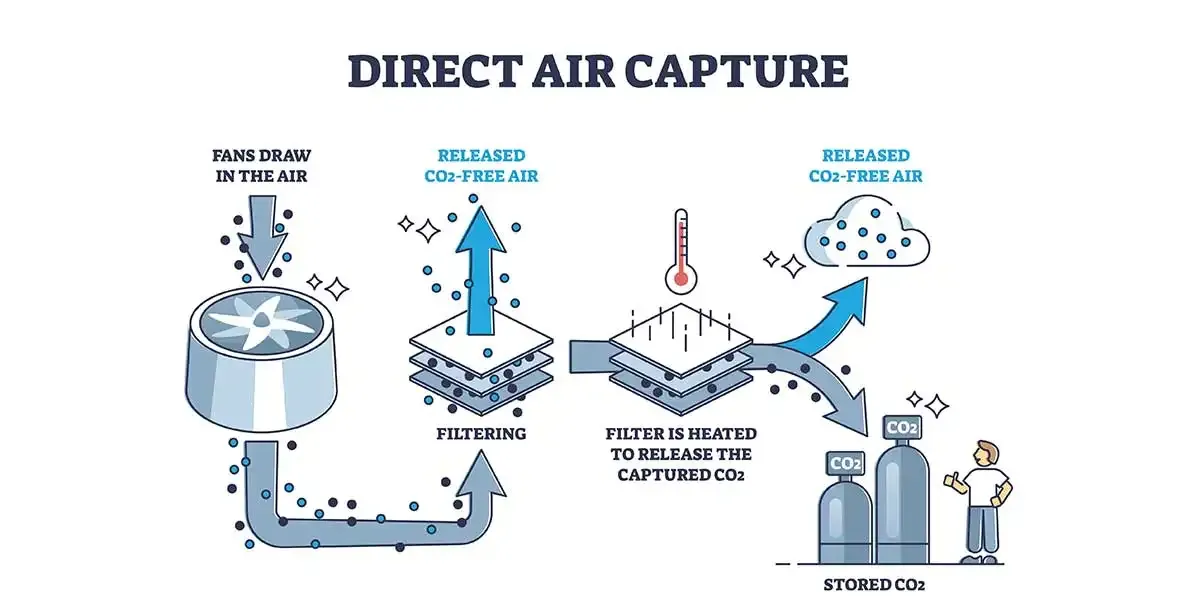
Direct air capture (DAC) refers to the process of removing CO2directly from the atmosphere by using various chemical processes. This CO2 is then either stored underground or used in various industrial processes, products, or fuel production. It is considered an important technology for removing CO2 and thus meeting the net-zero and sustainability goals. DAC provides a location-independent and scalable way to remove CO2 levels, making it a practical and scalable solution for achieving the net-zero targets. With its features of energy efficiency and CO2 storage or utilization systems, DAC is emerging as a fundamental technology in global climate management strategies.
Global temperature and climate impacts have been intensifying over the past few decades. NASA stated that the Earth was approximately 1.47°C warmer in 2024 than it was in the 19th century. These changes have necessitated an urgent shift in controlling CO₂ levels, thereby leading to the demand for DAC technology. This technology helps remove and reduce not only the current carbon particles but also the historical carbon emissions present in the environment.
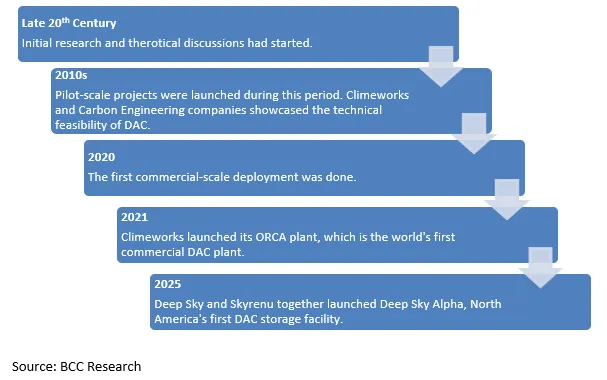
Tracing the Developments in DAC Technology
Major Growth Catalysts for DAC Adoption
The global push to adopt more sustainable and net-zero emission goals is leading to a wider adoption of DAC. This method of removing CO2 is expected to emerge as a significant tool to achieve the aim of decarbonization, thus helping governments and industries to achieve their CO2 removal aims. This is expected to be achieved through the following measures:
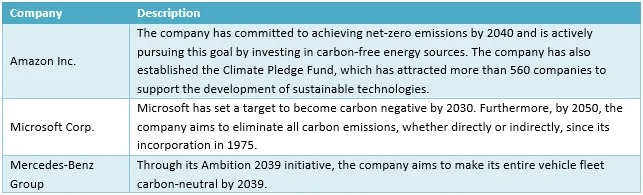
Corporate Decarbonization Pledges and Voluntary Carbon Ecosystem: Many companies are setting strong internal net-zero goals, driving demand for high-quality carbon removal credits. Microsoft Corp., Amazon Inc., Mercedes-Benz Group, for instance have set net-zero emission targets and aim to achieve them within the next one to two decades. DAC provides a permanent and verifiable method to remove CO₂, thus making it a preferred choice in the voluntary carbon system for companies seeking to credibly offset unavoidable emissions.
Net-Zero Emission Targets and Climate Imperatives: Many countries, including the U.S., Japan, the EU, South Korea, and other developing and developed countries, have set goals to achieve net-zero emissions by mid-century. The Intergovernmental Panel on Climate Change (IPCC) focusing on DAC, along with on aggressive emissions reductions, is helping to achieve these targets and limit global warming to 1.5°C, especially for addressing hard-to-abate sectors and legacy emissions.
The following table represents the key companies' targets:
Growing Policy Support and Incentives: Governments are now increasingly preferring DAC by introducing policies such as the U.S. 45Q tax credit, which provides strong incentives for Carbon Capture, Utilization, and Storage (CCUS). In December 2024, the U.S. Department of Energy introduced $1.8 billion Regional DAC Hubs Program, with the aim of scaling and commercializing DAC.
Increasing Availability of Renewable Energy: DAC is an energy-intensive process. Global proliferation and declining costs of renewable energy (solar, wind and geothermal) are making it economically and environmentally feasible to power DAC plants with clean electricity and heat. This enables the entire CO₂ removal process to achieve true carbon negativity.
Demand for Carbon-Negative Products and CO₂ Utilization: Captured CO₂ can be utilized to create carbon-negative products such as synthetic fuels, sustainable aviation fuels (SAF) and building materials, or chemicals. This creates additional revenue streams for DAC projects, enhancing their economic viability by linking CO₂ removal with sustainable industrial processes.
Key Barriers to DAC Commercialization
DAC promises strong growth opportunities due to increasing focus on CO2 removal policies. However, its wider adoption is hindered by factors such as high operational cost, scalability issues, and other such factors as discussed below, overcoming which is necessary for its seamless adoption:
High Capital and Operating Costs: Currently, DAC remains an expensive technology, with costs per ton of CO₂ significantly higher than many other mitigation strategies. The high upfront capital expenditure for plant construction and the ongoing operational costs (including energy and sorbent replacement) pose a major barrier to widespread deployment of DAC. For instance, the World Resources Institute stated that the cost of DAC can range from $100 to $2,000 per ton of CO₂, with an average cost of $490 per ton of CO₂, which can be expensive for many organizations. Furthermore, additional operational charges can further increase this cost, making it impossible, especially for smaller organizations, to invest in this technology.
High Energy Consumption: DAC processes require substantial amounts of thermal and electrical energy to extract CO₂ and sorbent regeneration. Although pairing with renewable energy sources can reduce the environmental impact, the overall energy intensity of DAC can still be a constraint. This is especially true in regions with limited renewable energy infrastructure or competing demands for clean energy.
Barriers to Large-Scale Deployment of DAC: Scaling DAC poses various challenges, including cost, land and infrastructure challenges. Large DAC plants require extensive land area and other infrastructure, including pipelines and storage sites, which can be an issue in many regions due to a lack of connectivity and resources. Moreover, being a novel technology, users are also worried about factors such as safety, effectiveness and energy use, making it essential to have clear communication and community engagement.
Major Company Initiatives Driving DAC Scale-Up and Innovation
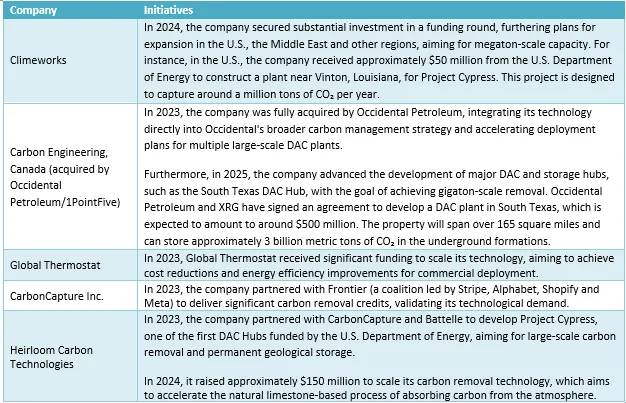
Source: BCC Research
Future Outlook: The Path Ahead for DAC
DAC technology is poised for exponential growth, reflecting its crucial role in future climate strategies. The adoption of DAC is anticipated to unfold in several distinct phases. The current phase (2020s) is characterized by pilot projects, early commercial deployments and a strong emphasis on technology validation and cost reduction. For instance, in May 2025, Mission Zero Technologies launched the world’s first DAC plant, which will be directly integrated into the production of building materials. The plant, located in Norfolk, U.K., will capture around 250 tons of CO₂ from the atmosphere. This captured CO₂ will then be used for manufacturing sustainable and carbon-negative aggregate for use in tiles, bricks and other such products.
As DAC technologies advance and become more cost-effective, it is expected to enter a rapid expansion phase (2025–2035). During this period, industry experts anticipate the development of larger, multi-megaton DAC plants, often co-located with dedicated renewable energy sources and integrated into industrial carbon capture and storage (CCS) hubs. In May 2024, Cliemworks commenced operations at its Mammoth plant in Iceland, situated at the Hellisheioi geothermal power plant. The property has the capacity to capture around 36,000 tons of carbon once it starts operating on a full scale. This plant is currently operating at 90% of its capacity and is expected to reach full capacity in the future. This plant showcases around a tenfold increase compared to Cliemworks’ previous Orca plant. Governments will likely expand policy support, moving beyond initial tax credits to broaden the adoption mechanisms and mandates.
By 2035–2040 and beyond, DAC is projected to reach the gigatons scale, becoming an indispensable tool for achieving global net-zero targets and actively drawing down historical CO₂ emissions. This long-term success is based on sustained technological breakthroughs, particularly in significantly reducing energy demands and capital expenditures, alongside the robust development of CO₂ transport and permanent geological storage infrastructure. Furthermore, gaining public acceptance and establishing clear societal frameworks for managing CO₂ as either a valuable resource or a permanent waste stream will be paramount for its widespread adoption.