

AI-Powered Driver Monitoring Systems: The Future of Road Safety
Clear insight into competitor positioning and market share.
Source: BCC Research
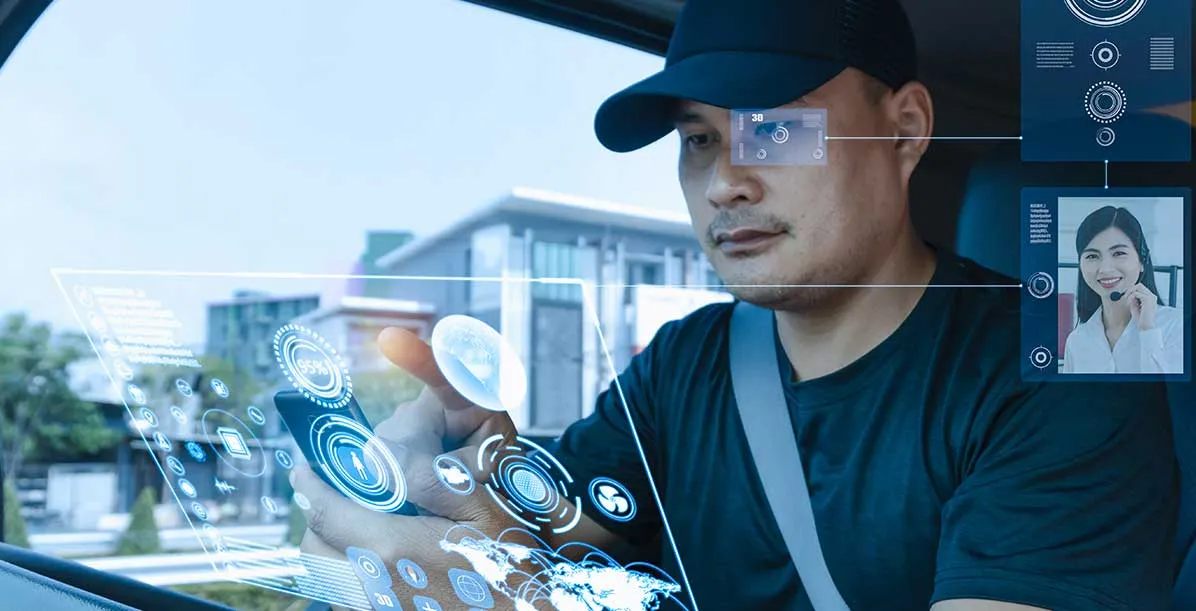
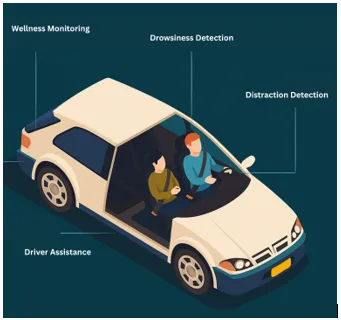
In this evolution, DMS uses cameras, sensors and AI to detect driver attention and drowsiness, as well as measure cognitive load. Increasingly, it is becoming a regulatory requirement, with legislation such as the European Union’s General Safety Regulation (GSR), which will take effect in 2026, mandating the inclusion of drowsiness and attention warning systems in all new cars. As semi-autonomous driving features continue to expand, DMS plays a crucial role in providing a vital link between human drivers and automatic systems, ensuring a secure and seamless transfer of control.
Regulatory Snapshot for DMS in the EU, China and the U.S., 2025
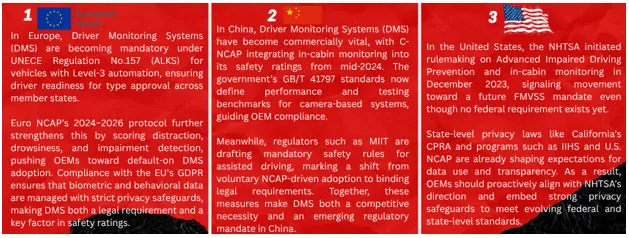
Source: Euro NCAP — Safe Driving / Driver Engagement protocol, NHTSA — ANPRM and 2024 Report, China GB/T standards (GB/T 41796/41797, C-NCAP / China NCAP updates
Evolution of DMS
DMSs have evolved far beyond their early beginnings, following the automotive industry’s shift toward software-defined vehicles. Continuous software updates now enhance DMS performance, expand functionality and ensure compliance with evolving safety regulations.
- The First Generation DMS (Pre-2010) was focused on basic alertness detection via steering wheel inputs or lane departure patterns. However, these systems were not accurate and were often prone to false alarms.
- The Second Generation DMS (2010–2020) was based on eye-tracking systems, which became mainstream. It used infrared cameras to monitor eyelid closure, head orientation and the direction of gaze.
- The Third Generation DMS (2020–Present) integrated AI and deep learning models to predict real-time behavior, distraction, microsleep and cognitive load. DMS also communicates with Advanced Driver Assistance Systems (ADAS) and semi-autonomous technologies, ensuring seamless control and safer vehicle interaction.
Key Drivers Accelerating Adoption
Several factors are propelling the widespread adoption of DMS, which include:
- Regulatory Push: Governments worldwide are driving the adoption of DMS with strict regulations. In the EU, the GSR mandates the inclusion of driver drowsiness and attention warning systems in all new cars by 2026. The U.S. National Highway Traffic Safety Administration (NHTSA) is moving forward with comparable rules under the Infrastructure Investment and Jobs Act, focusing on distraction and fatigue in semi-automated driving. Across Asia, national initiatives such as Japan’s Ministry of Land, Infrastructure, Transport and Tourism (MLIT) mandate fatigue detection in commercial and heavy-duty vehicles as part of broader national road safety strategies.
- Growing Road Fatalities: Road traffic injuries continue to be one of the major causes of death globally, especially among children and young adults aged 5–29, with nearly 1.2 million fatalities each year, according to the WHO. This data reveals a disturbing trend, highlighting the urgent need for advanced safety technologies like DMS. Rising accident rates are driving OEMs and fleet operators to adopt prevention-oriented strategies that enhance driver vigilance and reduce human error.
- Insurance incentives: These are promoting the adoption of DMS by rewarding safer driving behavior. Through driver attention tracking, drowsiness detection and real-time alerts, DMS minimizes accidents. Fewer accidents lead to reduced insurance claims, enabling insurers to provide premium discounts for DMS-equipped vehicles, generating an economic incentive and a safer driving community.
- The rise of semi-autonomous vehicles: The rise of such vehicles is driving the adoption of DMS further. Level 2 and Level 3 automated vehicles require drivers to stay engaged during automated phases. Regulations such as the U.S. NHTSA Automated Driving Systems guidance and the EU-GSR mandate driver attention monitoring and timely alerts when human intervention is needed, making DMS a key safety enabler in assisted and automated driving.
- Corporate fleet management: DMS helps reduce accidents, downtime and risky driving by monitoring fatigue, distraction and driver behavior in real time. This improves safety, reduces insurance and operational costs and enhances fuel efficiency, making DMS an investment for logistics, ride-hailing and public transport fleets and accelerating the adoption of DMS across fleet operations.
Technological Developments in DMS
Modern DMSs are more than simple face tracking tools; these are now AI-powered, multimodal platforms that integrate advanced sensors, analytics, and connectivity to present real-time, predictive safety interventions.
- Infrared and 3D cameras allow for monitoring in low-light conditions while minimizing driver distraction. For instance, Smart Eye uses infrared-based eye-tracking to detect drowsiness across different lighting environments.
- AI and machine learning (ML) models provide more accurate detection of fatigue, distraction and intoxication through behavioral cues. Seeing machines leverage deep learning to predict microsleep and driver distraction in real time.
- Multimodal sensor fusion combines camera data with steering input, heart rate sensors and voice analysis to deliver more reliable insights by cross-verifying behavior and physiological cues, thereby reducing false positives. Hyundai, for example, has explored in-cabin health monitoring using sensor fusion to enhance both safety and wellness.
- Over-the-air (OTA) updates, fleet-wide analytics and predictive maintenance are supported by cloud connectivity. Tesla, for instance, continuously improves driver monitoring through OTA software updates.
- Edge processing performs onboard computation to provide real-time responses with low latency, which is important for safety-critical functions. NVIDIA’s DRIVE platform supports real-time AI-powered driver monitoring decisions within the vehicle.
Growth Areas in DMS
The adoption of DMS is rapidly expanding beyond luxury vehicles and is becoming increasingly important across various segments of the automotive ecosystem. This growth is driven by regulatory mandates, declining hardware costs and increasing safety priorities.
- Adoption in mass-market passenger cars is rising as regulations make DMS mandatory and hardware becomes more affordable.
- DMS in commercial fleets helps reduce accidents, insurance claims and downtime caused by driver fatigue.
- Shared mobility and ride-hailing systems ensure driver alertness and enhance passenger safety.
- DMS in heavy-duty vehicles and buses prevents fatigue-related incidents in long-haul and public transport operations.
Future Outlook
The next three to five years will see DMS evolve into a standard feature across most vehicles, with AI, analytics and cloud platforms shifting their role from reactive alerts to predictive accident prevention.
- With higher automation (Levels 3–4), where the system can handle driving but still requires human fallback, DMS becomes critical for safe handovers between autonomous systems and drivers.
- DMS integration with in-cabin systems can adjust climate control, infotainment and seating to reduce fatigue and improve comfort, creating a safer and more personalized driving environment.
- Automakers may offer subscription-based safety add-ons or wellness features (e.g., fatigue-management tips), leveraging behavioral insights for recurring revenue.
- As DMS collects biometric and behavioral data, protecting this information from breaches is vital to maintain consumer trust and comply with privacy regulations.
Strategic Takeaways for Industry Leaders
For OEMs, Tier-1 suppliers, and tech companies, DMSs are no longer just a compliance requirement but a strategic differentiator that enhances safety, innovation and brand value. Investing in AI and ML helps reduce false positives while accurately detecting drowsiness, distraction, or intoxication with high precision.
Need deeper insight for your specific market?
BCC Research can tailor custom research by region, application, technology segment, competitor set, customer group, or investment priority.
Discuss a Custom Research Need