

Edible Sensors and Smart Pills
Expert guidance to accelerate your market and strategy decisions.
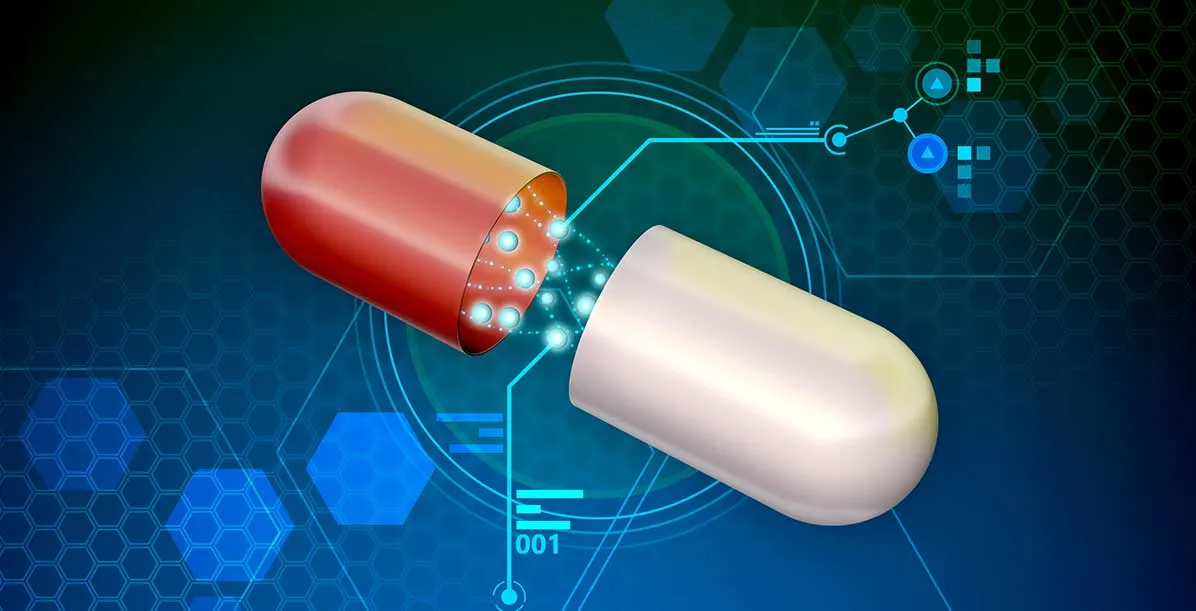
Edible Sensors and Smart Pills: Revolution in Digital Healthcare Diagnostics
The edible sensors and smart pills market includes retractable event markers, capsule endoscopy systems, and biosensing capsules. These devices, ranging from the FDA-approved digital pills (Abilify MyCite) to camera capsules (Medtronic's PillCam), capture real-time physiological and biochemical information from the gastrointestinal tract, enabling precision medicine, early disease detection and better treatment adherence. Factors projected to spur growth in the edible sensors and smart pills market include the rising incidence of gastrointestinal diseases, the global trend toward remote patient monitoring at home, and the growing trend of collaborations between pharmaceutical companies and medical technology companies that develop smart drugs.
Smart pills or edible sensors are electronic devices that can be swallowed to collect data from within the body, monitor health and deliver targeted therapeutics. They contain small sensors, microchips, or cameras that measure factors such as temperature, pH, and pressure or take pictures of the digestive tract. They are used in healthcare for applications such as imaging, adherence monitoring and gastrointestinal monitoring by relaying data wirelessly to external devices for real-time analysis. Edible sensors and smart pills offer a noninvasive and accurate means of monitoring internal health, and as such, are poised to disrupt the personalized medicine and digital healthcare space.
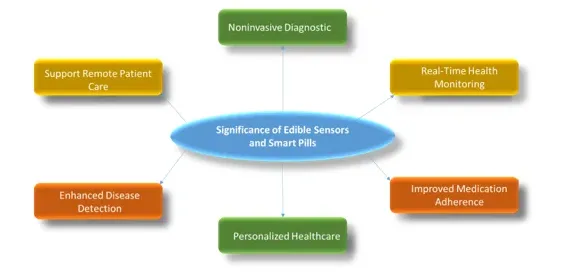
Source: BCC Research
How Smart Pills Work?

Source: BCC Research
Transformative Shifts
Miniaturization and Technological Advancements
The latest advancements have led to the development of ingestible sensors and smart pills that are significantly smaller and more efficient than their predecessors. These devices typically incorporate microchips, sensors and wireless communication capabilities, allowing for continuous and near real-time monitoring of physiological parameters, such as pH, temperature and drug delivery, in the gastrointestinal (GI) tract. Miniaturization is now possible due to advances in microelectronics and materials science, which enable the integration of even more complex functionalities into smart pills without compromising pill size. Ongoing advancements in the smart pill space are expected to yield improved, novel, more effective and user-friendly smart pill devices. Therefore, miniaturization and technological advancements are expected to support market growth in the future.
Integration of Artificial Intelligence (AI) with Personalized Medicine
The combination of AI with swallowable sensors is transforming personalized medicine. AI algorithms can analyze data from smart pills to provide insights into patient health, enabling the development of individualized treatment plans. This functionality includes the opportunity for real-time monitoring of patient therapies and the ability to make adjustments as needed, resulting in improved patient outcomes and increased efficacy of medications. Predictive analytics, based on AI algorithms, can identify patient health risks before they become acute issues, providing timely care and preventive interventions. As AI technology becomes more sophisticated, its adoption in swallowable sensor systems is expected to become more common and impactful, providing enhanced individualized healthcare experiences. Thus, integration of AI with personalized medicine is anticipated to boost market growth.
Recent Developments
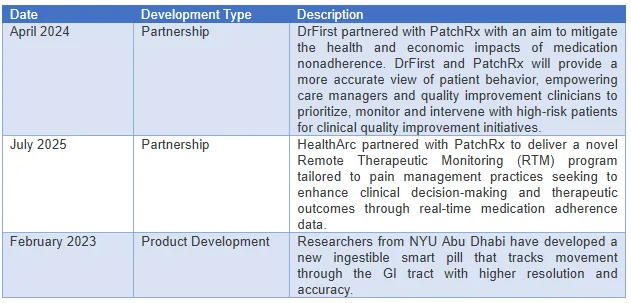
Source: Company Websites
Acceleration in the Adoption of Edible Sensors and Smart Pills
Rising Prevalence of Chronic Diseases
The increasing rate of diabetes, circulatory conditions, and gastrointestinal conditions is a key driver of the growth in demand for smart pill technologies. According to the International Diabetes Federation's (IDF) Diabetes Atlas (2025), approximately one in nine adults is living with diabetes. The prevalence of diabetes is expected to rise to approximately 853 million people, a 46% increase, by the end of 2050. As an advancement in clinical technology, edible sensors can be used for real-time monitoring of physiological parameters, scientific documentation of biological markers, and timely interventions for chronic diseases or the management of sudden acute illnesses. Thus, the increasing prevalence of chronic diseases is driving the market's growth.
Enhanced Medication Adherence
Medication nonadherence is a significant issue facing the healthcare sector, which can exacerbate an individual's health condition, lead to hospitalization, or increase healthcare system costs. Smart pills with ingestible sensors completely change the equation of nonadherence by enabling medication intake tracking and sending that information to a physician or caregiver. Also, introducing adherence monitoring can strengthen the interest of pharmaceutical companies in adopting smart pills, for purposes such as providing additional data in the clinical trial setting, identifying ways to prevent adverse drug reactions and enhance drug efficacy, and fostering continued trust and engagement with patients who use them.
Integration With Digital Health Ecosystem
Edible sensors and smart pills are being incorporated into general digital health ecosystems as well as mobile applications, cloud-based platforms and wearable devices. These systems enhance real-time monitoring, data visualization, and personalized insights, enabling patients and healthcare providers to deliver improved patient care. Thus, the integration of edible sensors and smart pills with digital health ecosystems is boosting market growth.
Future Outlook
The adoption rate of edible sensors and smart pills is expected to increase due to advancements in sensor technology, the growing prevalence of chronic diseases and a shift toward personalized, noninvasive healthcare. These devices are projected to extend beyond gastrointestinal monitoring to include cardiology, oncology and chronic disease management, while also facilitating integration with digital health platforms for real-time data sharing and remote patient monitoring. Emerging markets are also expected to witness the rapid adoption of edible sensors and smart pills for real-time monitoring of physiological parameters.
Strategic Takeaways for Industry Leaders
Edible sensors and smart pills are used for real-time monitoring of physiological parameters, enabling timely interventions for chronic diseases or the management of sudden acute illnesses. Industry leaders should prioritize sustained R&D to improve sensor accuracy, multifunctionality and battery longevity, and investigate other applications beyond gastrointestinal monitoring, including cardiology, oncology and chronic disease management. AI analytics and cloud systems are expected to enable real-time patient monitoring and personalized care. In this rapidly evolving healthcare technology landscape, complying with the regulatory environment, adopting a purpose-driven approach to expand into emerging markets, and educating patients and providers to foster trust are predicted to facilitate adoption and ensure product performance on health-related parameters.
Conclusion
The edible sensors and smart pills market is expected to experience robust growth due to innovation and development, increasing rates of chronic diseases, an aging population and a rise in demand for patient-centered, noninvasive healthcare technologies. These devices facilitate real-time monitoring, medication adherence and seamlessly integrate with digital health capabilities, thus becoming an indispensable part of the future of healthcare. Coupled with advancing R&D, a favorable regulatory landscape and increasing use cases across a range of therapeutic areas, the edible sensors and smart pills market is anticipated to enhance patient care, improve clinical outcomes and provide significant opportunities to healthcare providers, technology companies and pharmaceutical organizations.
Need deeper insight for your specific market?
BCC Research can tailor custom research by region, application, technology segment, competitor set, customer group, or investment priority.
Discuss a Custom Research Need