The retina is a small light-sensitive layer located at the back of the eye that helps the brain create vision by converting light into impulses. When cells or genes in the retina are destroyed, it can lead to visual difficulties or blindness. Some common inherited eye disorders that damage the retina include retinitis pigmentosa (RP), Leber congenital amaurosis (LCA), Stargardt disease, inherited retinal diseases (IRDs) and diabetic retinopathy (DR). According to the IABP Vision Atlas, over 1 billion individuals worldwide suffer from sight loss, with the majority still having no permanent solution.
Gene therapy is leading to breakthroughs in saving and restoring vision for people with retinal diseases by manipulating the genes to treat underlying diseases. Genetic material is introduced into a patient’s cell that restores the production of a protein that may be faulty due to the patient’s DNA. It utilizes harmless viruses, known as vectors, to transfer the repaired genes into a patient's cells. The adeno-associated virus (AAV) serves as the leading vector for delivering eye treatments, which have achieved the highest success rates. Three main types of gene therapy exist for medical applications.
- Gene Augmentation in Retinal Diseases: This introduces a new gene into cells to replace nonfunctional or absent genes. For example, Luxterna serves as a treatment for LCA, which affects infants and children. (This rare disease is a result of a variety of gene mutations.) Gene therapy allows the addition of a normal RPE65 gene that restores the visual cycle in patients.
- Gene Editing in Retinal Diseases: This involves revising the existing genetic code in a patient’s cell. (Phase II clinical trial- QR-110 sponsored by ProQR Therapeutics).
- Gene Inactivation in Retinal Diseases: This therapy works toward silencing a faulty gene. (Ongoing clinical trial - AAV Gene Therapy in Patients with CNGB3 Achromatopsia sponsored by Beacon Therapeutics)
Evolution and Current Market Adoption
The (voretigene neparvovec-rzyl) was launched by Spark Therapeutics in 2017 as the first treatment for biallelic RPE65 mutant IRD. The first approved gene therapy application occurred in ophthalmology through the U.S. FDA clearance of Luxturna. Luxturna was approved as the single gene therapy available for treating hereditary retinal diseases. The treatment expense amounts to $425,000 per eye, and patients need to pay $850,000 when they require treatment for both eyes. In 2024, UPMC Vision Institute performed the first clinical usage of Luxturna in a patient, indicating real-world growth into further clinical centers.
Almost a decade ago, to treat some of the most prevalent causes of irreversible blindness as caused in diseases like wet macular degeneration and diabetic retinopathy, monthly injections of anti-VEGF therapies were given. Now, with the advent of gene therapies, it is a potential option to treat such diseases by administering one-time gene therapy, in which the retina can produce its own lifelong medication within the eye. This will significantly reduce the treatment burden of patients in other therapies. The process of producing one’s own medication by one-time intravitreal injection or subcorneal injection of gene therapy is known as the Biofactory approach. In addition, more than 30 novel gene therapies are being researched globally to treat inherited retinal diseases (IRDs). For example, Sanofi's gene therapy candidate, SAR446597, a one-time intravitreal gene therapy, is presently undergoing Phase 1/2 trials for wet AMD. It received Fast Track designation from the FDA in July 2025. It may shift the treatment paradigm in retina from repeated injections (anti-VEGF, complement inhibitors) toward one-time or limited-time interventions.
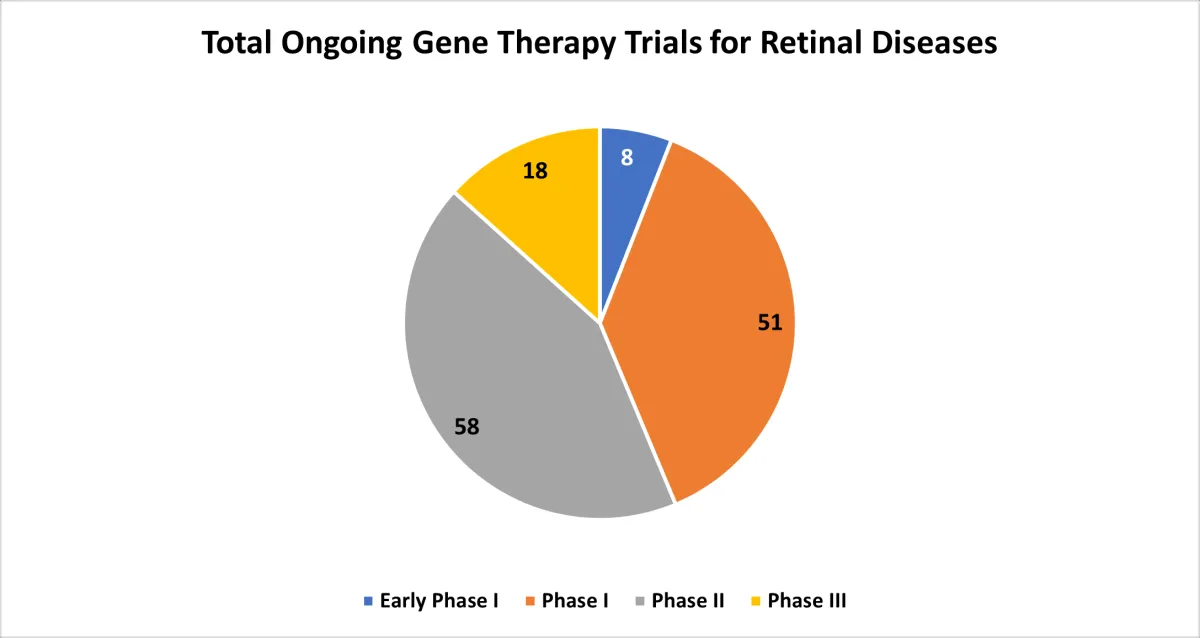
Clinical Research by Phase of Study:
Key Companies:
|
Company
|
Description
|
|
Spark
Therapeutics (Subsidiary of Hoffmann-La Roche)
|
Luxturna
(RPE65 gene therapy)
Spark joined forces with SpliceBio in October 2023 to create a gene therapy
for a genetic retinal disorder. Spark will utilize SpliceBio's technology
platform as part of the research partnership, and Spark will have the
exclusive global right to create, produce and market the resulting gene
therapy.
|
|
REGENXBIO
and AbbVie
|
ABBV-RGX-314
(in Phase 2/3 Clinical trial)
AAV8
gene therapy is used for wet age-related macular degeneration (wet AMD) and
diabetic Retinopathy. It utilizes the NAV AAV8 vector platform, enabling
one-time subretinal or suprachoroidal administration.
The Phase 3 clinical trial of ABBV-RGX-314 for diabetic retinopathy (DR) is
currently being run by AbbVie and REGENXBIO. The organizations will share
results from their ongoing studies about ABBV-RGX-314 subretinal delivery in
wet AMD patients during 2026.
|
|
Ocugen
Inc.
|
Novel modifier
gene therapy for retinitis pigmentosa RP, (OCU400) – currently in Phase 3
trial.
Ocugen has initiated a Phase 3 clinical
trial for its gene-agnostic modifier treatment to treat RP. The study will
have 150 participants spread across 15 venues in the U.S.
The
company Ocugen established a partnership with Kwangdong Pharmaceutical in
September 2025 to obtain exclusive rights for the distribution and promotion of
OCU400 gene therapy in South Korea for retinitis pigmentosa treatment.
|
|
Beacon
Therapeutics
|
AGTC-501
(laru-zova; AAV-based gene therapy for X-linked retinitis pigmentosa (XLRP)),
currently in Phase 2/3 VISTA trial.
Precision
AAV delivery expressing full-length RPGR to restore rod and cone function,
building a differentiated retinal gene therapy platform.
In Q2 2024, Beacon entered a long-term manufacturing partnership with Ascend
for clinical and commercial AAV production and a non-exclusive agreement with
Abeona Therapeutics to evaluate the AAV204 capsid for
ophthalmology indications.
|
|
PYC
Therapeutics
|
VP-001
(RNA therapy for RP11)
RNA-based
medication VP-001 for treating retinitis pigmentosa type 11 (RP11).
The
company achieved positive results with its investigational RNA therapy VP-001,
which targets retinitis pigmentosa type 11, during two Phase 1/2 clinical
trials conducted in the U.S. and Australia in May 2025. The company commenced
Phase 3 clinical testing of VP-001 during the last months of 2025.
|
Future Outlook
- REGENXBIO and AbbVie are continuing to develop RGX-314, a next-generation AAV-based gene therapy for treating wet AMD and other retinal diseases. The program demonstrates advanced ocular gene delivery capabilities because researchers expect pivotal trial results in 2026, followed by commercial availability in 2027.
- Multiple Phase 2/3 and registrational trials have produced encouraging preliminary results, which demonstrate the real clinical progress in this field.
- The field advances through partnerships, investment agreements and regulatory fast-track designations, which drive new developments. These strategic business developments demonstrate an ongoing long-term commitment from the biopharma industry and investors.
- The collaboration between Verana Health and Nanoscope Therapeutics uses large de-identified real-world datasets to speed up retinitis pigmentosa research. It will also speed patient enrolment, trial design and early steps toward commercialization.
Conclusion:
Gene therapy for retinal diseases provides patients with the opportunity to regain their vision through single-dose or extended-duration treatments. The upcoming decade will bring improved accessibility of these treatments worldwide through advancements in safer delivery systems, enhanced manufacturing techniques and payment system innovations. The path to progress in this field faces multiple actual obstacles, which include vector production scale-up, immune system management, regulatory authorization and extended treatment success verification. The ongoing Luxturna clinical trials show that patients experience side effects, such as inflammation and cataract formation, and elevated eye pressure that requires continuous patient supervision. The implementation of these treatments encounters three primary challenges: inadequate testing facilities, high costs and limited genetic screening options. The field advances due to powerful clinical development pipelines, increased funding and adaptable regulatory frameworks.