

Shaping New Era of Data Storage: Holographic Data Storage
In-depth market intelligence to support growth and planning.

One new development in the field of high-capacity data storage is holographic data storage. Holographic storage encodes information across the entire volume of a recording medium. In contrast, optical and magnetic storage devices store individual bits as distinct optical or magnetic modifications on the medium's surface. By using light at different angles, this method enables the storage of multiple data.
Traditional optical and magnetic storage systems record data sequentially, one bit at a time; holographic storage facilitates the simultaneous recording and retrieval of millions of bits in parallel. This capability markedly improves data transfer rates, exceeding those attainable with conventional optical and magnetic storage technologies.
Evolution: From Concept to Market
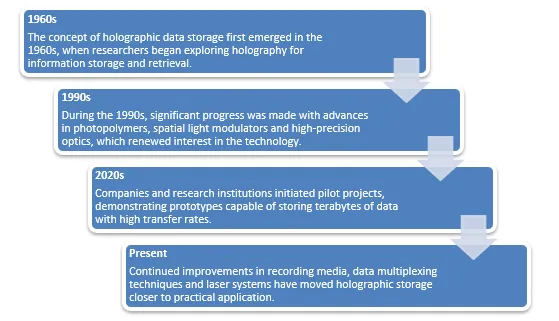
Holographic data storage has experienced a prolonged and gradual evolution from its initial conception to its present state of near-commercial viability. Initially proposed in the 1960s, preliminary research indicated the theoretical viability of volumetric information storage via holography; however, practical application was hindered by technological constraints. The resurgence of interest in the 1990s, bolstered by governmental and industrial initiatives like the HDSS program, alongside advancements in photopolymers and optical systems, made the technology more viable. During the 2000s, InPhase and Aprilis demonstrated prototypes exhibiting high-capacity storage capabilities, but obstacles concerning cost, material stability and system complexity impeded widespread adoption. During the 2010s, advancements took place in recording media, multiplexing techniques and system architectures, accompanied by renewed industry interest in cloud and archival applications. Currently, ongoing advances are establishing
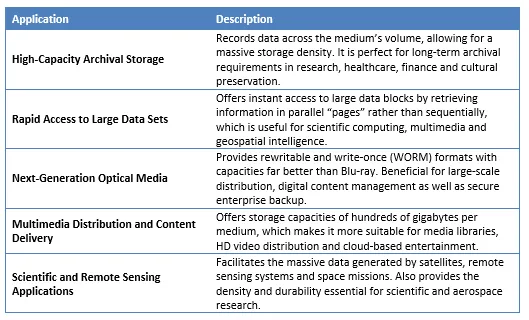
Major Application of Holographic Data Storage
Key Challenges in the Adoption of Holographic Data Storage
Material Stability and Environmental Sensitivity: Holographic media, such as photopolymers and photorefractive crystals, can degrade over time due to shrinkage, dark decay and sensitivity to temperature or humidity. For instance, in 2019, a research paper on photopolymer holography was published in the Asian Journal of Physics. It indicated that write-once photopolymers may shrink during or after exposure. This can cause loss of diffraction efficiency and misalignment of multiplexed holograms.
High End-to-End Cost and Energy Requirements: Although holographic storage promises very high density, the cost per TB and overall energy cost (for read/write, media maintenance, error correction, refreshing, etc.) remain significantly higher than more mature storage methods. For example, in December 2024, Microsoft published an article titled “Holographic Storage for the Cloud,” which states that to be competitive without compromising the data density, the energy efficiency must be increased by one to two orders of magnitude.
Current Scenario and Industry Engagements
Holographic and volumetric optical storage technologies are still in an early, pre-commercial phase, with efforts primarily occurring in research laboratories, hyperscale cloud providers and a select few specialized startups such as HoloMem. Although the concept has been explored for decades, recent advancements in materials science, photopolymers and collinear holography are facilitating renewed experimentation and pilot demonstrations. For instance, in August 2025, researchers reported a significant improvement in photopolymer materials used for holographic storage. These materials can be obtained by doping poly (methyl methacrylate) (PMMA) with phenanthrenequinone (PQ). This results in a 5.5-fold increase in photosensitivity, over half ton percent improvement in diffraction efficiency and four times reduction in volume shrinkage. This further enhances the data storage capabilities.
Key Industry Participation Can Be Shown on Multiple Levels:
Holographic data storage is gaining traction as a potential next-generation technology that can meet the increasing need for high-density, durable and long-term data archival solutions. Key industry and research stakeholders are actively advancing the field, from hyperscale cloud providers to startups and academic institutions, each contributing to technical innovation and practical deployment strategies.
Hyperscale Cloud Providers: In late 2019, Microsoft first unveiled the concept of testing its Project Silica. This project is a prime example of how hyperscale cloud providers are at the forefront of holographic storage. The project exhibits remarkable durability by utilizing media based on quartz and glass, which can withstand harsh environmental conditions. The project has advanced from lab prototypes to integration studies for cloud archival workflows, emphasizing the potential for enterprise adoption and long-term scalability.
Startups and Emerging Players: In July 2025, U.K.-based startup HoloMem introduced a ribbon-based multi-layer holographic storage system. Such a system has a life span of more than 50 years. The system utilizes off-the-shelf, low-cost components that integrate seamlessly into existing LTO tape libraries. This enables higher capacity and cost-effective upgrades. Along with that, the system can function flawlessly with LTO workflows, which require no software changes or operational disruptions. Startups like these are still in the pilot-testing phase, but their potential for cold storage applications has drawn media attention and R&D funding. They are early-market innovators because of their efforts to increase write/read efficiency, media longevity and cost-effective scaling.
Academic and Technical Research: Academic institutions and technical research centers continue to drive advances in holographic storage. Advancements in read/write optics, media stability and multiplexing are highlighted in publications in SPIE and Opto-Electronic Advances. To close technical gaps, improve data density, and make sure the technology remains feasible for enterprise-level deployments and next-generation storage systems, such research is essential.
Future Outlook: Adoption and Integration
As the technical obstacles progressively disappear and integration with cloud and archival systems accelerates, the future of holographic data storage appears bright. It is anticipated that adoption will progress from specialized pilot projects to focused enterprise implementation, especially in long-term archival and cold storage applications.
(1) Advanced Media and Materials: Quartz, photopolymer, and glass-based innovations are poised to become the focus of near-term growth by improving durability, longevity, and data retention under harsh conditions, thereby lowering maintenance and replacement costs.
(2) Read/Write Efficiency and Multiplexing: Advances in laser optics and holographic multiplexing methods will increase storage density and speed, making holographic storage more competitive with traditional tape or disk archives.
(3) Data centers with Low Energy Consumption: Holographic storage's passive, low-energy data retention properties meet sustainability goals and provide a way to reduce energy usage in enterprise and hyperscale cloud data centers.
(4) Pilot-to-Enterprise Integration: By showcasing scalable, dependable solutions, startups like HoloMem and Microsoft (Project Silica) are advancing the integration of holographic storage into current cloud workflows.
The creation of reproducible, scalable manufacturing processes with strong quality control and the creation of transparent environmental data via digital product passports and labeling are two essential factors that facilitate broad adoption. These steps will help both businesses and consumers to make well-informed decisions.
Conclusion
A promising approach to improving performance while minimizing environmental impact is holographic data storage. Material innovations, methodical process design and thorough lifecycle assessments will all be necessary for successful implementation. It will be critical for businesses to concentrate on uses where holographic storage can provide observable advantages, like decreased maintenance, energy savings, or increased durability, and to work with suppliers who share these values. Holographic data storage can move from experimental technology to a competitive advantage in the data management market with these tactics in place.