

Hospital Asset Management: Driving Efficiency, Safety and Digital Transformation in Healthcare
January 21, 2026
Expert guidance to accelerate your market and strategy decisions.

Hospital asset management is the efficient tracking, monitoring and managing of medical equipment, consumables and infrastructure through the use of technology, including radio frequency identification (RFID), real-time location systems (RTLS), Internet of Things (IoT) and cloud-based systems. It helps hospitals better utilize their assets, reduces equipment loss, provides access to timely maintenance and assists with patient safety. Utilizing real-time data to gain visibility into an asset's performance and location helps hospitals to streamline workflows, lower costs and meet healthcare compliance in a modern, data-driven and efficient healthcare system. Hospital asset management is a vital part of healthcare systems today.
The hospital asset management market is advancing as healthcare organizations are implementing digital technologies to enhance their operations, increase the use of resources and improve patient outcomes. Hospital asset management utilizes technologies such as RFID, RTLS, IoT sensors, analytics with AI and cloud-based platforms, allowing hospitals to track and manage their assets, including medical devices, consumables and staff in real time. These technologies have enabled hospitals to better mitigate equipment loss, reduce operational costs, improve the timeliness of equipment maintenance and maintain compliance with safety standards. Companies offering hospital asset management such as Securitas Healthcare LLC, Zebra Technologies, GE HealthCare Technologies Inc, CenTrak and Siemens Healthineers are all focused on developing platforms that can integrate visibility of assets, predictive maintenance and operational efficiencies, all in a cloud-connected world. All of these changes represent the evolution of hospital management in an operationally effective, transparent and smart management ecosystem.
Applications of Hospital Asset Management
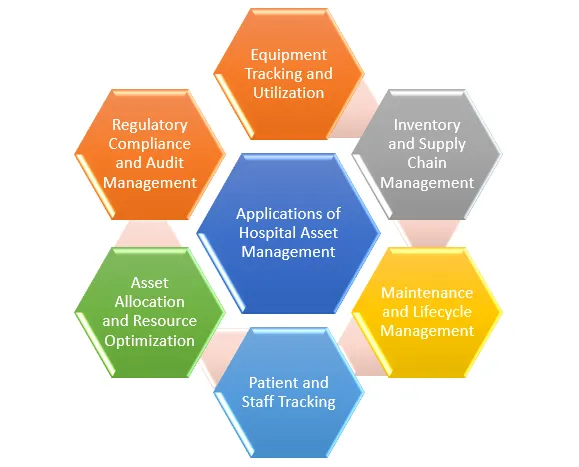
Source: BCC Research
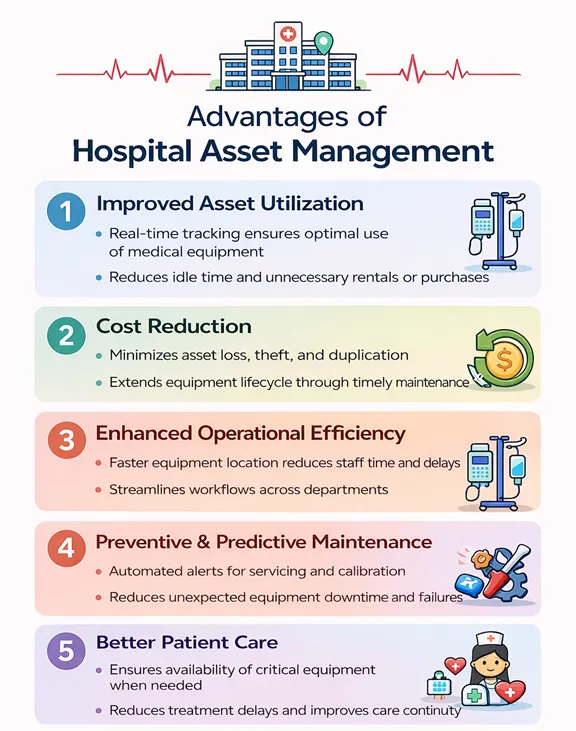
Source: Navigine
Need deeper insight for your specific market?
BCC Research can tailor custom research by region, application, technology segment, competitor set, customer group, or investment priority.
Discuss a Custom Research NeedNext-Generation Movements in Hospital Asset Management
IoT and RTLS for Smart Asset Tracking
The combination of IoT devices and RTLS is transforming hospital operations by providing real-time visibility into the location and status of assets, staff and patients. Hospitals can track assets continuously through RFID tags, Bluetooth low energy (BLE) beacons, and Ultra-Wideband (UWB) sensors. The operational efficiency gained by locating devices more quickly and ensuring critical equipment is readily available for use ultimately leads to better patient outcomes. Hospitals are utilizing RTLS (BLE, WiFi, UWB) and IoT to gain real-time visibility into the location and status of equipment and staff, ultimately minimizing the time wasted searching for those items and efficiently redeploying assets. One hospital has deployed an RTLS system for over 7,000 assets, achieving immediate results within three months. A case study from a hospital in Michigan, which focused on IV pumps, illustrates the enhanced visibility of assets that significantly improved inventory management and eliminated unnecessary costs by implementing RTLS at the hospital. Therefore, the integration of IoT and RTLS for smart asset tracking is anticipated to propel the market growth.
Predictive Maintenance through AI and Analytics
A significant trend impacting the market is the use of AI and predictive analytics for proactive equipment maintenance. Traditional maintenance models are reactive, responding only when equipment breakdowns. However, AI-based systems assess operational data in real time, recognize usage patterns, and predict potential equipment failures before they occur. This leads to lower downtime, longer lifespan of assets and greater efficiency in scheduling maintenance. For example, a predictive analytics solution integrated with hospital asset management software enables administrators to anticipate service needs for imaging systems, such as MRI machines or infusion pumps, thereby ensuring uninterrupted clinical workflows. The predictive approach can also help hospitals reduce total maintenance costs by avoiding costly emergency repairs, aligning with the overall shift toward data-driven hospital management. Hospitals are increasingly able to use sensor data, IoT devices and analytics/ML to predict when a device may fail, rather than waiting for breakdowns. Maintenance becomes more planned, downtime decreases, the lifetime of equipment extends and hospitals can save on high costs. A case study of an IoT-based predictive maintenance platform at a hospital containing 450 beds, resulted in a 35% reduction in maintenance costs and significant decreases in emergency repairs. Therefore, it is expected that AI and analytics will inform predictive maintenance, driving market growth.
Cloud-based Platforms and Multi-Site Integration
The emergence of cloud-based hospital asset management systems is changing how healthcare organizations manage resources across multiple locations. Cloud solutions provide a centralized dashboard with scalability, facilitating easier data integration with other systems within the hospital ecosystem, including electronic health records (EHRs) and supply chain management. This enables larger healthcare networks to remotely monitor and manage assets, gain unified visibility across multiple sites and standardize operations. As hospitals operate within the context of larger healthcare networks or multicampus systems, the need for scalable hospital asset management capabilities that can span sites, integrate with existing systems (including EHR, inventory and CMMS), and provide real-time dashboards is increasing. Cloud-based solutions provide central visibility, facilitate easier updates and reduce reliance on on-site infrastructure in some situations. While there are not as many specific case studies publicly detailed in this space as others, all vendor material and industry commentary support a focused momentum in the move from on-premises silos to the cloud, with IoT and analytics improving the hospital operations environment. A case in point is a vendor's promotional material on RTLS capability paired with analytics and centralized management capabilities, which allow hospital staff to focus more on patient care than on locating equipment. Therefore, cloud-based platforms and multi-site integration are expected to support.
The future of the hospital asset management market looks very good, inspired by the accelerated digital transformation of healthcare systems and the increased need for operational efficiency, cost efficiencies and patient safety. Emerging technologies, such as IoT, AI, predictive analytics and cloud-based RTLS platforms, are changing hospital asset management from simple tracking tools to intelligent, data-driven ecosystems that provide real-time visibility, predictive maintenance and workflow automation. The implementation of cloud-based multi-site management is rapidly expanding, enabling the integrated management of operations across hospital networks. Sustainability initiatives, outcome-based pricing models and growing regulatory focus on patient safety and audit readiness will also propel this market forward. Nevertheless, recognized challenges will persist or increase in the near term, including high implementation costs, implementation complexities and cybersecurity risks.
Strategic Takeaways for Industry Leaders
Stakeholders across the industry must actively invest in integrating AI, IoT and cloud-based analytics to drive operational efficiency and predictive maintenance, effectively evolving what were tracking systems into more intelligent asset optimization platforms. Organizations must focus on interoperability, data security and cyber protection while developing scalable, outcome-driven models to foster client loyalty and long-term value. Furthermore, emerging markets are witnessing an increase in adoption as providers innovate solutions aligned with sustainability goals that promote waste reduction and equipment lifecycle extension, giving them a competitive edge over both global and local competitors. It will also be crucial to position market leaders in a rapidly evolving digital healthcare ecosystem by highlighting ROI-driven results, such as cost reduction, and improvement in equipment use and patient safety.
Conclusion
The market for hospital asset management is on a growth trajectory due to the shift toward digitalized, efficient and data-driven healthcare functions. The intersection of IoT, AI and cloud technologies is transforming the landscape of asset management by enabling real-time monitoring, predictive maintenance and enhanced resource utilization across the healthcare system. Despite potential implementation challenges, including high costs and cybersecurity risks, the benefits of reducing operational waste, promoting patient safety and optimizing workflows will continue to outweigh the risks associated with implementation. As healthcare facilities continue to modernize, hospital asset management will evolve from an administrative function to one that enhances operational excellence, becoming an essential component of the smart, connected healthcare future.