

From Smart Signals to Self-Aware Networks: How Cognitive Radio is Shaping the AI-Native 6G Revolution
Clear insight into competitor positioning and market share.

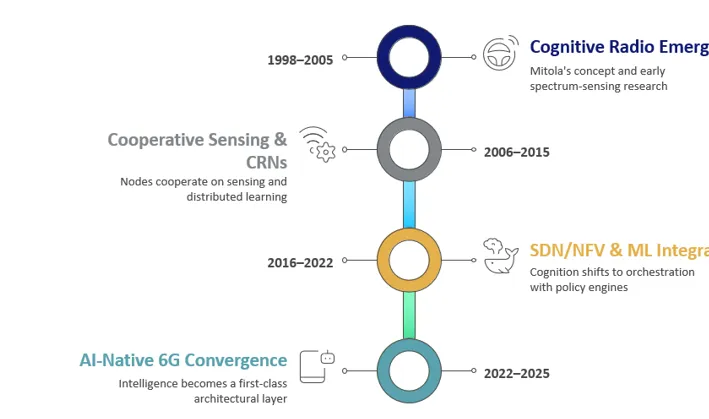
Evolution from Cognitive Radio to Cognitive Networks
- 1998–2005: Cognitive radio concept and early spectrum-sensing research (dynamic spectrum access, IEEE 802.22).
- 2006–2015: Cooperative sensing, distributed cognitive radio networks (CRNs) research, and early cross-layer management ideas.
- 2016–2022: Rise of SDN/NFV combined with machine learning (ML), cognition shifts from single radios to orchestration through policy engines, intent-based networking.
- 2022–2025: Convergence with AI-native networking and 6G research positions intelligence as a first-class architectural layer, including edge AI, knowledge planes and semantic/intent-based networking.
Key Trends in Cognitive Networks
- Edge intelligence and federated learning move AI processing closer to the data source, such as on-site, at base stations or in vehicles, rather than in remote clouds. Devices learn models locally and update global models with updates rather than raw data, enabling cooperation among devices. This approach decentralized data, protecting privacy and reducing latency. For example, in connected vehicle networks, vehicles run local driving trials to improve navigation or connectivity models without revealing private information. This allows for expedited, secure and more adaptable network intelligence.
- Dynamic spectrum sharing (DSS) allows several operators and users to jointly utilize available frequency bands by dynamically sensing the radio environment and reallocating unused spectrum. Using spectrum sensing and centralized databases, networks can automatically allocate idle channels, such as unused TV or public safety bands, to users in need. When the primary owner reclaims the spectrum, the system instantly vacates it without interference. This intelligent sharing ensures better coverage, especially in rural areas, delivering faster and more reliable connectivity for end users.
- Dynamic spectrum sharing allows networks to sense idle frequencies and query a spectrum database for available bands in real time. In rural broadband, for example, networks can sense when public safety and TV channels are not in use and borrow them to connect local businesses and farms. Upon the return of Primary User (PU), the band is automatically relinquished by the system for coexistence. This maximizes the spectral efficiency of secondary operations while ensuring interference-free service for end users.
- Cognitive networks serve as 6G’s fundamental architecture, incorporating core technologies such as reconfigurable intelligent surfaces (RIS) for intelligent signal steering, semantic communication to send useful data more intelligently, and terahertz bands for ultra-low-latency connections. For example, in a 6G smart city, cognitive controllers could dynamically control reconfigurable intelligent surfaces (RIS) panels and terahertz links to accommodate densely populated crowds during events, while maintaining smooth delivery of AR/VR and high-speed services. These technologies combine adaptive, efficient networks that maximize coverage, capacity and user experience on the fly.
Ongoing Developments and Challenges (Mid-2024 to 2025)
The Future Trajectory of Cognitive Networking Development
Figure 2
Design Principal and Objective of AI Native 6G
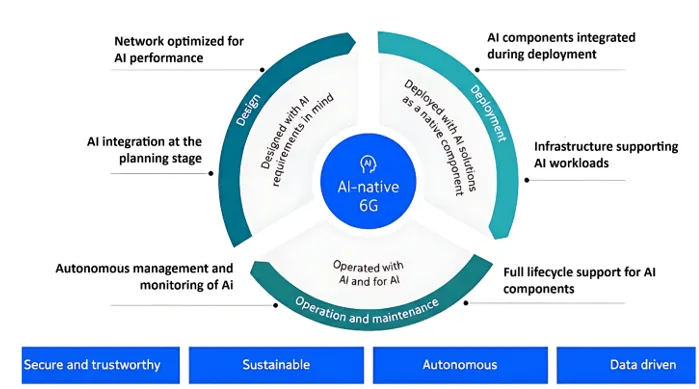
Source: Nokia Corp.
Cognitive networks are transforming from basic automation to smart, cooperative systems that drive future distributed intelligence. Below are the key points that will help understand the evolving future of networks, enabling automated decision-making and resource management.
- In the short term (2025–2028), networks will see selective deployment across verticals that value automation and low latency, such as industrial campuses, transport corridors and smart cities. Operators are anticipated to adopt AI controllers for monitoring, slice orchestration and predictive maintenance while standards and regulatory pilots continue to expand.
- During the medium term (2028–2032), cognitive functioning enters operator software offerings. Intent-based APIs, semantic policy and knowledge planes make it feasible for service developers outside of traditional operator relationships to ask for network action instead of modifying parameters. Spectrum sharing and dynamic licensing become ubiquitous.
- In the long term (2032 and beyond), networks become ecosystems of cooperation for cognitive agents, devices, edge nodes and policy realms, which negotiate near-real-time contracts for resources. The result is a highly resilient and efficient global framework that facilitates new generations of distributed intelligence, including real-time digital twins and large-scale networks of autonomous systems.
- AI efficiency advantages, positive regulations for dynamic spectrum, and robust vertical use cases will continue to be growth drivers. Systemic risk is chief among key risks if security, explainability and global governance aren’t resolved.
Growth will be fueled by AI-driven efficiency, supportive spectrum regulation and proven vertical ROI, though unresolved issues in security, explainability and governance pose systemic risks.
Conclusion
Cognitive networks are revolutionizing wireless communication from basic rule-based systems to intelligent, AI-powered ecosystems. With the integration of edge AI, dynamic spectrum management, and sophisticated hardware such as RIS and terahertz links, these networks can learn and adjust in real-time, enhance efficiency and enable new applications, including smart cities, autonomous cars and industrial automation. For industry leaders, the watchword is to treat cognition as a strategic architectural transition, starting with vertical pilots that yield evident ROI, investing in explainable and secure models of AI, and maintaining robust data governance and interoperability. This is the way networks will become more resilient, efficient and ready for the future in the age of 6G.