

In-Orbit Data Center: Future of Cloud Storage
Clear insight into competitor positioning and market share.
Introduction
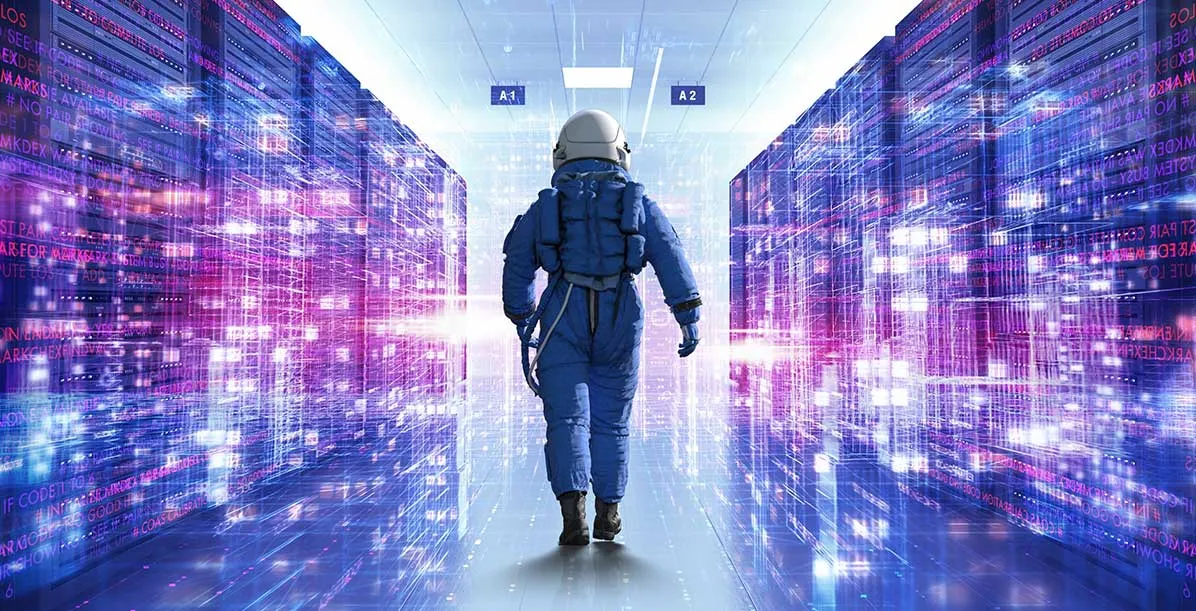
In-orbit data centers, also known as orbital or space-based data centers, are computing and storage facilities deployed in space, often in Low Earth Orbit (LEO), that are involved in data processing, storage and communication without relying entirely on terrestrial facilities. To minimize the burden on downlink bandwidth and latency, these systems aim to process data in space ahead of sending results to Earth for computation, rather than sending raw data from satellites.
This concept leverages the advantages available in space, including vacuum-based thermal radiative cooling, nearly constant exposure to sunlight for solar power, and the ability to avoid terrestrial constraints such as land, grid capacity, weather and cooling systems. However, due to the harsh environment, including vacuum, radiation, thermal extremes and reliability, there are significant operational and engineering challenges.
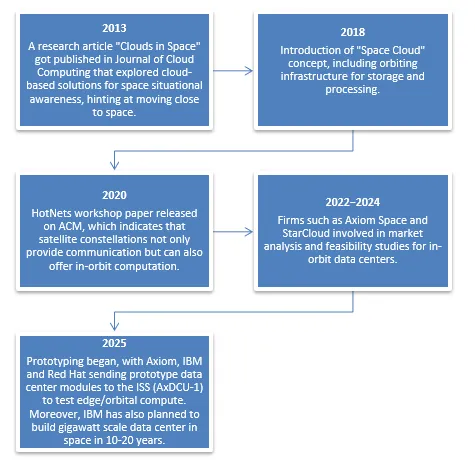
Technological and Academic Foundations of Space-Based Computing
Currently, the conversation around orbital computing is more influenced by early-stage initiatives and technical research than by market projections. Furthermore, corporate partnerships and pilot projects are currently underway to confirm the commercial viability of space-based data centers. At the same time, academic studies offer architectural blueprints and highlight important challenges. Some of them are listed below:
- The arXiv’s research paper, published in March 2025, represents a hierarchical architecture that integrates remote sensing constellations, ground data centers and satellite-based cloud systems. It also analyzes challenges such as resource virtualization, task orchestration and heterogeneous resource sharing.
- This organization also published in December 2024, a research paper on addressing system designs that schedule both computation and communication across ground stations as well as cloud resources to reduce latency and costs for satellite data processing.
Underway Initiatives and Project Announcements
- In October 2025, Axiom Space and Resonac Corp. signed an MOU to co-develop advanced semiconductor materials in microgravity. The collaboration aims to enhance crystal growth, reduce soft errors caused by cosmic radiation, and develop scalable in-space manufacturing for next-generation semiconductor technologies by leveraging the International Space Station (ISS) and Axiom's orbital platforms.
- In August 2025, In-Q-Tel, the U.S. government–backed strategic investor, announced an investment in Starcloud. The action indicates that space-based data centers are moving beyond conjecture into areas of strategic and institutional interest. This highlights the growing recognition of orbital computing as a crucial technology with potential national security applications.
- In February 2025, Starcloud, formerly known as Lumen Orbit, secured an additional $10 million in funding, bringing its total seed round to $21 million, among the largest for a Y Combinator graduate. The startup's goal is to deploy megawatt-scale, solar-powered data centers in Earth orbit. This would offer a sustainable substitute for terrestrial facilities that face constraints such as land, energy and environmental factors.
- Axiom Space is also receiving interest from European partners. For example, 4iG Space & Defence, a Hungarian firm, is exploring collaboration with Axiom on orbital data center infrastructure. The partnership aims to leverage Axiom’s in-orbit operational expertise with 4iG’s European network capabilities to create secure, energy-efficient space-based data storage solutions.
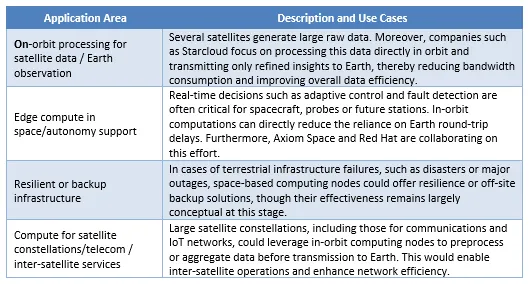
Applications and Use Cases of In-Orbit Data Center
Source: ISS National Laboratory and GeekWire
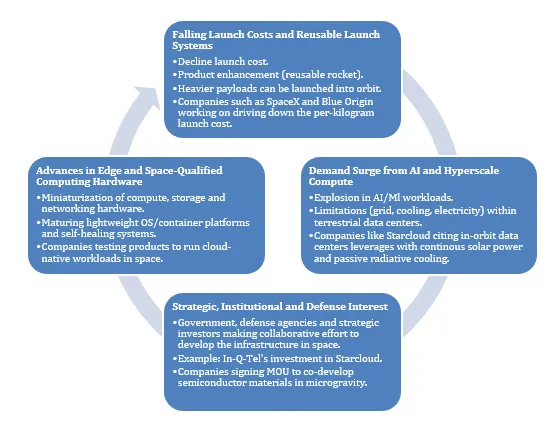
Key Driving Forces
Source: BCC Research
Key Challenges Within the Industry
Radiation, Reliability and Durability: Space-based data centers face many challenges because of the harsh orbital environment. Electronics must survive solar flares, cosmic rays and high-energy particles, which can cause malfunctions or permanent damage. Operations are further complicated by limited repair options, power limitations and isolation from support systems. For systems to reliably store and process data in the face of radiation exposure and environmental stressors, they must be robust, self-healing and capable of continuous operation without human intervention.
Mass, Launch Cost and Deployment Risk: Launch of hardware into space is a major challenge because of high cost, mass and inherent risks. Due to the high cost of each kilogram sent into orbit, Starcloud must create systems that are both incredibly dependable and lightweight. Every mission is high stakes because a failed launch means the satellite or data center is completely lost. To test and validate megawatt-scale, GPU-powered data centers in LEO, Starcloud employs a modular scaling strategy with smaller demonstrator satellites. The recent $21 million seed funding lowers financial risk while advancing ambitious space-based computing and edge processing capabilities by enabling multiple launches and in-orbit experimentation.
Future Scenarios
By 2040, in-orbit data centers are expected to evolve into modular computing clusters operating in space. Such facilities will enable real-time satellite data processing, AI training and seamless inter-satellite communication. Organizations such as Starcloud and Axiom Space are setting standards with initial in-orbit demonstrations. These centers will provide autonomous, energy-efficient and low-latency computing capabilities by functioning as an extension of the terrestrial cloud.
Moreover, in the long term, integration with deep-space and lunar networks could provide robust backups and support for off-earth operations. This advancement is a crucial step toward a distributed and sustainable ecosystem for space-based computing.
Conclusion
Future growth and technological growth prospects are anticipated to be favorable for the in-orbit data center market. By leveraging the unique characteristics of space to overcome terrestrial limitations such as limited land, energy and cooling capacity, in-orbit data centers offer a revolutionary approach to computing and data management. These systems can lower downlink demands, improve latency for space-native applications, and offer robust, off-Earth alternatives for critical workloads by processing data directly in orbit. Together with scholarly research, publicly visible projects by companies such as Axiom Space and Starcloud demonstrate technical viability and growing interest in this new area.
However, many obstacles remain, such as radiation, thermal control, launch expenses and legal issues. Despite these challenges, the gradual demonstration, modular deployment and integration into distributed computing ecosystems suggest that orbital data centers will eventually be used in conjunction with terrestrial infrastructure. This is being done to support new applications in global communications, scientific research and Earth observation while also encouraging innovation in space-based technologies.
Need deeper insight for your specific market?
BCC Research can tailor custom research by region, application, technology segment, competitor set, customer group, or investment priority.
Discuss a Custom Research Need