

Legal Tech 2025: Innovation, Regulation and the Future of Digital Justice
Clear insight into competitor positioning and market share.

Legal technology has undergone a major change in the last two years. The gradual digitization that was widely perceived initially, such as cloud-based file storage, electronic filing and practice management systems, has now transformed into a whole different direction of legal workflows, reshaped by genAI, government support through modernization programs, and specific public funding aimed at increasing access to justice.
Why Legal Tech Matters?
The legal industry made a huge leap in the application of new technologies during 2024 and 2025, moving from testing to limited operational use. According to the American Bar Association’s (ABA) 2024 Legal Technology Survey Report, the Thomson Reuters Institute's Legal Technology 2025 Outlook, and the Clio Legal Trends Report 2024, two key trends are emerging in legal technology:
- A significant number of legal employees and judges are starting to use genAI and automation tools.
- The public sector and legal aid funders are boosting tech investments to push the legal system further toward its goal of providing faster justice through improved accessibility and reduced delays in court processes.
At the same time, the ABA's 2024 survey confirmed the rise of cloud services in legal firms, increasing interest in AI-assisted jobs, and rising security concerns in law offices.
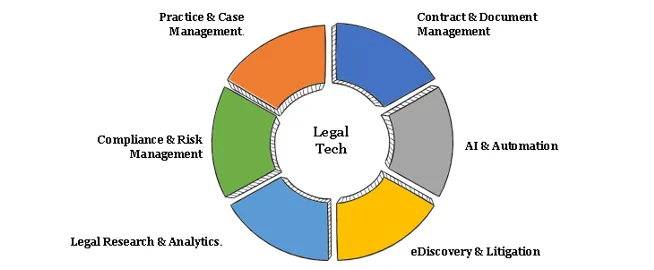
Source: BCC Research
The U.S. Legal Services Corp. has decided to extend full support for new technologies and expand technology grants for legal aid organizations in 2024. This will help these organizations provide more services online. Meanwhile, the U.K. government has released case studies and launched digital court initiatives showcasing the growing use of digital tools for scheduling, case listings and online case file management. These government actions are like a dual engine working side by side: the private sector increases its efficiency and reduces its costs, while the public sector provides more services and ensures that people have equal access to them.
Why 'Legal Tech' Is Adopted Rapidly?
The rise of genAI and automation has been the legal industry's most significant transformative force. The ABA's Formal Opinion 512 (2024) has finally given lawyers and firms the much-needed assurance and clarity on the ethical use of AI, including the standards for competence, confidentiality and supervision. This new rule has mitigated the ambiguity and bolstered the methodical acceptance of AI-enabled tools in law firms and within the legal departments. On the other hand, the firms have been prompted to investigate automation of contracts, document review platforms, and eDiscovery systems due to the increasing demand for cost-saving measures, transparency and quicker turnaround times. Like that, public bodies have also followed this trend. The U.S. Legal Services Corp. (LSC) increased its Technology Initiative Grants in 2024 to support legal-aid providers in modernizing their services. In the U.K., the Ministry of Justice fast-tracked the implementation of court digitization and case management systems under the Digital Justice initiative.

The adoption of legal tech is being significantly enhanced by the combination of technological innovation and some structural as well as regulatory factors. Legal tech tools have become a 'must-have' rather than a 'nice-to-have' largely due to the mounting cost pressures, widening access-to-justice gaps, and increasing compliance obligations. Governments and bar associations are not just funding innovation but also determining the moral and operational standards for the responsible use of technology. This scenario has ushered in a more advanced and standards-driven environment in which vendors are required to comply with very high expectations regarding data protection, explainability and integration with the existing legal systems. The above-mentioned forces, technological maturity, regulatory clarity and institutional backing are all together making the next wave of legal tech growth across private practice, corporate law and public-sector justice systems more likely.
A Quick Focus on the Issues
The legal tech sector, nevertheless, continues to face several structural restraints despite increasing momentum, which act as a barrier to widespread adoption. One of the most persistent issues is data privacy and risk management, particularly in the context of AI tools usage in the legal process. Law firms have historically been risk-averse and subject to extremely rigorous confidentiality rules, and the absence of uniform data protection policies for AI systems complicates compliance. Furthermore, concerns about algorithmic bias, lack of accountability, and unauthorized data sharing contribute to the reluctance of firms to completely entrust AI with legal processes that require confidentiality. Particularly small and mid-sized law firms are in a difficult situation where the high costs of implementation and subscription often surpass the short-term productivity gains.
The integration and change management are also major restraints. Many law firms' existing systems, such as those for document management or billing, are based on outdated software, making it difficult for new technologies to integrate effortlessly. This leads to a heavy dependence on external IT support and to an unwillingness among legal staff who are not digitally educated to change. Besides, the lack of digital literacy and technical training among the legal workforce is still a factor preventing the adoption of technology, especially in areas outside big cities. In public-sector or court applications, there are also issues such as bureaucratic inertia and funding limitations that pose obstacles to transformation efforts. Together, these factors create a divided adoption landscape where innovation is limited to top-tier firms, and the rest of the smaller practices and legal aid institutions remain behind in the race of modernization.
Emerging Opportunities and Areas for Investment
The legal tech sector is entering a critical phase of growth. New opportunities are emerging in automation, AI-driven analytics and access-to-justice solutions. One of the most exciting areas is GenAI-assisted legal research and drafting. This technology is changing how lawyers create contracts, briefs and client documents. Tools that use large language models (LLMs) help firms reduce research time, improve accuracy and serve more clients without significant increases in costs.
In the U.S., the LSC has broadened its technology initiative grants to fund AI projects aimed at making legal assistance more accessible to low-income citizens. Meanwhile, the U.S. Patent and Trademark Office (USPTO) continues to invest in AI tools for patent examination and document classification. In the U.K., initiatives under LawtechUK, supported by the Ministry of Justice and Tech Nation, are speeding up innovation by backing startups that develop solutions for contract intelligence, dispute resolution and compliance automation. These programs show strong collaboration between the public and private sectors, helping to boost the adoption of legal tech.
Another major opportunity lies in expanding legal tech beyond traditional law firms into corporate legal departments, public administration, and regulatory compliance systems. As businesses deal with increasing environmental, social and governance (ESG) reporting requirements and stricter data protection laws, legal tech tools are being integrated into broader enterprise governance frameworks. Startups that focus on regulatory technology (RegTech) and compliance automation are gaining traction. They help companies monitor changing legal obligations across jurisdictions.
In addition, the growth of online dispute resolution (ODR) and court digitalization platforms is creating new investment opportunities in public-sector legal infrastructure. With governments in both the U.S. and the U.K. prioritizing digital justice reform, these opportunities are expected to create consistent demand for interoperable, secure and transparent legal systems. Overall, these changes indicate a future where legal tech will be vital not only in legal practice but also in promoting fair, efficient and data-driven justice delivery.