

Micro Data Centers: Compact Compute for an Edge-First World
Clear insight into competitor positioning and market share.
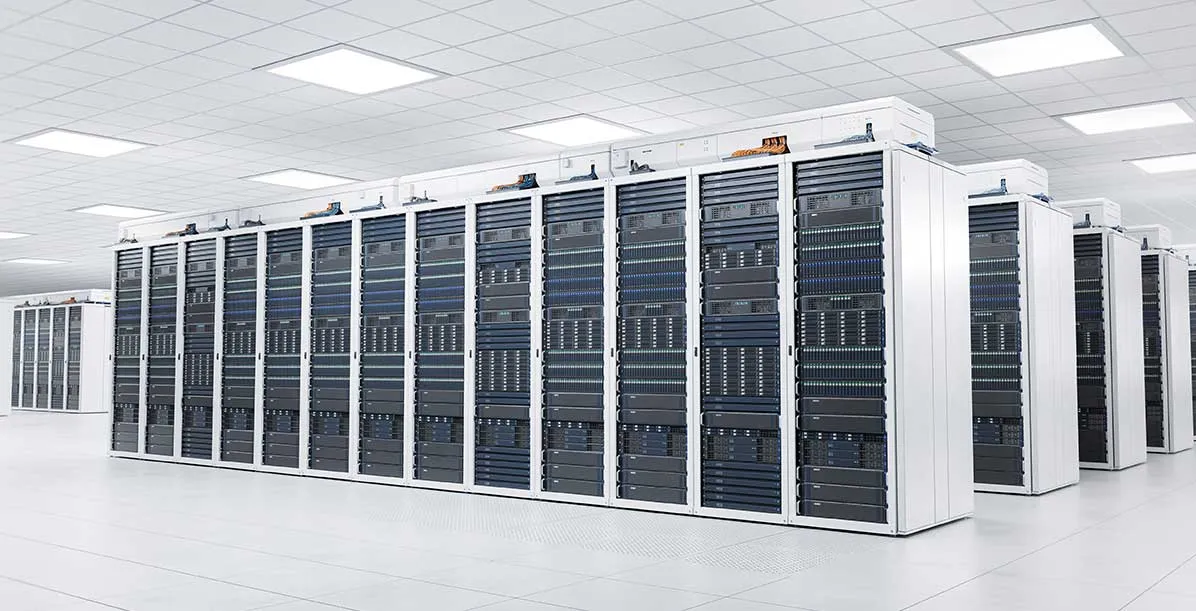
A micro data center (MDC) is a compact and self-sufficient computing facility that contains the main components of a traditional data center: servers, storage, networking devices, power supply, and cooling unit in a reduced-size, modular case. These systems can be quickly deployed and run alone at or very close to the point of data generation. While traditional data centers are large, occupying very large buildings, an MDC can be in a small room, an outdoor cabinet, or even a modified shipping container.
The primary objective of an MDC is to provide computing resources near data sources, a concept known as edge computing. Rather than transmitting all data to a centralized cloud for processing, MDCs enable local data flow, thereby reducing latency, boosting response times, and ensuring operation even during network outages. This kind of setup has become increasingly necessary in a society where data is continuously generated by devices, sensors, and applications, and processing must be done in real-time. MDCs are often installed at sites like mobile towers, retail outlets, factory floors, drilling platforms, university campuses and crossroads of smart cities. These function as middle nodes between the end-user devices and the central cloud servers, forming a distributed computing network.
Why Do Micro Data Centers Matter?
Traditional hyperscale data centers are characterized by the centralization of computing resources in a few very large sites. However, several applications nowadays need these in smaller locations; for example, self-driving cars, industrial automation, real-time video analytics, AR/VR, and certain AI loads for inferencing. These require very low latency, predictable throughput, and local data sovereignty simultaneously. MDCs are the perfect solution that brings the barriers down by locating fully integrated and hardened computing nodes in locations like telecom towers, cell sites, street cabinets, factories, campuses, and even rooftops. They eliminate the round-trip, cut down the backbone bandwidth for raw telemetry, and provide resilience and local processing whenever the connection to the core is down. Micro data centers are acknowledged by the standards and technology roadmaps coming from the research and engineering communities explicitly as part of the edge continuum.
Why Are Micro Data Centers Becoming Popular?
The MDCs are perceived as the most suitable and efficient way to cope with the demands of a hyperconnected world. The proliferation of IoT devices, 5G networks, and real-time applications is contributing to vast amounts of data that are being produced at the edge of networks. This is, in fact, very far from traditional centralized data centers. Processing this data in the cloud causes latency, uses up bandwidth and may lead to unreliable performance for time-critical operations like autonomous driving, telemedicine, industrial automation and smart city analytics.
Their modularity allows them to be built in remote locations or areas with limited space, which is very convenient and much faster than setting up a full data center. Their scalability is unlimited, allowing small users to start with a small installation and grow as demand increases. Moreover, governments and corporations are considering the use of MDCs for such issues as the geographical location of data, sustainability, and energy efficiency—these are the three basic factors to be considered in planning digital infrastructure. As the major market sectors are gradually migrating to decentralization to meet the needs of modern connectivity, MDCs are gaining ground as primary tools for providing low-latency services, local processing that is resistant to failures, and utilizing distributed environments for data that must adhere to standards.
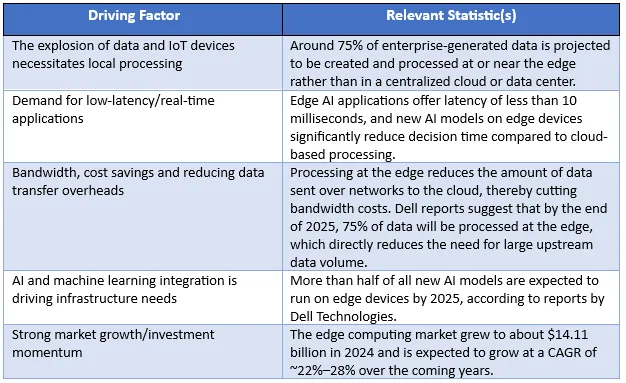
Source: Dell Technologies
A Quick, Focused Look at Issues
MDCs have proven to be efficient solutions to most infrastructure and data management problems; however, they also introduce numerous small-scale yet intricate issues. Power and cooling limitations at scale are perhaps the most serious issues. With MDCs spread across different sites, typically in locations with limited access to reliable power or advanced thermal control systems, maintaining a consistent energy supply and efficient cooling becomes a challenge. In comparison to conventional data centers with advantages in centralized infrastructure, MDCs mostly depend on dependable on-site power systems like Uninterruptible Power Supply (UPS) units and localized backup mechanisms. In its 2024–2025 program documents and Categorical Exclusion technical reports, the U.S. Department of Energy (DOE) continues to emphasize the critical need for cooling and energy efficiency innovations tailored to modular and edge deployments to ensure their sustainability and reliability.
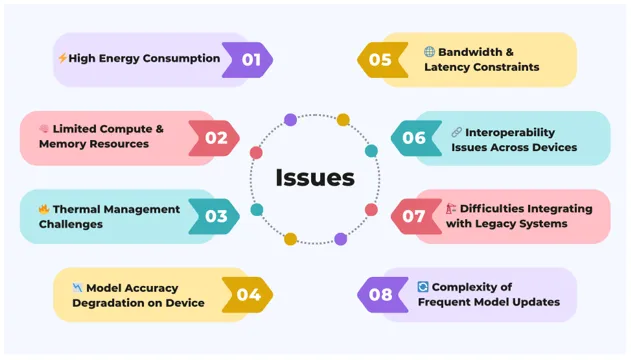
Source: BCC Research
Need deeper insight for your specific market?
BCC Research can tailor custom research by region, application, technology segment, competitor set, customer group, or investment priority.
Discuss a Custom Research NeedAnother set of challenges includes standardization, security, and regulatory issues. Keeping track of thousands of MDC devices spread across scattered sites requires advanced orchestration, standardized management interfaces and cohesive fault-reporting systems, gaps that industry respondents pointed out in their 2024 feedback on government Requests for Comments (RFCs). Since most MDCs are placed in public or semi-accessible areas, they present special security and physical hardening concerns, requiring them to be shielded against tampering, theft and targeted attacks. Although MDCs are smaller than large data centers, they still face planning, permitting and zoning issues, especially in cities. European and U.S. regulatory debates surrounding the usage of energy, building standards, and data center location continue to this day. These continue to evolve and impact deployment timelines and operational consistency for this growing infrastructure framework.
Emerging Opportunities and Areas for Investment
For operators, city planners, telecom companies, or investors who consider MDC deployment, several practical measures can be taken to yield stable and sustainable results. The first measure is a site and grid assessment, which requires early cooperation with local utilities to find out the grid capacity and the interconnection timetable. The U.S. Department of Energy (DOE) has pointed out that the availability of a reliable power supply is a major reason for both centralized and distributed computing infrastructure—this means the need for power planning is strong.
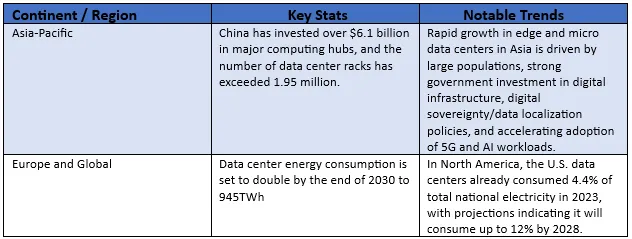
Source: The State Council, The
People’s Republic of China, U.S. Department of Energy
It is essential to invest in energy and cooling innovations to maximize the benefits of MDC and extend its lifespan. The use of more effective cooling equipment, high-performance microelectronics and modular secondary cooling modules means that heat density will be significantly reduced, and computing power will be available at a lower energy cost. The DOE is still backing research and pilot projects aimed at enhancing cooling and power efficiency in modular buildings.