

Perovskite Quantum Dots (PQDs): Tiny Crystals Driving Big Innovations
In-depth market intelligence to support growth and planning.
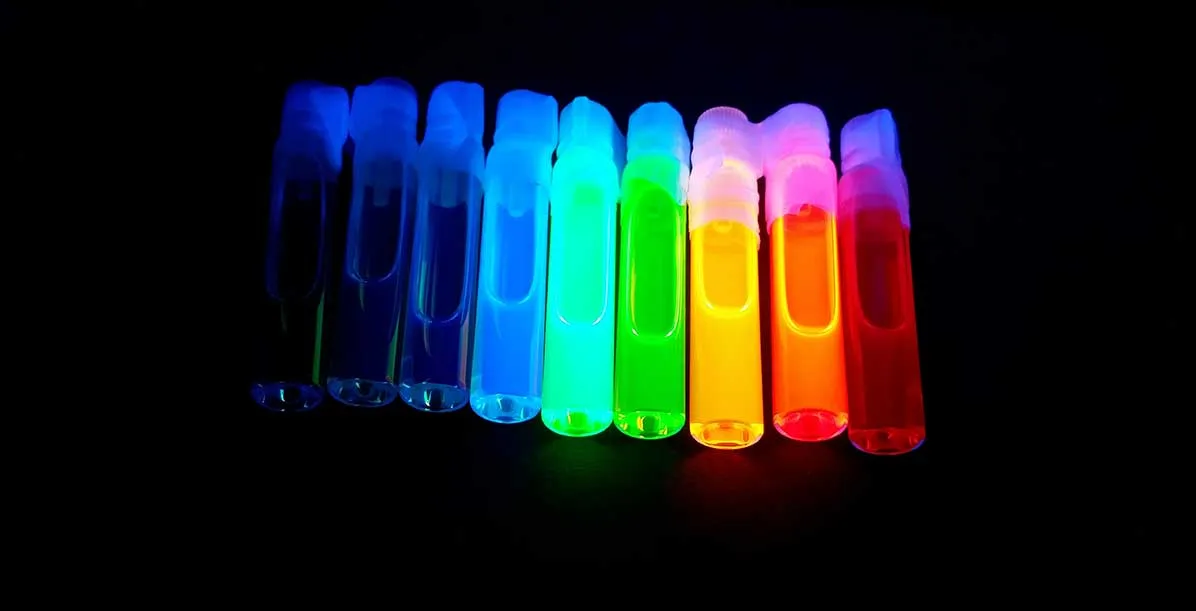
Perovskite quantum dots (PQDs) are a unique class of nanomaterials that bridge the superior optoelectronic properties of lead-halide perovskites with the size-tunable effects of quantum confinement. Since their first synthesis in 2012, PQDs have existed as nanocrystals—generally sized 2–15 nanometers, allowing for tunable band gaps, emission colors and exciton dynamics through composition, size, shape and surface chemistry. Such flexibility has called attention to PQDs for potential next-generation applications in displays, solar energy conversion, photodetectors, lasers, chemical sensing and bio-imaging.
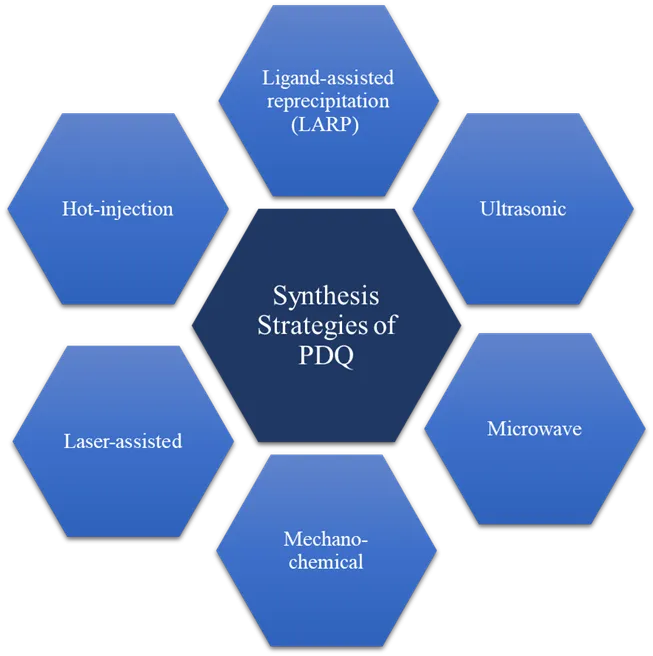
PQDs are metal halide nanocrystals that have a unique AMX₃ crystal structure, where A represents the organic or inorganic cation, M is the divalent metal cation (which is usually Pb²⁺), and X represents a halide anion. PQDs can be synthesized through various strategies, each offering distinct advantages in terms of scalability, particle uniformity and stability. The figure below shows the widely used methods for PQD synthesis.
Evolution of PSCs
and the Emerging Role of Perovskite Quantum Dots
Perovskite solar cells (PSCs)
have undergone systematic development, beginning with the first
solution-processed devices in 2012, to mixed-cation and mixed-halide systems,
progressing to 2D/3D heterostructures, and perovskite-silicon tandems, which
now exceed 29% efficiency. The figure below represents the detailed roadmap of
PSCs. As research progressed beyond 2020 to address the challenges of
passivation and interface engineering, perovskite quantum dots are being
increasingly incorporated into PSC architectures, predominantly either in
interfacial layers or light-absorbing nanocrystals.

Source: https://www.sciencedirect.com/science/article/pii/S2772834X25000119
Why Is the Adoption Rate Increasing?
- Optoelectronic capabilities: PQDs exhibit ultra-high photoluminescence quantum efficiencies and narrow emission for highly efficient LEDs and displays. Thus, many companies use PQDs for producing LEDs. For instance, in June of 2025, Yicai Core Light, a Chinese startup, commenced mass production of a new display chip that utilizes perovskite quantum dot technology to create a microLED display that features full color in micro size.
- Bandgap tunability and strong light absorption: Composition and size-dependent band gaps allow manufacturers to tune absorption/emission (utilizing high absorption coefficients) across the visible (near-IR) spectrum, which is advantageous for LEDs as well as photovoltaic up-conversion/solar applications.
- Improved scalability and stability: Companies are integrating QD/perovskite technology into panels due to its improved scalability and stability. For instance, in May 2023, Canon Inc. announced that it had developed a quantum-dot ink with a perovskite structure (perovskite quantum-dot ink) as a next-generation material for quantum-dot displays and demonstrated its practical durability for the first time worldwide.
Key Developments
- In July 2025, UbiQD, a company that focuses on quantum dot nanotechnology, signed an exclusive, multi-year supply agreement to provide its proprietary fluorescent QD technology to First Solar, Inc. This agreement enables the incorporation of QD technology into First Solar’s thin-film bifacial photovoltaic (PV) solar panels. This represents a high-volume QD supply agreement outside of the display space.
- In April of 2025, Midsummer, a Swedish thin-film solar cell manufacturer, was selected by the Italian Ministry of University and Research to be in a consortium to develop "Quantum Dots CIGS/Perovskite Tandem" solar cells. The project called "Quantum Dot Enhanced Lightweight Solar Cells" (QDELS) aims to develop and validate a new production process for CIGS solar cells featuring a tandem perovskite structure enhanced with quantum dots. The end goal is to develop and validate a new process for enhancing CIGS cells to achieve efficiencies beyond those of silicon in every parameter.
- In February 2025, UbiQD, a developer and manufacturer of quantum dot technology, acquired BlueDot Photonics. The acquisition includes perovskite-based quantum-cutting technology, as well as exclusive rights to BlueDot’s related intellectual property, initially developed at the University of Washington.
Challenges:
- Environmental instability: PQDs can degrade relatively quickly under moisture, oxygen, heat, or light, which affects the device's performance.
- Ion migration: Mobile ions in lead-halide perovskites can result in irreversible degradation when exposed to an electric field or illumination.
- Surface/defect issues: Weak ligand passivation creates trap states, which cause blinking, resulting in lower stability.
- Toxicity risk: Presence of lead in PQDs raises environmental, health, and regulatory considerations.
- Scale-up challenges: Although progress continues, it remains difficult to produce PQDs on a large scale, reproducibly, and at low cost.