

Predictive Immunology: AI Models Forecasting Immune Response
January 21, 2026
Tailored research built around your exact strategic priorities.
The immune system, a complex symphony of cells, chemicals and signals that work together to protect the body, has traditionally been compared to an orchestra. However, despite its great role, it has been one of the most unpredictable "performers" of biology. The reasons why some people recover quickly from infections while others become seriously ill, why vaccines produce strong immunity in some people and not in others, or why autoimmune diseases develop seemingly out of the blue have long been mysteries to medical science. AI is learning to interpret the complexities of the immune system, enabling predictive immunology to anticipate immune responses and predict the future rather than merely reacting to it.
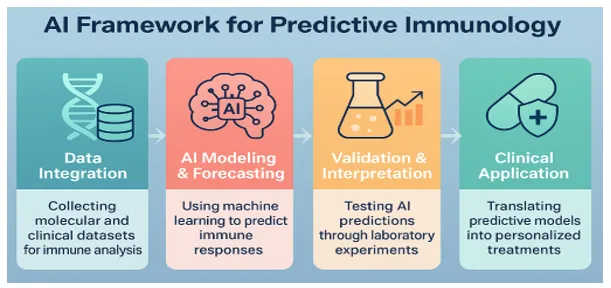
Source: BCC Research
From Observation to Prediction: A Paradigm Shift
Immunology began as an empirical discipline. After exposure to an antigen or vaccine, one often measures cytokine levels, antibody titers and cell counts. Although this method uncovered a lot about the immune system, it hardly had any predictive power. The response of each patient was a new variable, and the results were often only understood after they had already taken place.
AI is revolutionizing our understanding of the immune system. By analyzing extensive datasets of genomic, proteomic and clinical information, AI systems are uncovering patterns and rules of immune regulation. Machine learning algorithms can now accurately predict bodily responses to pathogens, therapies and stressors. For instance, in January 2023, Stanford University researchers employed deep learning algorithms to forecast an individual's antibody response to the influenza vaccine based on pre-vaccination gene expression profiles. In addition to identifying the particular immunological pathways that affected the result, the model actually predicted which individuals would have a significant response. This information can be utilized to build vaccines and develop customized immunization plans.
Such a shift from being merely reactive to measurement to being proactive in modeling is probably the most significant change of nature that has happened to immunology.
Emerging Trends in AI-Driven Drug Repurposing
Predictive immunology is the major driver of change in healthcare, offering the most advanced diagnostics, treatment and prevention by leveraging the fusion of computer science and molecular medicine. The use of AI models for R&D of vaccines and therapeutics is one of the main trends that has been identified. Top biotech companies such as BioNTech, Moderna and Insilico Medicine are turning to AI-powered immune prediction tools to create and test the viability of vaccine candidates in the preclinical phase.
These computational models can access genomic and immune repertoire data and accordingly predict the response time and population-level variability, and this way saving the industry a great deal of both money and time. At the same time, the development of “immune digital twins” — computer models that map an individual’s immune system — is revolutionizing personalized medicine. There were a number of biotech companies that initiated the use of such models in their research for the treatment of autoimmune disorders and oncology, giving doctors the ability to predict immune responses. The approach not only shortens treatment time but also greatly increases effectiveness.
Together, these trends point to a clear direction: predictive immunology is moving from a hopeful experiment to a practical pillar of modern healthcare, helping drive the shift toward personalized, data-informed and anticipatory medicine.
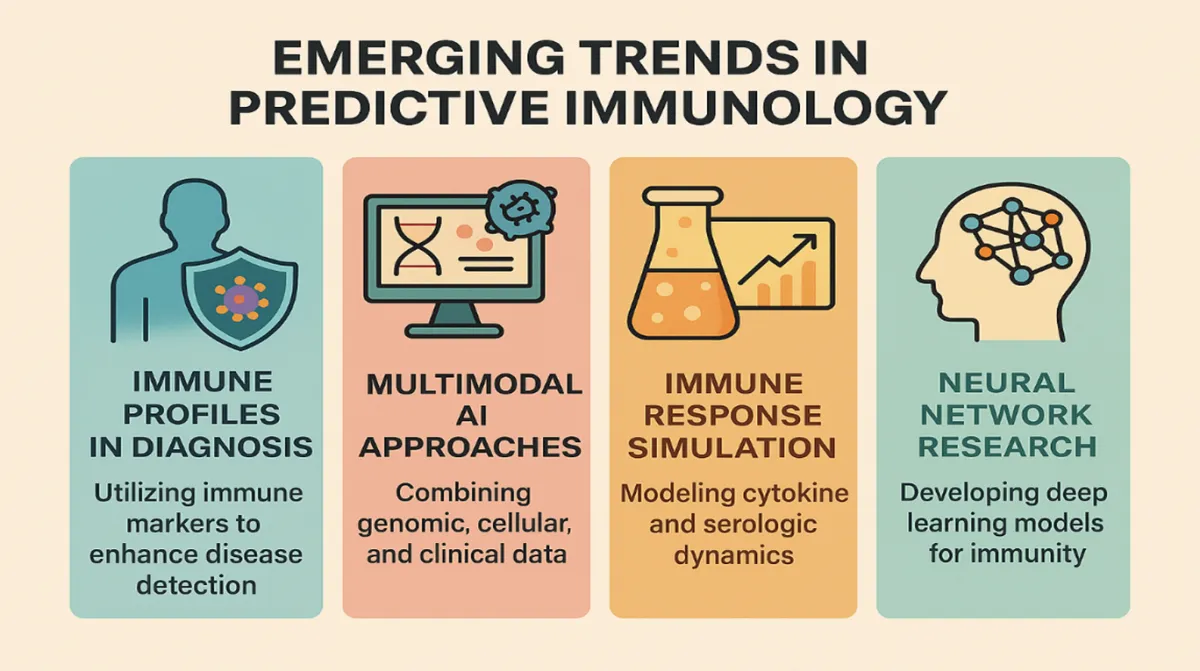
Source: BCC Research
Need deeper insight for your specific market?
BCC Research can tailor custom research by region, application, technology segment, competitor set, customer group, or investment priority.
Discuss a Custom Research NeedStrategic Initiatives in Predictive Immunology
Although AI is radically altering immunological research by making it a data-driven discipline, industry and academia continue to advance. They are actively developing concrete plans to translate these healthcare breakthroughs from laboratory research into practical applications. The company's success stems not only from its algorithms but also from its collaborative efforts, innovations and the deep-seated network of relationships.
The Human Immunome Project is one such example. It's a global collaboration launched in September 2022 and is aimed at mapping the genetic and molecular basis of immune variation across different populations. The project, through the use of AI, seeks to predict the response of individuals to diseases, vaccines and treatments. Computational models refined through the open data-sharing agreements are expected to guide next-generation therapeutic development, reflecting both population diversity and the biological complexity of the real world.
On the other hand, pharma and tech collaborations, however, seem to be the main drivers of hybrid innovation models. In June 2024, AstraZeneca and BenevolentAI signed a deal to utilize predictive modeling in identifying novel immunology drug targets. These companies' moves are not only different from each other, but they actually signal a broader shift in the entire industry toward Collaborative Intelligence, a scenario wherein human capabilities and machine learning co-evolve on an interactive basis.
Challenges and Ethical Frontiers
Predictive immunology faces significant challenges that may delay its clinical application and warrant further investigation. This represents one of the top challenges related to data diversity and generalization. Immunological factors that affect response include not only DNA but also surroundings and infection history, although AI models used in practice are generally trained on datasets that are either small or consist of similar samples. Therefore, such models have a restricted capability of generalized performance concerning different populations. Concurrently, a PubMed review on the use of AI in immunotherapy held in July 2025 pointed out that the predominant challenge of predictive systems is “insufficient generalization ability,” that is, the task of developing datasets that are not only spatially but also demographically representative, thus providing the basis for models that present their performance across different populations equivalently.
A less explored challenge behind the wall of issues is that of interpretability and self-consistency of AI solutions. Although correlation-finding AI algorithms can identify hidden immunological motifs, their reasoning often remains opaque. The clinicians approach the black box problem of AI outputs in an attempt to close the gap between their insight and computational power. In January 2023, a paper in The Journal of Allergy and Clinical Immunology showcased a machine-learning-driven method for the detection of primary immunodeficiency, which manifested excellent prediction ability. However, at the same time, it necessitated a thorough confirmation of accuracy, going far beyond controlled situations by different hospitals. The dilemma at the core of the theory is clear: testing biological and demographic variability serves as continuous validation in vivo, while verifying a model's reliability amounts to real-world testing.
Future Outlook: The Path Ahead
Immunological prediction will no longer be a mere experimental lab work, but rather, it will be available in clinics, hospitals and even as wearable diagnostics. AI-powered systems will continue to analyze a person’s immune data through smart patches that monitor cytokine levels, as well as digital platforms that predict susceptibility to infection or autoimmune flare-ups, marking the future of immunology.
Soon, "digital immune twins"—computational models of an individual's immune system may simulate their response to therapies or exposures. The idea, which is heavily involved in collaborative research institutes in Europe and the U.S., is expected to transform personalized medicine into a predictive one, making prevention the norm, rather than the exception.
As quantum computing and multimodal AI mature, predictive models will achieve unimaginable precision, forecast immune responses and enable real-time treatment decisions through immediate intervention suggestions. So, predictive immunology is the coming together of biology and computation, the point where human comprehension of immunity starts to be at par with its intricacy. The immune system is no longer just a mystery to study. Rather, it is turning out to be a system that can be anticipated, optimized and harmonized.
Conclusion
AI’s contribution to predictive immunology is not just a mere computational advancement. It marks a fundamental shift in the way we understand life. By predicting immune responses, the focus is shifting from treating disease to preventing it. Eventually, the idea is not to rally against diseases but to be able to know health in advance, to recognize immunity before it even talks.
When the models become more accurate and refined, they will undeniably be able to close the gap between the intricacy of the phenomena and the understanding, between mere reaction and foresight.