

Regenerative Intelligence: The Intersection of AI, Cellular Reprogramming and Longevity
January 21, 2026
Tailored research built around your exact strategic priorities.

For centuries, people have sought longer lives, moving from mythical potions to modern gene therapies. Most substantial advances, however, have come from science and biology rather than from myths. Artificial Intelligence (AI) is a major factor in unraveling the mysteries of aging and even discovering ways to reverse it. The precision of an algorithm combined with the robustness of a biological system has led to the formation of a new idea, which is regenerative intelligence.
Regenerative intelligence is a fusion of AI and cellular reprogramming, in which machine learning (ML) is used to rejuvenate cells, repair tissues and regenerate organs or even entire organisms. The objective is not immortality, but rather a return to a youthful state, healing of the body, and continuation of strength through computation and biology.
Source: BCC Research
Emerging Trends Shaping Regenerative Intelligence
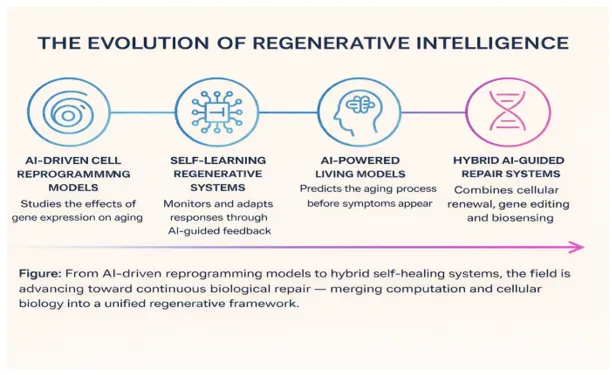
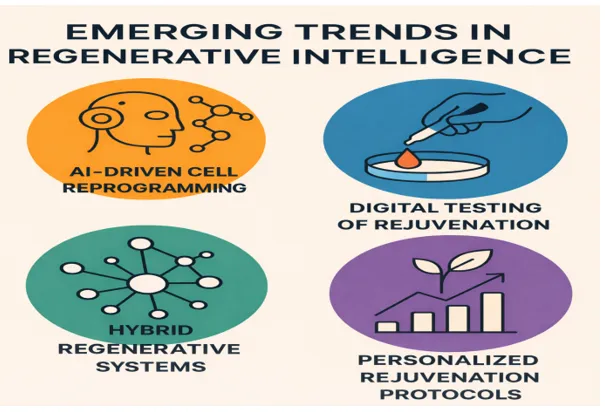
Regenerative intelligence is evolving at a rapid pace due to the major breakthroughs in AI, cellular reprogramming and multiomics integration. One of the primary trends shaping the field is the use of AI-driven cell reprogramming models that simulate how gene expression changes affect biological aging. In July 2024, researchers at Harvard Medical School and Altos Labs Inc. invented large-scale genomic language models that can forecast rejuvenation outcomes. Thus, they made it possible to create digital twins of cells in order to test the reprogramming factors virtually before actual reprogramming in the lab. In September 2025, scientists from Harvard Medical School and Altos Labs advanced their earlier work on genomic language models by releasing an AI-driven framework that forecasts cellular rejuvenation and gene repair pathways with greater precision. The refined model incorporates live multiomics data — transcriptomic, proteomic and epigenetic — to depict the reversal of cellular aging in various biological scenarios.
Another major innovation is the concept of self-learning regenerative systems that integrate real-time biosensing, multiomics and AI-guided feedback loops. In March 2025, Faculty at Stanford University began developing hybrid systems designed to track cellular health and, by inference, suppress reprogramming in cells to prevent aging-related decline. At the same time, Deep Longevity and Gero.ai, two startups, are using AI to analyze molecular “signatures of youth” with the goal of creating personalized rejuvenation protocols from epigenetic and metabolic data. Together, these technologies mark a turning point in longevity science, where AI not only monitors aging but also identifies ways to reverse it, shifting the field toward proactive, intelligent regeneration rather than reactive treatment.
Source: BCC Research
Need deeper insight for your specific market?
BCC Research can tailor custom research by region, application, technology segment, competitor set, customer group, or investment priority.
Discuss a Custom Research NeedStrategic Alliances Driving the Regenerative Intelligence Revolution
The rise of regenerative intelligence is strongly influenced by a wave of strategic partnerships between biotech pioneers, AI startups and pharmaceutical leaders. These partnerships are revolutionizing the way in which data and biology interact and enable human longevity. Companies are building ecosystems where algorithms decode biology and biology guides algorithms, creating a coordinated future for regenerative medicine.
In February 2025, PHC Corp. signed a Master Collaboration Agreement with CCRM (Canada’s Centre for Cell & Gene Therapy translation) to develop primary T-cell expansion culture processes for cell and gene therapy manufacturing. In April 2024, Altos Labs entered into a partnership with AI-powered biology firms to map cellular aging paths. The goal of the collaboration was to accelerate drug discovery in fibrosis and age-related diseases, thereby providing a clear instance of the use of AI in regenerative research pipelines.
Such endeavours signal a change for regenerative intelligence to be not just an innovation but a collaborative global movement. By harnessing AI’s prognostic power with cellular science, these partnerships are defining a healthcare model where rejuvenation is a scientific coordination of reality rather than a distant, futuristic vision.
Challenges and Ethical Hurdles
As regenerative intelligence (RI) moves beyond the theoretical sphere and reaches practical application, it is confronted with a myriad of challenges – ethical, technical and regulatory. The most pressing challenge is the issue of AI data bias. In January 2025, a study reported in npj Digital Medicine revealed that almost 60% of clinical AI systems perform poorly across different ethnic and gender groups due to the lack of representation of these groups in the datasets. Without inclusive and standardized data practices, regeneration algorithms risk entrenching inequities rather than solving them — a problem that becomes especially serious when AI decisions directly impact genetic and cellular outcomes.
Moreover, the issues of oversight and accountability are at the same level of ambiguity. In its February 2025 policy review, the Association of Clinical Research Professionals (ACRP) argued that the current regulatory frameworks for medical devices and biologics are insufficient to govern AI platforms that change the behavior of live cells. The question of liability — whether it rests with algorithm developers, biotech companies or medical practitioners — continues to confuse regulators.
These instances highlight the importance of ethical innovation. Regenerative intelligence can become a trusted, ethically grounded pillar of future medicine only if it is implemented with transparent governance, strict safety checks and fair access.
Future Outlook: The Road Ahead
Regenerative intelligence is expected to transition from being a mere concept to a necessity in the coming years. AI-powered living models will forecast aging years before symptoms show up. According to the research published by the University of Zurich in August 2025, scientists indicated that the combination of AI-directed cellular renewal, gene editing and real-time biosensing in hybrid systems could be the main driver for the creation of a biological repair continuous feedback loop. Such a dynamic interplay might empower humans to perform self-monitoring, self-diagnosing and thus, self-healing. Essentially, preventive medicine would be restructured from the very base.
In this futuristic view, longevity is reframed as a human adaptation of resilience rather than as a struggle against mortality. With the use of intelligent systems to regulate individual biology based on cellular signatures, medicine will transition from curing illness to preserving life. The distinction between healing and enhancement will become less clear as AI and biology shape a new paradigm of life.
Conclusion
Regenerative intelligence, at its core, is the most profound union of machine precision and the natural wisdom of a living being. This shifts the paradigm of healing from replacement to actively reprogramming aging, balancing computation and cellular renewal, to potentially redefine human existence.
Eventually, with the development of AI-guided reprogramming, healthcare will be beyond the realm of treatment and continuous regeneration will be the norm, a living collaboration between algorithms and biology. The longevity challenge, which was previously the realm of myths, is quickly becoming a reality that can be designed not by chasing immortality, but by creating a self-repairing human future.