

Satellite-Powered Pet Tracker: The Future of Animal Locational Intelligence
Clear insight into competitor positioning and market share.

A satellite-powered pet tracker is a wearable device for animals that uses satellite connectivity to provide global location tracking and sensor data, even in remote areas without cellular coverage. In contrast to conventional global positioning systems and cellular trackers, it uses energy-efficient designs, multi-constellation global navigation satellite systems (GNSS) and low-power satellite IoT networks to ensure continuous monitoring. Features such as geofencing, real-time location and health alerts are made possible by such devices. However, power management, compact antenna design, regulatory approvals and high operating costs are some of the difficulties in developing them. Despite these challenges, satellite-enabled trackers provide dependable connectivity for pet safety anywhere, extending well beyond the limits of terrestrial networks.
Evolution in Satellite-Powered Pet Trackers
Source: Argos Services, Johns Hopkins Technical Digest, ScienceDirect, National Library of Medicine and Skylo
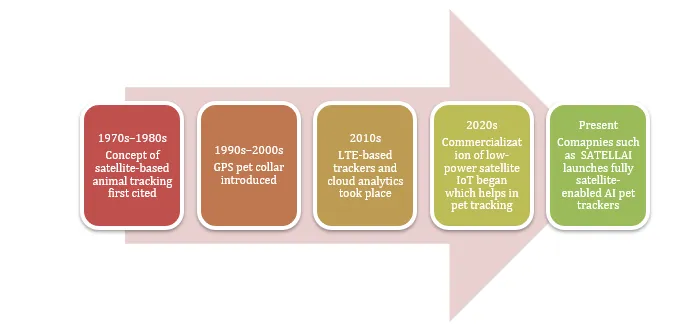
In the late 1970s and early 1980s, wildlife telemetry projects that employed Argos satellites to track migratory species introduced the idea of satellite-based animal tracking. Large and expensive, these early systems were only appropriate for scientific study. Consumer-grade GPS pet collars became possible with advances in battery technology and the miniaturization of GPS chips during the 1990s and 2000s. However, these devices continued to rely on radio or cellular networks for communication. Cloud analytics, long-term evolution (LTE)-based trackers, and smartphone integration were introduced in the 2010s. However, coverage gaps persisted in rural and remote regions. Furthermore, the commercialization of low-power satellite IoT and the emergence of low-Earth orbit (LEO) constellations, such as Starlink, Swarm and Skylo, in the 2020s represent a significant process. After decades of development, SATELLAI finally released the first fully satellite-enabled AI pet tracker in 2025, transforming a research techn
Applications
Source: BCC Research
Driving Forces
Advances in Low-Power Satellite Communications: By leveraging the integration of edge and space infrastructure, FOSSA Systems S.L. is developing IoT relay networks based on nanosatellites. Academic studies demonstrate that scalable ground-to-low-Earth orbit (LEO) gateways are feasible, enabling the effective integration of IoT devices through LoRa-NTN frameworks. One such study is "Performance Evaluation of LoRa for IoT Applications in Non-Terrestrial Networks via ns-3," was published by arXiv in 2025.
Moreover, in 2025, SATELLAI’s tracker uses 3GPP Release 17 5G IoT-Non-Terrestrial Network (NTN) capabilities to support satellite communication directly. Additionally, initiatives such as next-generation network architecture (NGN-Arch), under the European Space Agency (ESA), are researching NTN (GEO/MEO/LEO) architecture options, including their use with user equipment, indicating that standards work is progressing.
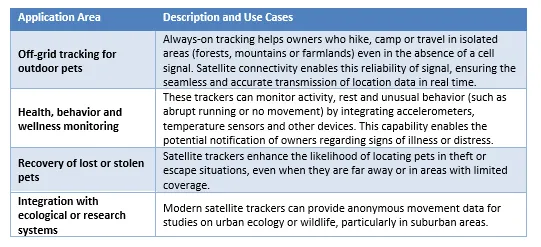
Rising Pet Ownership and Safety Awareness: The global growth in pet adoption, along with rising concerns for pet safety and well-being among pet parents, is driving demand for these pet trackers. Satellite-powered pet trackers can help trace the location of the pet in real time, even in remotely connected areas. Thus, this can help pet owners ensure the safety of their pets and trace them even if they wander in remote areas.
Expansion of Affordable Low-Earth Orbit Connectivity: The introduction of LEO satellite constellations has further supported the growth of satellite-powered pet trackers. Satellite communication supports constant and stable connectivity even in hard-to-reach areas, thus ensuring that precise locations can be traced. Such advances are further driving growth in this market.
Key Challenges Within the Industry
Power vs. Size Trade-off: Data transmission to a nearby cell tower uses significantly less energy than satellite communications, particularly uplink. It's not easy to get a small wearable with a battery that lasts for several days or a week. Weather, orientation and shade decrease reliability, but solar augmentation aids. For instance, Tractive's DOG XL GPS tracker (2025) allows for up to 30 days of low-update usage but only about 15 days of more active usage. Using features such as live tracking significantly reduces battery life.
Antenna Design and Link Budget: Maintaining a line-of-sight connection to satellites requires effective antennas that are either unobtrusive, directional or omnidirectional. It is necessary to carefully balance the link budget, which includes transmitting power, path loss and noise. For example, according to a Cornell University article of 2025, LoRa/Satellite IoT studies address link reliability issues such as low Signal-to-Noise Ratio (SNR), Doppler shifts and path loss. They achieve this by employing repeated transmissions along with precise frequency and phase alignment to enhance the overall link budget.
Latency, Throughput and Duty Cycle: Satellite links may have higher latency or lower guaranteed throughput. Trackers must batch or compress data, schedule reporting duty cycles, and tolerate occasional delays. For example, according to a 2025 article by RF Wireless World, discussions of LoRaWAN-satellite integration highlight that satellite links often impose store-and-forward architecture, increase latencies and restrict throughput. Nodes must be designed for batching or delayed reporting.
Future Scenarios
In the coming years, satellite-powered pet trackers will evolve into intelligent, multifunctional companions seamlessly integrated into pet collars or harnesses. Satellite-powered pet trackers will evolve into smart, multipurpose accessories that seamlessly blend in with pet collars or harnesses by the end of the next decade. These small devices will use hybrid cellular–satellite networks to maximize cost and power while providing continuous worldwide coverage. Trackers with on-device AI will evaluate behavioral, health and movement data locally and only send important updates. Months of operation will be made possible by solar-assisted, ultra-low-power designs and efficiency will be increased by mesh connectivity among surrounding pets.
This potential is already being demonstrated by platforms such as SATELLAI (CES 2025) and Invoxia's Minitailz (2024), which utilize biometric analytics and satellite IoT connections. These systems will provide AR-based pet tracking, predictive alerts and social pet networks that link pet owners globally by utilizing edge and in-orbit computing. Pet trackers may eventually function as individual IoT hubs, connecting pets, homes and cities within a vast "Internet of Pets," which will be enabled to develop 3GPP NTN standards and utilize deregulated consumer satellite IoT bands.
Conclusion
Compared to conventional cellular-only systems, satellite-powered pet trackers represent a major advancement. These gadgets provide dependable, always-on tracking, even in isolated or off-grid locations, by combining GNSS positioning, low-power satellite IoT, smart sensor fusion, and cloud-based analytics. With hybrid satellite/GNSS collars that offer AI-driven health monitoring and worldwide connectivity, early pioneers such as SATELLAI are establishing the standard. Rapid advances in satellite networks, miniaturization and pet technology suggest that satellite-enabled pet trackers could become a widely available, consumer-ready product in the upcoming years.
Need deeper insight for your specific market?
BCC Research can tailor custom research by region, application, technology segment, competitor set, customer group, or investment priority.
Discuss a Custom Research Need