

Self-Amplifying RNA Vaccines Market: Powering the Next Wave of Scalable Immunization
January 21, 2026
In-depth market intelligence to support growth and planning.

Self-amplifying RNA (saRNA) vaccines are an advanced version of mRNA vaccines that not only provide genetic guidance for the target antigen but also replicase enzymes so that RNA self-amplify in cells. Due to self-amplification, more antigen expression can be derived from a smaller dose, improving immune response and reducing manufacturing costs. Encapsulating saRNA vaccines in lipid nanoparticles increases both stability and delivery of saRNA vaccines. These vaccines offer several advantages, including the generation of a strong immune response, manufacturing efficiencies necessary for large-scale distribution, and are a promising medication for infectious disease and cancer immunotherapy. However, challenges with RNA instability and complicated manufacturing processes still exist.
The saRNA vaccines are increasingly gaining importance due to their enhanced capability to induce robust immune responses from small dosages via an in-cell RNA replication. They are also becoming a crucial part of the RNA-related vaccination market. Growing investments in preventing infectious diseases and enhancing cancer immunotherapies are improving lipid nanoparticle delivery and RNA synthesis. Although manufacturing complexities and instability continue to present obstacles, the increasing demand for saRNA vaccines due to its cost-effectiveness makes it a scalable next-generation option for global vaccination approaches.
How Self-Amplifying RNA Vaccines Work?
Source: “An Update on Self-Amplifying mRNA Vaccine Development,” Vaccines (Basel), 2021, National Library of Medicine.
Applications of Self-Amplifying RNA Vaccines
Source: BCC Research
Infectious Diseases: The saRNA vaccines are under development for viral infections such as COVID-19, influenza, Zika, Ebola and rabies. Their rapid design flexibility leads to a quick response to emerging pandemics and variants, requiring lower doses than conventional mRNA vaccines.
Cancer Immunotherapy: The saRNA platforms are capable of encoding tumor-associated antigens that activate strong cellular and humoral immune responses against cancer cells. Personalized saRNA cancer vaccines are being evaluated and studied for the treatment of melanoma, lung and prostate cancers.
Protein Replacement and Gene Therapy: Beyond vaccination, saRNA is explored for the transient expression of therapeutic proteins to treat genetic or metabolic disorders.
Veterinary Medicine: For expanded use cases, saRNA vaccines are being further researched for animal health to control zoonotic diseases and efficiently manage livestock infections.
Key Advances in saRNA Vaccines
Dose-Sparing Efficiency and Enhanced Potency
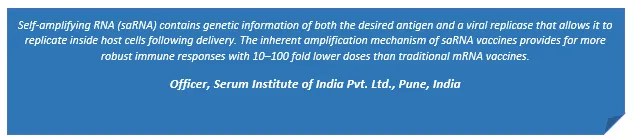
One of the main disruptive changes to occur in the saRNA vaccine landscape is the ability to generate robust immune responses with ultra-low dosages of vaccines, making them much more efficient than conventional mRNA vaccines. Further, the saRNA molecules replicate in the form of encoded replicase enzymes, amplifying the production of antigens within cells for multiple generations. The ability for self-replication reduces the dosage required by orders of magnitude, up to 100-fold, while still achieving a robust immune response compared to mRNA vaccines. For instance, Gennova Biopharmaceuticals Limited has secured up to $ 13.38 million from the Coalition for Epidemic Preparedness Innovations (CEPI) to develop a self-amplifying mRNA (saRNA) vaccine candidate against the Nipah virus. These vaccines function by sending the body instructions to create mRNA that produces the necessary antigen, which could lead to a heightened immune response with a smaller dose than current mRNA vaccines. This dosage efficiency leads to reduced raw material consumption and lower manufacturing costs, improving global access to vaccines, especially in low-resource settings. Therefore, saRNA vaccines are emerging rapidly to achieve a strong immune response.
Rapid Platform Development and Pandemic Preparedness
The saRNA vaccines provide a versatile and plug-and-play platform, enabling the simple design and rapid production of vaccines for newly emerging infectious diseases. The modularity of RNA sequence design allows developers and researchers to swap out antigen sequences within weeks, providing a crucial advantage in the response to a pandemic. Vaccines designed based on saRNA technology progressed into preclinical and early human studies during the COVID-19 pandemic, almost immediately after the release of the genome sequence of the causative pathogen. This was achieved with a speed comparable to mRNA platforms, but more efficiently. Now organizations such as CEPI are also funding saRNA programs for the rapid development of prototype vaccines for other high-priority pathogens, such as Nipah and Lassa viruses. Also, companies are focusing on the development of saRNA vaccines platform. For instance, in May 2024, GenScript announced expansion of its in-vitro transcription (IVT) RNA synthesis services to include self-amplifying RNA (saRNA) formats for vaccines, immunotherapies and gene/cell therapies. In March 2025, TechInvention entered a partnership with Quantoom to establish a manufacturing platform in Navi Mumbai to produce mRNA and self-amplifying RNA vaccines. Thus, rapid platform development is anticipated to boost market growth.
Expansion into Oncology and Therapeutic Applications
In addition to infectious disease applications, saRNA platforms are progressing rapidly in the field of cancer immunotherapy as well as for therapeutic protein delivery. By incorporating tumor-associated antigens, saRNA-based vaccines can mount strong cytotoxic T-cell responses against tumors, without the associated risk of gene integration that comes from using DNA-based platforms. Arcturus Therapeutics and other RNA and biotech companies are investigating the use of saRNA-based therapeutic vaccines targeting solid tumors and personalized cancer-associated antigens for treatment. In a similar vein, preclinical work is demonstrating the use of saRNA for transient protein expression, opening additional routes for treating genetic or metabolic disorders. Also, HDT Bio Corp. has entered into a collaboration with National Cancer Institute (NCI) to co-develop saRNA vaccines aimed at both prevention and treatment of multiple cancers, leveraging its proprietary LION™ delivery system. This expansion of saRNA is positioning it as a robust biomedical platform that spans the prophylactic and therapeutic sectors.
Future Outlook
The saRNA vaccines market is projected to see tremendous growth over the next decade, driven by rapid developments in RNA technology, rising demand for safe and effective vaccines, and expanding uses across infectious diseases, such as influenza, HIV, and RSV and cancer immunotherapies. Unlike traditional mRNA vaccines, saRNA vaccines replicate inside host cells to generate strong and persistent immune responses using lower doses, which can reduce production costs and increase global accessibility. Additionally, the increasing number of partnerships and innovations in technology, along with the clinical development efforts, are expected to incentivize enhanced use and adoption. However, challenges such as the complexities of the regulatory environment, safety determinations and fluctuation in funding to support vaccine development will play a role in shaping market dynamics. Nonetheless, saRNA vaccines exhibit a strong potential for a new platform to evolve the standards of next-generation immunization and therapeutic strategy, providing scalable, efficient and highly flexible solutions as global health challenges continue to emerge.
Strategic Takeaways for Industry Leaders
In the saRNA vaccines market, industry stakeholders should prioritize R&D for efficacy, stability and delivery systems, while also lowering the price of the vaccine by using a dose-sparing feature, thereby reducing production costs. Companies can diversify their product offerings and market reach by utilizing approved pathogenic vaccines or investigational vaccines to expand their therapeutic potential beyond infectious diseases (i.e., oncology or personalized medicine). In addition to its current partnerships, companies can establish partnerships or collaborate with biotechnology firms, research institutions or the government to get their vaccines to market rapidly and efficiently. For instance, Arcturus Therapeutics Inc. collaborated with CSL Limited to develop and commercialize self-amplifying mRNA vaccines. Arcturus licensed its self-amplifying mRNA platform (STARR®) and LUNAR® delivery technologies to CSL Seqirus for developing vaccines for respiratory infectious diseases, such as COVID-19 and influenza, to ensure pandemic preparedness. In emerging markets, localized partnerships, specificity and thoroughness will continue to offer high-growth opportunities. The market also requires attention to potential regulatory challenges, constant adaptation to funding and policies, education of the public regarding vaccine safety and efficacy to build trust and uptake, and to stabilize the progression towards a competitive market.
Conclusion
The saRNA vaccines market is poised to become a groundbreaking sector in the global vaccine and immunotherapy market, considering the product's potential to stimulate a strong immune response with lower doses, as well as its applications in preventing multiple infectious diseases and cancer. The saRNA vaccine market faces barriers such as complex regulatory pathways, clinical de-risking and prospective funding, but continued advances in technology, partnerships and increased attention to healthcare investing are expected to mitigate these risks and expedite growth. The saRNA vaccines are poised to have a significant impact on vaccine development, providing scalable, cost-effective and next-generation vaccines to address global unmet health needs and to help advance public health preparedness against current and future disease threats.