A solar photovoltaic (PV) panel contains PV cells that absorb the sun’s light and convert solar energy into electricity. These cells are composed of a semiconductor that transfers energy and are arranged in series to create a module. This single, encapsulated unit serves as the fundamental building block of a solar panel system. A typical rooftop solar PV panel has 30 modules. In solar PV panels, a semiconductor absorbs sunlight, which knocks electrons free from their positions, allowing them to flow through the semiconductor. These dislodged electrons, each carrying a negative charge, flow across the cell toward the front surface, generating an imbalance in charge between the back and front. Photovoltaic cells generate electricity because this imbalance, in turn, produces a voltage potential similar to that of the negative and positive terminals of a battery. The current is then collected on wires and utilized instantly or stored in a photovoltaic battery. During a cloudy day, solar PV panels generate less power than on a sunny day.
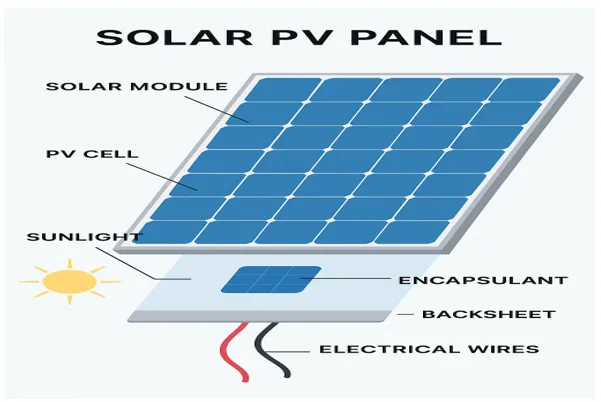
Source: What is a photovoltaic system and how does it work?, Enel X S.r.l, 2025
Solar PV panels are a modular technology that can be produced in large-scale plants, creating economies of scale, but can also be deployed in very small quantities at a time. This permits a wide range of applications from small residential rooftop systems to utility-scale power generation installations.
Evolution of Solar PV Panel
|
Decade
|
Key Milestone
|
|
1830s-1880s
|
Ø 1839: Photovoltaic effect
discovered by Alexandre-Edmond Becquerel.
Ø 1873: PV effect in selenium
observed by Willoughby Smith.
Ø 1876: William G. Adams and Richard
Day performed the PV effect in a selenium-platinum junction.
Ø 1883: First selenium solar cell
developed by Charles Fritts.
|
|
1900s-1930s
|
Ø 1905: A theoretical explanation of
the PV effect was provided by Albert Einstein.
Ø 1918: Jan Czochralski discovered a
method for producing monocrystalline silicon.
Ø 1921: Einstein won the Nobel Prize
for his work on the photoelectric effect.
Ø 1932: Finding the PV effect in
cadmium sulphide.
|
|
1950s-1960s
|
Ø 1954: The first practical silicon
solar cell was developed by Bell Labs.
Ø 1958: Vanguard 1 became the first
satellite powered by solar cells.
Ø 1963: Sharp produced the first
practical PV module.
Ø 1964: First large-scale PV field
utilized in the Nimbus space project.
|
|
1980s
|
Ø 1980s: Crystalline silicon solar
cells reached an efficiency greater than 10%.
Ø 1982: In California, U.S., the first
megawatt-scale PV power station was installed.
Ø 1989: Development of advanced
inverters for grid-connected PV systems.
|
|
1990s
|
Ø 1990: United Solar Systems Corp.
was founded for large-scale solar cell production.
Ø 1999: Industry shifts focus toward
high-efficiency and thin-film technologies.
|
|
2000s
|
Ø 2003: “Solarpark Hemau” became the
world’s largest PV plant.
Ø 2004: Germany's Renewable Energy
Law (EEG) accelerated large-scale solar deployment.
|
|
2010s
|
Ø 2012: The cumulative solar PV
capacity surpassed 100 gigawatts (GW) globally.
Ø 2016: Global average module price ~ $0.47/Watt
Peak (Wp), decreased sharply from ~$1.78/Wp in 2010.
Ø 2017: U.S. fixed-tilt utility-scale
solar systems first fell below $1.00 per watt‐Direct Current (DC).
|
|
2020s
|
Ø 2020: Silicon/ perovskite tandem
solar cell reached a certified Power Conversion Efficiency (PCE) of 29.15%.
Ø 2024: Qcells sets world
record (28.6%) for commercially scalable perovskite-silicon tandem solar cell
at full-area M10 size.
|
Solar PV Technology to Become the Largest Renewable Energy Source by 2029
Benefiting from the fact that the cost of electricity generated from solar PV panels has decreased significantly compared to conventional fossil fuel-based power and other renewable sources, supportive policies have further contributed to an increase in solar PV panel deployment. The demand for solar PV panels tripled from 2018 to 2023, driven by rooftop installations for commercial and residential users, as well as utility-scale power plants. Between 2024 and 2030, solar PV technology is anticipated to account for 80% renewable energy capacity. Therefore, a rise in demand for solar PV panels is expected as new large solar projects are constructed and more businesses and households adopt rooftop solar PV panels. In the near future, solar PV panels are poised to become the primary component in renewable energy production, surpassing hydropower and wind, which are currently the largest renewable energy generation sources, highlighting significant opportunities for panel producers and suppliers across commercial, residential and utility markets.
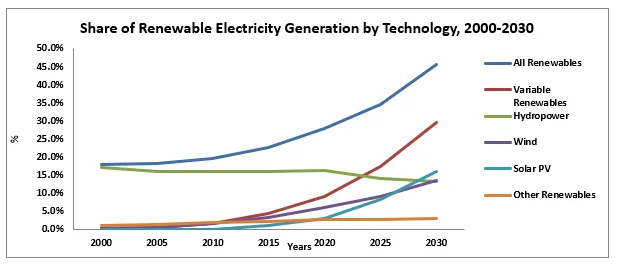
Source: Share of Renewable Electricity Generation by Technology, 2000–2030, International Energy Agency, 2025
Global Policies and Investments Accelerating Demand for Solar PV Panels
Policy support remains a primary driving factor for the solar PV panel deployments in the majority of the world. Several types of policies underpin the capacity growth of solar PV, including feed-in tariffs, contracts for difference, auctions and net metering. The following important policy and target changes affecting solar PV growth have been implemented in the last few years:
- In November 2021, during 26th Conference of the Parties (COP26) to the United Nations Framework Convention on Climate Change (UNFCCC), held, India declared new 2030 targets of 500 GW of total non-fossil power capacity and 50% renewable electricity generation share, as well as net zero emissions by 2070, with solar PV being one of the major technologies utilized to achieve these goals.
- In June 2022, China published its 14th Five-Year Plan for Renewable Energy, which covers an ambitious target of 33% of electricity production to come from renewables by 2025, including an 18% target for wind and solar technologies.
- The federal government of the U.S. introduced the Inflation Reduction Act (IRA) in August 2022, which considerably expands support for renewable energy in the next 10 years through tax credits and other measures.
- In May 2022, the European Commission (EC) planned to raise the European Union’s (EU) renewable energy target for 2030 to 45% as part of the REPowerEU Plan. Multiple European countries have expanded their solar PV support mechanisms to accelerate capacity growth in preparation for the 2030 targets and in response to the energy crisis caused by Russia’s invasion of Ukraine. Additionally, in February 2023, the Commission announced the Green Deal Industrial Plan, directing support for the expansion of clean energy technology production, including solar PV.
- In June 2025, Maruti Suzuki India Limited announced an investment of approximately $112 million to expand its renewable energy initiative, focusing on scaling its solar power capacity to 319 Megawatt-peak (MWp).
As governments demonstrate ambitious renewable targets and incentive schemes, the resulting increase in solar installations directly accelerates the expansion of the solar PV panel market, creating new opportunities for producers across residential, commercial and utility-scale segments.
According to the International Energy Agency (IEA), the global solar PV investments in capacity addition rose by about 30% in 2023 and exceeded $480 billion. In 2023, Solar PV investment exceeded that of all other power generation technologies combined. Investment in PV is expected to increase further in the near future due to ambitious government targets, policy support and growing competitiveness.
Future Outlook
Solar PV panels remain the keystone of the global renewable energy transition, driven by cost competitiveness, continuous innovation and supportive policy measures. With governments worldwide strengthening renewable energy targets and implementing tax incentives, the solar PV panel industry is set for sustained growth throughout the decade. Solar PV technology is becoming increasingly efficient with the adoption of advanced cell designs, such as Heterojunction (HJT), Perovskite-based panels, and Tunnel Oxide Passivated Contact (TOPCon) panels, thereby improving energy yield and system reliability.
The expansion of decentralized power generation, particularly through rooftop and community solar projects, will further strengthen the role of PV panels in distributed energy systems. Additionally, technological advances in energy storage integration and the recycling of end-of-life panels are anticipated to enhance lifecycle sustainability and reduce dependency on raw materials. With supportive policy frameworks, reduced manufacturing costs and substantial investment in next-generation technologies, solar PV panels are well-positioned to play a crucial role in achieving global net-zero energy ambitions and ensuring long-term energy security.
Strategic Takeaways for Industry Leaders
The solar PV panel industry is entering a new phase of technological advances and large-scale deployment, supported by strong policy frameworks and record-level investments. Industry leaders are strategically focusing on enhancing manufacturing capabilities, particularly in high-efficiency technologies such as TOPCon, HJT, and perovskite panels. As global competition intensifies, securing long-term supply chains for critical materials like polysilicon and glass has become a key differentiator.
Companies’ main activity in solar PV panel deployment can be divided into two categories:
Companies are investing in distributed solar PV installations, including rooftop systems, on their own buildings and premises.
Companies entering into corporate Power Purchase Agreements (PPAs) – signing direct contracts with solar PV plant operators for the purchase of generated electricity.
With solar PV panels expected to dominate new renewable installations, proactive engagement in emerging markets, innovation ecosystems and policy advocacy can help industry leaders maintain technological leadership and capture long-term growth opportunities.