

Sovereign Clouds: Why Countries Are Building, Buying and Regulating Them?
Clear insight into competitor positioning and market share.

Cloud computing has had a significant impact on the IT world over the past decade by offering the flexibility of capacity, services under management, and fast innovation as its main features. However, for a significant portion of the state and the localized industries sector, the advantages are deemed unacceptable due to issues in the public cloud, particularly when it is under the authority of foreign companies. The problem lies in the legal, security and political aspects because different jurisdictions may have control over data and services that extend beyond a country. Here comes sovereign clouds, the idea of having cloud infrastructures, platforms, and services set up, operated, and managed in such a way that the most important data, the control authority, and the compliance align with a legal and regulatory boundary as defined.
What is a Sovereign Cloud?
A sovereign cloud is more than just a data center located within the borders of a country.
It represents the coexistence of a domestic physical footprint with constraints in the form of a logical shield, which ensures that corporate and operational guarantees prevent data from leaving the country. This setup enables the population to have ultimate control over security and privacy, ensures that data can be easily linked back to its owner, applies the country's legislation, and places the courts of that country in charge of any disputes. Both the government and controlled industries can find a sanctuary in a cloud comprising hardware, software, fabrication chains and arrangements of contracts, not only for providing an advanced level of security but also for infrastructural self-healing, to name a few. Many European local sites and a few small community centers, like Conceptboard, view the national cloud as a source of authority, stability and independence in data concentration.
Why do Sovereign Clouds Matter?
The shift to sovereign clouds is driven by a combination of legal, security, and public trust factors that have intensified over the last few years. Governments and authorities are tightening data protection laws. For example, the EU's digital strategy emphasizes reducing the use of foreign providers and stricter enforcement of data residency. Moreover, national security issues have become more serious—the decision-makers are increasingly convinced that the cloud infrastructure managed by foreign-based companies is a weak point rather than an advantage, as it exposes the most essential public and defense-related data to risks of being under the jurisdiction and surveillance of another country.
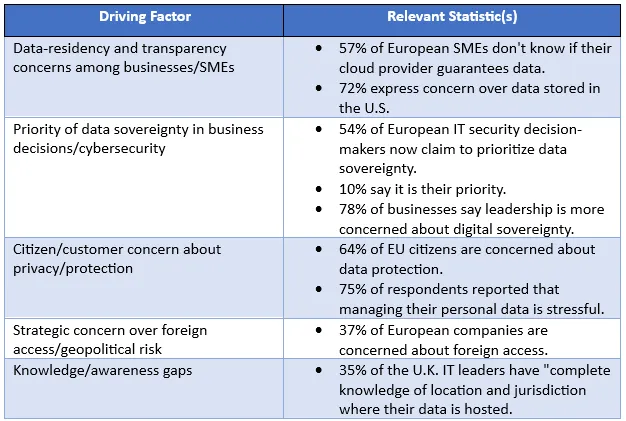
Sources: Harfang Labs, Samsung Electronics, Eurobarometer Survey and Microsoft.
The U.S. 2024 International Cyberspace and Digital Strategy, as well as the new rulemaking to avoid foreign access to bulk sensitive data, are examples of a paradigm shift toward protectionist digital governance. Furthermore, there is a significant increase in public support for the changes, as shown by a vast number of surveys conducted by Samsung, the Bhabha Atomic Research Centre (BARC) study and reports by the European Union (EU). These studies and reports show that more than 50% of the population is worried about their data privacy, and most companies are already giving data sovereignty considerations in procurement and compliance options.
These pressures are further amplified by the dominance of the three largest U.S. hyperscalers that control a significant portion of the global cloud market. Consequently, governments in Europe and Asia face increasing pressure to adopt national or hybrid "sovereign cloud" solutions to ensure greater control over their data, maintain security and reduce dependence on foreign providers. The ultimate concern is with the sovereign cloud's resilience and continuity, or, in other words, the ability to run essential services without depending on geopolitics or supply-chain disruptions. This has turned the sovereign cloud from a minor technological issue to a major national concern. Consequently, the said reasons are driving the policy and investment in cloud technology worldwide, providing sovereignty, trust and autonomy as the basis of the future digital infrastructure.
A Quick, Focused Look at the Issues
Sovereign clouds are appealing, but they come with tradeoffs. The use of sovereign data clouds ensures businesses have full control, compliance with laws and exclusive rights to the data stored, but they have their fair share of problems. One of the drawbacks is that the local cloud ecosystem construction and compliance with very restrictive regulatory norms contribute to a situation where economies of scale are unavoidably hindered. Hence, the cost of doing business goes up. Sovereign providers that are highly specialized may be slow to adopt or may not even enter certain technological areas, such as managed AI services, serverless computing, or advanced databases, unless they obtain the right certification to become part of the larger cloud ecosystem.
Sovereign clouds also require highly skilled IT and cybersecurity professionals, but these skills are currently in short supply. This shortage can reduce operational efficiency and slow down overall growth. Additionally, if we assume a model where benefits and responsibilities are shared between governments and cloud providers, the compliance burden can become especially heavy. This is because such an arrangement would require extensive changes to existing policies, processes, and the traditional way organizations conduct their operations.
Emerging Opportunities and Areas for Investment
Sovereign clouds are believed to be the next catalyst for the cloud industry boom with their hybrid models that will provide global cloud technology while respecting national data control. In this respect, global cloud providers are required to operate local sovereign zones under contract, adhering strictly to the technical conditions that have been implemented. Alternatively, sovereign overlays such as key management, identity, and audit layers may be added to cloud regions. These means of attacking the problem offer huge pros as they are like going halfway between home and hyperscale providers, or on the other extreme. That is, one could argue that it is a way of seizing dual benefits, which is increasing the country's ability to recover economically and, simultaneously, the realization of the more advanced technological aspects of global cloud platforms. These combined approaches are explicitly supported in European policy discussions, realizing the possible improvement in both sovereignty and competitive by outsourcing domestic care to global cloud providers.
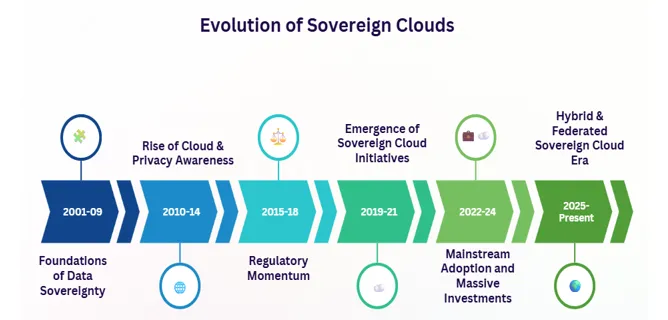
Encryption and key sovereignty services are highlighted as another promising area that enables a country to retain control over cryptographic keys, hardware security modules, and key escrow frameworks, while also being prepared for threats such as those posed by post-quantum cryptography. Governing bodies like national labs, standards bodies, and specialized workstreams are actively creating technical guidance for this; therefore, the field is very attractive for both investment and innovation. In the same vein, federated interoperability and open-source cloud stacks are slowly gaining ground, offering the advantages of workload movement between different sovereign areas and the ability to avoid vendor lock-in. Various communities and nonprofits are the driving forces behind the formation of technical standards that will shape interoperable ecosystems, and they are doing so actively.
There is also an expectation that compliance and assurance services will be in higher demand. Certification agencies' offerings, audit services, and tools that correlate cloud settings with the state law endorsements will shift from the market's margins to its core, as governments and organizations will soon require more tangible proof of compliance. The U.S. Government Accountability Office is emphasizing governance and auditability as a significant factor in cloud deployment, and consequently, third-party assurance providers will likely see more opportunities soon. Eventually, sector-specific government offers, such as those in health, finance, elections, and defense, will likely proliferate, bringing about market-segment solutions with specially oriented layers of compliance, identity, and provenance for the needs of tightly regulated industries and government agencies.