

Terahertz Photonics from Lab to Market: Bridging the Gaps in Science, Imaging, Sensing and Communication.
January 24, 2026
In-depth market intelligence to support growth and planning.

Terahertz (THz) photonics, which works at the frequency range of 0.1 to 10 THz, holds a unique position in the electromagnetic spectrum. It is the bridge between microwave and infrared technology, offering the speed of high-frequency communication and the ability to penetrate materials. This balance provides THz photonics with tremendous usefulness in applications ranging from high-resolution imaging and spectroscopy to secure communications.
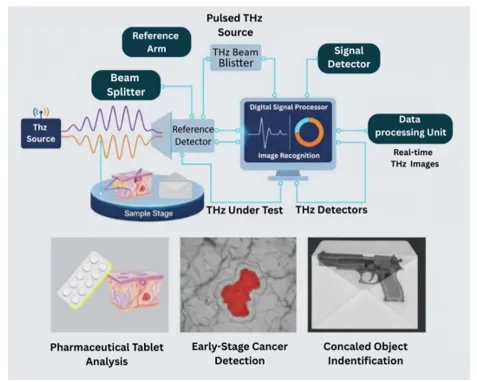
For example, in pharmaceuticals, tablet coatings can be imaged using THz imaging without damaging the product. In medicine, early skin cancers are identified by THz spectroscopy through tissue property analysis. In security matters, THz scanners enable non-invasive scanning at airports to identify objects hidden under clothing without exposure to dangerous radiation.
Figure 1
THz Photonics Non-Invasive Imaging Procedure
Source: BCC Research
Evolution of Terahertz Photonics: Turning from Concept to Reality
- 1960s–1970s: As researchers investigated the mainly unexplored areas of the electromagnetic spectrum, the idea of THz radiation started to take shape. The phrase "terahertz gap" was created at this time to refer to the scarcity of useful sources and detectors that could function in the frequency range of 0.1–10 THz. Understanding the fundamental characteristics of THz waves and identifying possible methods for producing and detecting them were the main goals of the research.
- 1980s–1990s: The development of early THz generation techniques, such as nonlinear optical technologies and photoconductive antennas, expedited progress. Researchers progressively demonstrated the viability of THz spectroscopy and imaging in laboratory settings as they began working with semiconductors and ultrafast laser systems.
- 2000s: More useful THz sources and detectors were made possible by developments in semiconductor technology and ultrafast optics. Better sensitivity, more compact THz systems and increased output power were made possible by the development of quantum cascade lasers and enhanced photoconductive materials. These innovations paved the way for practical uses in biological imaging, material characterization and security screening.
- 2010s: Early commercial uses of THz technologies started to emerge from laboratory experiments. Research grew into fields including enhanced spectroscopy, wireless communications and non-destructive evaluation, and small and portable THz devices appeared. Governments and private organizations began making large investments in THz research initiatives after seeing how well it could solve important business issues.
- 2020s and Beyond: Today, THz photonics is entering a period of rapid innovation. Miniaturized hybrid photonic–THz chips, high-resolution imaging systems and integration with AI and quantum technologies are pushing the boundaries of what is possible. With increasing industrial and government interest, THz photonics is poised to play a transformative role in healthcare, security, telecommunications and other high-impact sectors.
Key Drivers Accelerating the Adoption of Terahertz Photonics
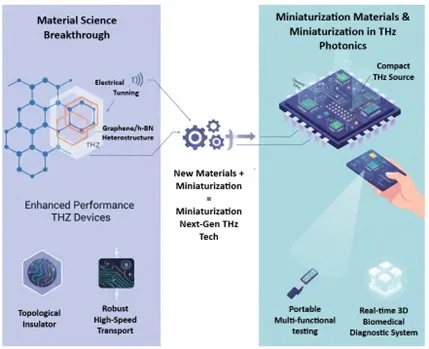
Latest terahertz breakthroughs are transforming the boundaries of high-speed communication and imaging. From ultra-miniature hybrid photonic-THz chips to real-time 3D terahertz imaging systems, researchers are making significant advancements in efficiency, resolution and application potential.
Figure 2
Advancements in Material Science: From THz to Next-Generation Photonics
Source: BCC Research
Need deeper insight for your specific market?
BCC Research can tailor custom research by region, application, technology segment, competitor set, customer group, or investment priority.
Discuss a Custom Research NeedThe miniaturization of terahertz devices made terahertz technology more portable and versatile. Advances in microfabrication technology and photonic circuit integration have pushed the development of compact THz sources and detectors needed for portable applications. The efficient, compact devices facilitate real-time 3D imaging, as seen in multispectral biomedical diagnostics created by UCLA scientists. Portable THz systems are also revolutionizing industrial quality control and security screening, allowing non-destructive testing and quick data acquisition. With the combination of speed, accuracy and portability, miniaturized THz technology is creating new opportunities across all fields of use.
Government and institutional funding have been essential to the advancement of THz photonics. A significant amount of money has been invested in projects like TeraOptics, a mission devoted to integrated THz devices for sensing, imaging and communications, under programs like the European Union's Horizon 2020. This funding has promoted collaboration between academics and industry, advancing innovation and bringing technology closer to the point of use. Similar investments were made in THz research by the National Science Foundation (NSF) and the Department of Energy (DoE) in the U.S., which resulted in new materials, tools and systems for absorbing THz radiation. These initiatives have been crucial in translating scientific findings into practical applications.
THz photonics are increasing commercially as companies wake up to its potential in numerous industries. TeraView, for example, is a U.K.-based company that specializes in THz imaging systems and the application of THz inspection to semiconductors, pharmaceutical quality assurance, and biomedical diagnostics, providing non-destructive analysis that can identify subsurface information without staining or labeling. Likewise, Germany's TOPTICA Photonics is entering the field of THz technologies to address the rising demand for high-speed communications and sensing applications such as wireless communication, security scanning and industrial inspection. By integrating THz components into their existing products, both companies aim to deliver advanced, practical solutions that address evolving customer needs.
Riding the Terahertz Wave: Cutting-Edge Breakthroughs in Photonics
In August 2025, researchers at EPFL and Harvard revealed an unprecedented hybrid photonic-terahertz lithium-niobate chip the size of a coin. The chip is an ultra-thin fusion of photonic circuits and terahertz generation and detection, enabling seamless optical-to-THz and THz-to-optical signal conversion. By harnessing the electro-optic behavior of lithium niobate, the chip unleashes terahertz fields that are more than 100 times higher than previous records, ranging from 680 GHz to 3.5 THz. This innovation possesses the prospect of ultrafast wireless communication with extremely high-resolution distance measurement and unprecedented efficiency and bandwidth.
UCLA Samueli School of Engineering engineers in January 2024 showcased a terahertz imaging system that captures real-time 3D multispectral video. Other systems employ point-by-point scanning, whereas this technology eliminates raster scanning, resulting in image acquisition 1,000 times faster with a high signal-to-noise ratio. It allows non-invasive, high-resolution imaging of tissue via an FPA and identification of hidden defects and diseases at an early stage. This rapid, high-resolution imaging has the potential to transform biomedical diagnosis and medical imaging protocols.
Real-World Applications of Terahertz Photonics
TeraView Ltd (U.K.) is a leading firm that provides THz imaging and spectroscopy technology for biomedical uses, such as cancer diagnosis. Along with Guy's Hospital, they have performed in vivo trials to image breast cancer tissue and carcinomas of the skin. They utilize the contrast between healthy and cancer tissue variation in THz absorption and refractive index. The research demonstrates that THz photonics is more than a real-time theory; THz spectroscopy already exists and is used to detect cancer by analyzing tissue water content and contrast.
The security screening company that provides is TeraSense Group, Inc., which provides a Terahertz Security Body Scanner, non-ionizing, safe THz imaging to identify hidden items such as weapons or explosives up to 3 meters away. They also have a high-speed THz scanner for packages and mail, allowing for non-destructive inspection of parcels or envelopes without opening them. These technologies remind one that THz photonics offer safer, quicker and more efficient screening technologies that replace or even outperform conventional X-ray technologies. Fraunhofer HHI in Germany, in collaboration with Fraunhofer IAF, demonstrated the real-time wireless transmission of 4K video using a terahertz (THz) link. This experiment showed ultra-high data rates far beyond what typical 4G or 5G networks can handle. It highlights how THz photonics can overcome bandwidth limitations, demonstrating that these technologies are transitioning from theory to practical telecom applications.
Future of Terahertz Photonics: Convergence of Quantum, AI and Miniaturized Technologies
The second generation of THz photonics will emerge at the intersection of global collaboration, consumer electronics and quantum technologies. For instance, the combination of THz photonics with quantum sensing can make ultra-secure banking transactions and medical diagnostics possible with unprecedented accuracy. Miniaturized THz chips are also expected to power consumer electronics in the near future. Smartphone cameras are expected to be able to remotely measure vital signs without physical touch, scan food quality and identify hidden product flaws. To make these innovations scale globally, international standardization initiatives, like 5G deployment agreements, will be essential to ensure interoperability and mass adoption across sectors.
Conclusion
Terahertz photonics has transitioned from theory to real-world applications, driving innovation in communication, medicine, and security. With advances continuing in materials science, miniaturization, and hybrid integration, THz systems are becoming faster, more compact and more convenient. The integration of AI, quantum technologies, and photonics will broaden the possibilities even further by providing secure data links, real-time imaging and future wireless networks. Supported by international investment and standardization, terahertz photonics will become a key technology that bridges science and real-world applications.