

E-Methanol: Powering the Future of Sustainable Fuel
Forecast-backed insights for confident investment decisions.

E-methanol is a liquid fuel made by combining green hydrogen (H₂) and captured carbon dioxide (CO2). This process uses renewable electricity to create green hydrogen from water through electrolysis. Hydrogen is then synthesized with CO2 captured from sources such as industrial facilities or the atmosphere. It is considered a sustainable alternative to fossil-based fuels. It can be used directly in various vehicles, including power plants, trucks and ships, and can also be used as feedstock for the production of other chemicals, such as formaldehyde and fuels, consisting of kerosene and gasoline.
E-methanol also provides a carbon-neutral energy option if the carbon used in its production process is sustainably sourced. Thus, it can be considered a healthy solution that helps reduce greenhouse gases and supports a low- or net-zero economy. By supporting the increasing advancements in sustainable energy and carbon capture technologies, e-methanol is expected to play a significant role in meeting the global climate goals.
The Evolution of E-Methanol Technology
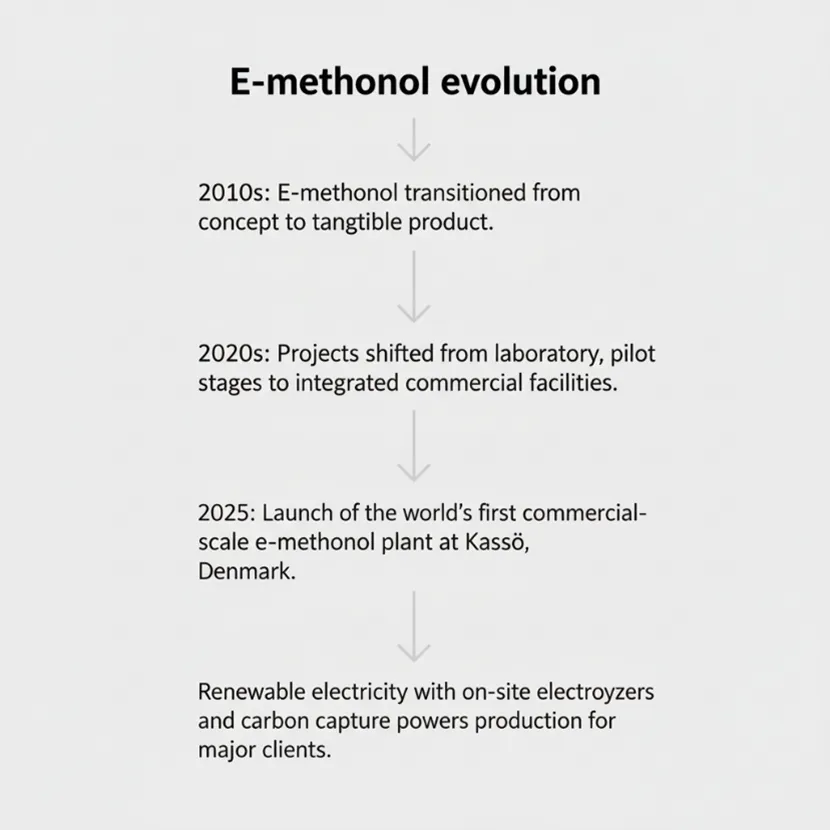
Source: BCC Research
The evolution of e-methanol is being driven by strong demand from maritime shipping and aviation sectors, where direct electrification is not feasible. The shipping industry has become a key early adopter, with companies such as Maersk ordering methanol-capable vessels. The development of dual-fuel engines that can run on both traditional fuel and e-methanol has made it a practical and low-risk option for fleet owners. While the current cost of e-methanol is higher than fossil-based methanol, ongoing advancements in electrolyzer technology and a projected decrease in renewable electricity costs are expected to make it more economically competitive over time.
Driving Forces Behind E-Methanol Adoption
Advancing Cost Efficiency: The trend of declining renewable energy costs is expected to lead to a fall in the overall cost of production of e-methanol, making it a strong alternative to the currently used conventional products. Innovation and improvements in carbon capture and electrolyzer efficiency are further expected to help manage cost while improving efficiency. This will be a result of:
Falling Renewable Electricity Prices: The cost of solar and wind power continues to decline, which is the most significant factor in the production cost of e-methanol. The cost of solar photovoltaic (PV) modules has dropped by over 90% in the last decade, primarily due to large-scale manufacturing in China.
Improved Electrolyzer Efficiency: Ongoing R&D is making water electrolyzers more efficient and cheaper to manufacture, lowering the cost of green hydrogen production.
Scaling Up Production: As the industry scales up, economies of scale are expected to reduce the cost per unit of e-methanol, making it more competitive. The International Renewable Energy Agency (IRENA) predicts that costs could be halved by 2030 in certain regions with abundant renewable resources.
Regulatory Frameworks and Policy Support Accelerating E-Methanol Adoption: Governments and international bodies are playing a crucial role in accelerating the demand. To support the decarbonization of the maritime sector, the European Commission's FuelEU Maritime Regulation (Regulation (EU) 2023/1805) encourages the use of renewable, low-carbon fuels and clean energy technologies for ships. The regulation has been in full effect since January 1, 2025. Policies in the EU and the U.S. are driving the economic viability of e-methanol. The U.S. Inflation Reduction Act (IRA) offers significant tax credits for the production of clean hydrogen and low-carbon fuels, while China uses national planning and preferential rates to support its development.
E-Methanol’s Industrial Demand: The future of e-methanol will be defined by its adoption in sectors where electrification is not a feasible option.
- Maritime Shipping: This industry is a key driver of demand for e-methanol. It is establishing e-methanol as a viable alternative to heavy fuel oil.
- Aviation: While still in the early stages, e-methanol can be used as a precursor for sustainable aviation fuel (SAF), providing a pathway for the aviation industry to decarbonize.
- •hemical Industry: As a vital chemical feedstock, e-methanol is expected to play a major role in the transition to a bio-based economy. It can replace fossil-based methanol in the production of a wide range of chemicals, plastics and other materials.