

Virtual and Augmented Reality: Emerging Solution for Advanced Healthcare
Expert guidance to accelerate your market and strategy decisions.

Revolution in Healthcare: The Rising Adoption of Virtual and Augmented Reality
Virtual and augmented reality (VR and AR) are two emerging sectors of healthcare. The adoption of VR and AR in healthcare has increased due to advancements in technology, enhanced surgical planning, and a growing demand for advanced medical training and pain management solutions. While VR provides realistic simulations for training in surgical procedures and other aspects of care, AR is used for point-of-care real-time overlays to support clinician diagnostics and intra-operative guidance. Both the tools are also changing the approach to therapy for mental health, chronic pain and neurological rehabilitation with personalized, non-invasive and engaging treatment options. Although there are expensive implementations and challenges in integrating with existing systems, efforts to enhance clinical evidence, regulatory support, along with the convergence of AR/VR and AI, as well as telehealth, are expected to catalyze the proliferation of interoperable AR/VR solutions that will impact global healthcare delivery and training.
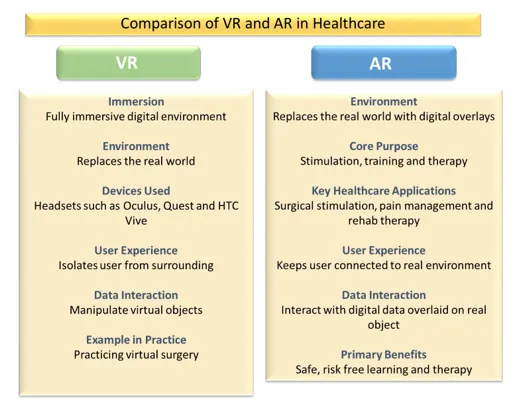
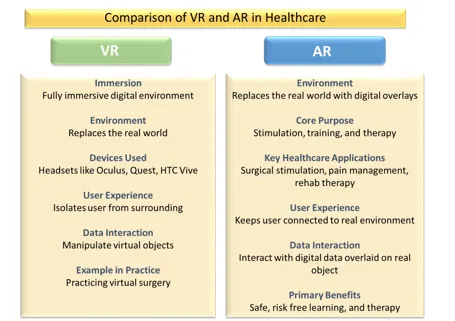
Source: BCC Research
Next-Generation Movements in VR and AR in Healthcare
Advancements in technology related to VR and AR are transforming the delivery of healthcare by creating immersive digital worlds that also meet the actual clinical requirements of healthcare practitioners. Technologies are adding greater levels of detail in education and training of healthcare practitioners (using hyper-realistic visuals during education), creating more realistic surgical simulations (by training through simulation versus actual surgery), and providing new avenues for patients to receive rehabilitation (by providing patients with physical therapy in their homes instead of at a facility). In combination with advances in computing capabilities and growing acceptance of using these technologies within both clinical and consumer healthcare environments, VR and AR will represent significant new foundations for creating future care systems.
Integration of AI and Biosensing Technologies
Constantly adapting AI and biosensing technologies, combined with augmented and virtual reality, presents an opportunity to transform personal healthcare. AR/VR systems can adjust simulations and therapeutic experiences according to patients' physiological reactions. This novel development improves the accuracy of diagnostics, patient monitoring and the measurement of rehabilitation progress. For example, XRHealth's VR therapy enables adaptive rehabilitation programs. Thus, integration of AI and biosensing technologies is promoting the adoption of VR and AR in healthcare.
Expansion in Remote Care and Telemedicine
The rapid embrace of telemedicine and remote care is generating interest in VR/AR options to expand a clinical context beyond health services. For instance, in a study involving 5,438 ICU patients, the ICU mortality rate dropped from 8.5% to 3.8% and the hospital mortality rate decreased from 12.4% to 7.7% after the implementation of a Tele-ICU system. An AR tool can assist a specific healthcare provider by providing remote diagnostics and consultations, while also offering patient data and/or visual guides to the user treating the patient. This value-based trend can help address access-to-care issues in rural or resource-limited areas while also improving the cost and continuity of care for patients.
Patient Centric Care
Using interactive, immersive and personalized treatment environments, VR/AR is revolutionizing patient engagement and therapeutic experience. Virtual reality is used for pain management, anxiety reduction, post-traumatic stress disorder therapy and phobia desensitization through the distraction or calming of patients during treatment. On the other hand, AR aids in explaining complex diagnoses and treatment plans through 3D visualizations, thereby enhancing the patient's understanding and compliance. This shift toward experiential healthcare not only improves emotional health status but also facilitates speedy recovery and satisfaction, a crucial measure of modern-day healthcare service delivery.
Treatment Domains: VR and AR are used for Patient Care

Source: BCC Research
What is Accelerating the Adoption of VR and AR in Healthcare?
The adoption of VR and AR in healthcare is accelerating as providers seek immersive, data-driven tools to enhance clinical training, patient care and treatment outcomes. Advances in real-time 3D visualization, falling hardware costs and growing evidence of improved patient engagement are fueling this momentum. With the increasing need for the provision of therapeutic modalities remotely, precision in surgery and more personalized rehabilitation, VR and AR will soon transition from experimental technologies to widespread enablers of contemporary healthcare.
Improved Access to Healthcare Services:
Virtual and augmented reality technologies can provide patients with easily accessible, high-quality care. Combining telemedicine and AR, practitioners may engage with a local health worker to guide them as they remotely assist a patient in carrying out a challenging and significant procedure in real-time. For instance, a telementoring study stated that AR remote mentorship reduced intraoperative stress among residents, demonstrating improved feasibility of remote supervision. VR may provide practice teams with an opportunity to develop and simulate ideal therapeutic environments for patients who may never visit a clinic in person. Scaling access to care is driving the adoption of VR and AR technologies in healthcare systems.
Increasing Demand for Self-directed and Remote Care:
Patients are empowered to be more engaged in their care through the use of VR and AR. For example, VR can be utilized in rehabilitation programs (e.g., post-stroke or musculoskeletal recovery) by incorporating interactive exercises in the home environment. AR apps can assist patients with medication management, wound care, or physiotherapy exercises. This improves adherence to the treatment plan, decreases hospital visits and improves patient independence. Thus, increasing demand for self-directed and remote care is propelling the adoption of VR and AR in healthcare.
Product Innovations

Source: Company websites
Future Outlook:
The adoption rate of VR and AR in healthcare is expected to rise due to growing technological advancements, increasing demand for remote care and rising adoption of telemedicine. The main components of growth include AI-powered devices, high-fidelity VR devices for surgical simulation, immersive training programs and remote patient care devices. VR/AR will improve patient outcomes through personalized treatment, improved accessibility to quality care in rural areas and reduced healthcare costs using fewer resources and leveraging telemedicine. Emerging markets will also see rapid adoption of VR and AR-integrated solutions for self-directed and remote care.
Strategic Takeaways for Industry Leaders
Virtual and augmented reality provide real-time analysis for the healthcare system. Industry leaders should adopt VR and AR as advanced solutions for various treatment domains such as ophthalmic diagnostics, mental health care, pain management, telemedicine and surgery planning. VR and AR help clinicians with remote consulting. Thus, growing adoption of telemedicine and remote consultation will boost the adoption of VR and AR solutions among clinical professionals.
Conclusion
VR and AR in the healthcare market are positioned to grow considerably over the coming decade, supported by technological innovation and increasing demand for remote healthcare, along with the application of immersive technologies in medical education, diagnostics and patient care. VR/AR applications include surgical simulation, anxiety management, rehabilitation and telemedicine. These initiatives will enhance clinical outcomes, foster patient engagement and expand access to quality healthcare on a global scale. Companies that heavily invest in innovation, comply with regulations, adhere to patient-centric values and partner strategically will be positioned for success.