

Voice-Enabled Virtual Health Assistants in Patient Engagement
Expert guidance to accelerate your market and strategy decisions.

Voice-enabled virtual health assistants combine speech interfaces and AI to streamline access, self-management and routine clinical workflows. These are not only digital devices; they are the front-runners in delivering personalized, on-demand patient care, making healthcare more accessible, intuitive and efficient than ever before.
The healthcare industry is at a tipping point due to intelligent voice solutions that are revolutionizing patient engagement, clinical workflow, chronic disease management and mental health support. Adoption is expanding across patient access, intake, chronic care support and behavioral health as organizations test targeted use cases.
Transformative Impact on Patient Engagement
- The modern patient is digitally savvy and expects instant access, seamless communication, and personalized healthcare experiences. Voice-enabled assistants can support the following patient-engagement needs:
- Round-the-Clock Support - Voice assistants deliver real-time medical and health-related information to patients, remind them about medication and help with behavioral changes, thus naturally engaging the patient, even in non-professional settings.
- Personalized Health Journeys - AI-powered assistants take the patient's medical history and, after getting to know them further, provide custom reminders, personalized education and actionable health insights that lead to higher user satisfaction and compliance.
- Inclusive Care for All Populations - The use of voice command technology helps in overcoming the accessibility barrier that may be caused by hearing or visual impairments, limited mobility, or language factors. Thus, it is a tool that has the potential to increase the participation of those who have been previously underserved. At the same time, it can be an even more effective tool for achieving better health outcomes.
- Mental Health and Emotional Support - Virtual assistants can extend their functionalities beyond the usual administrative tasks. They help in cognitive behavioral therapy, giving coping strategies, reducing anxiety and engaging empathically when there is a need for support and a moment of vulnerability.
Why Early Adoption of Voice AI Is Transforming Healthcare Operations?
As adoption increases, early adopters are gaining clear advantages and establishing new benchmarks.
- Sites piloting voice AI report improved intake efficiency, fewer no-shows and higher patient experience scores when integrated into existing workflows.
- Facilities employing voice bots for triage and intake have expedited their documentation and have reduced the clinician's workload, which has led to a decrease in burnout and operating costs.
- Medical networks that integrate voice assistants with electronic health records (EHRs) and scheduling systems are undergoing significant improvements in care coordination, response speed and compliance.
The need to act is apparent. Not adopting voice-enabled assistants now means falling behind competitors who are already gaining higher engagement, better outcomes and lower costs.
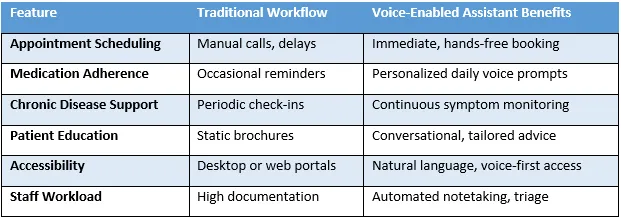
Table: Impact of Voice-Enabled Health Assistants
Current Innovations:
Voice assistants are evolving far beyond basic virtual receptionist roles. Recent breakthroughs include:
- Natural Language Understanding: Advanced voice AI interprets medical jargon and everyday speech, resulting in clearer, more actionable conversations and fewer misunderstandings.
- Real-Time Monitoring and Alerts: Voice assistants analyze speech patterns and biometrics to flag early symptoms of respiratory or neurological issues, allowing preemptive intervention and enhanced safety.
- Integration Across Devices and Platforms: Modern assistants sync with wearables, smart speakers, mobile apps and EHR systems, supporting omnichannel engagement and a unified patient record.
- Data-Driven Personalization: AI algorithms constantly learn from patient interactions, refining reminders and educational content to maximize engagement and drive lasting behavioral change.
- Safe, Regulation-Abiding Communication: The leading voice platforms come with strong security features, similar to HIPAA standards, which are meant to ensure patient confidence and ease the provision of care in compliance with regulations.
Future Outlook: From Assistants to Companions
Voice-enabled virtual health assistants are evolving into emotionally aware companions that can manage complex conversations, detect mood changes and proactively support wellness goals. Emerging trends indicate:
- Conversational AI as Primary Touchpoint: Voice assistants will replace static portals and manual processes, guiding patients through every step of their health journey.
- Self-Management and Preventive Care Focus: Assistants will enable patients to take initiatives in managing chronic disease, home rehabilitation and lifestyle modification, reducing hospital admissions and improving population health.
Expanded Use in Mental Health: Voice bots for cognitive behavioral therapy and emotional triage will increase, supporting mental wellness in ways traditional systems could never scale.
Roadmap for Voice Health AI
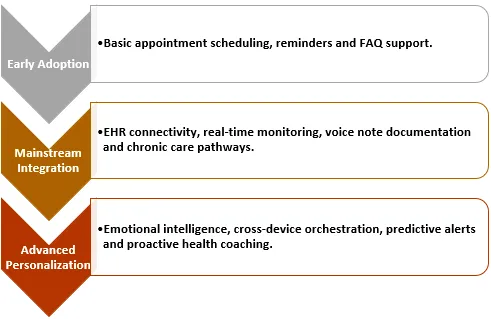
Over the next couple of years, adoption is expected to progress from digital-front-door tasks to select clinical support scenarios where accuracy and safety thresholds are met. As technology continues to evolve, organizations that take the lead will have a significant advantage in integrating such systems easily into their workflows, improving patient communication and reducing administrative burdens. The transition to voice-enabled and AI-driven solutions will soon be considered standard practice in the industry rather than a differentiator. The tone of the communication is that the era of healthcare conversation is underway. For health systems, practitioners and innovators, this is the time to prepare and adjust calmly. The real bet is not only on the speedy uptake but also on the proper engagement of innovation to create lasting value and sustainable change.