

Wearable Bioelectronic Patches for Chronic Disease Monitoring
January 24, 2026
Expert guidance to accelerate your market and strategy decisions.
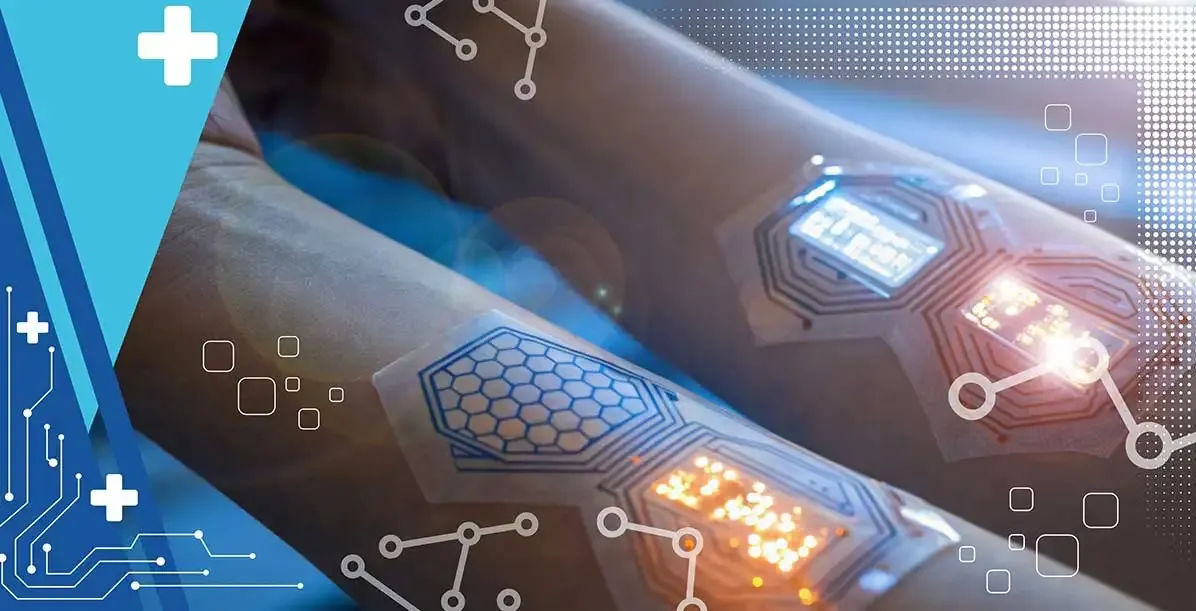
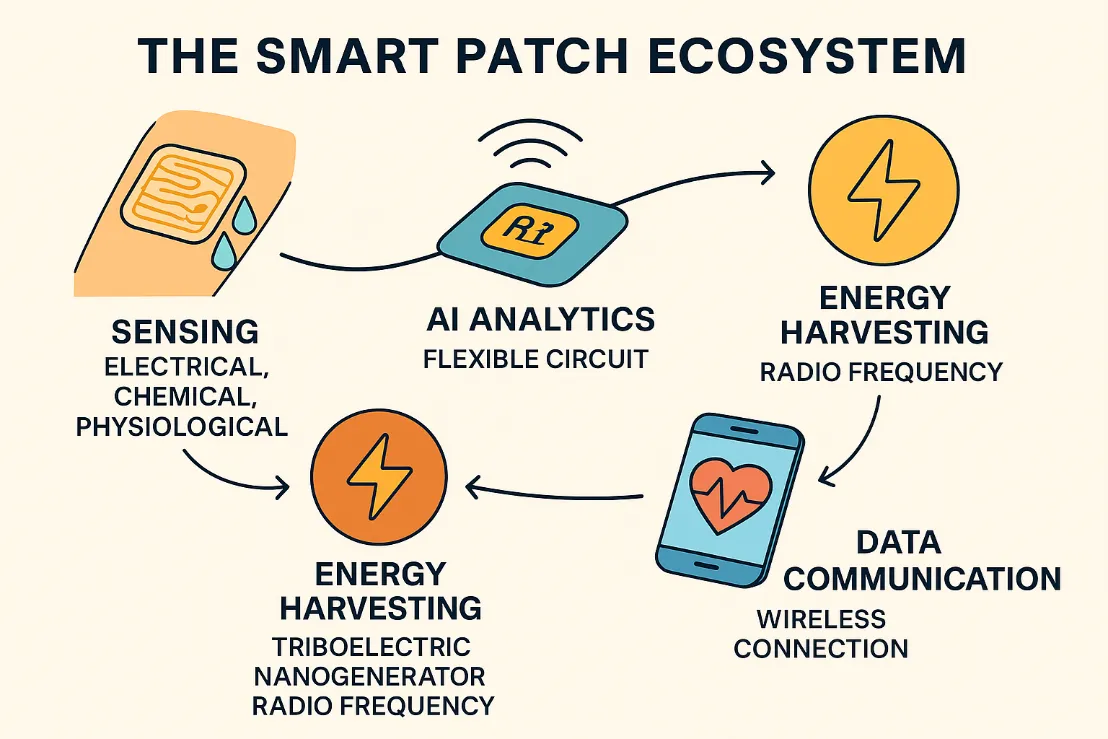
For decades, the healthcare system has been dependent on periodic checkups and hospital visits to detect and treat illnesses. Today, however, medicine is evolving beyond the clinic, moving directly onto the patient’s skin. This is the potential of wearable bioelectronic patches—extremely thin, flexible devices that are placed on the skin, offering the ability to detect and communicate the body's electrical, chemical and physiological changes in real time.
The new generation of tech is changing the landscape of chronic disease monitoring and management. What used to be done with heavy machines or rare lab tests can now be done with a patch that is as light and natural as a second skin. These patches are nowhere near being wearable gadgets; they are becoming an extension of the body's own intelligence, a new digital nervous system for the medicine of the future, by being able to track glucose and lactate levels in sweat, record cardiac rhythms, and monitor electrolyte balance.
Source: BCC Research
Emerging Trends in Next-Generation Wearable Bioelectronics Patches
Wearable bioelectronic patches are evolving rapidly due to several factors, such as the melting-pot science, new energy sources and artificial intelligence (AI). Healthcare wearables, which were once used for simple tracking, are now being transformed into intelligent, adaptive companions that provide continuous, real-time health management. In fact, the newest patches are even thinner and more comfortable and are also more intelligent as they can adhere to the skin for several days while maintaining signal accuracy and user comfort.
Perhaps one of the most notable changes in the advent of epidermal electronics is the extremely soft and clear patches that can be worn on the skin, allowing them to move and flex naturally. Compared to typical wearables, these devices are almost unnoticeable; however, they have the capacity to measure multiple biomarkers simultaneously. For Instance, according to a Stanford University news article published in March 2024, scientists at the university have made significant progress with their skin-like, stretchable electronics, revealing soft integrated circuits that can mimic the flexibility of human skin while maintaining high performance.
Concurrently, research published by Springer Nature in September 2024 highlights brand-new microfluidic sweat-sensor platforms, making it possible for the dependable collection and multi-biomarker analysis of extremely small sweat volumes. This provides a completely painless way to assess the body’s hydration levels, electrolyte status, and metabolic trends.
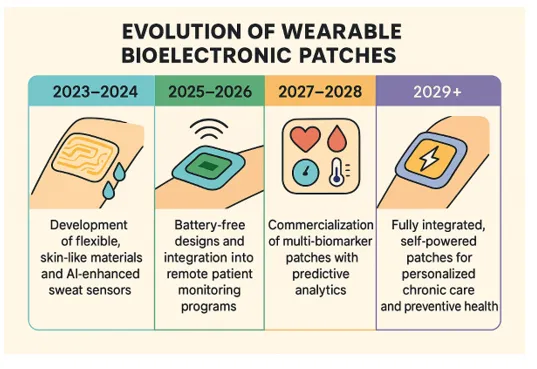
Energy and intelligence upgrades have been of equal importance over the years. A gradual battery-free operation is becoming increasingly feasible due to innovations such as triboelectric nanogenerators (TENGs) and radiofrequency (RF) energy harvesting, which allow devices to operate locally without the need for frequent recharging. On the other hand, AI integration has elevated these devices to a new level, moving them from merely collecting data to actively participating in health interpretation. Currently, patches equipped with algorithms can detect very small changes in a person's physiological condition, such as heart rate variability, and send the first indications of cancer growth to the doctor before clinical symptoms appear.
The transition to edge AI and predictive analytics has been instrumental in the creation of closed-loop systems that not only sense parameters but also learn and respond autonomously. Thus, the systems monitor the patient and can simultaneously take actions to help. As innovation spreads and deepens in different fields, these patches are evolving into living interfaces that not only comprehend the human body but also forecast its needs, thereby enabling a smarter, more personalized version of continuous healthcare.
Source: BCC Research
Need deeper insight for your specific market?
BCC Research can tailor custom research by region, application, technology segment, competitor set, customer group, or investment priority.
Discuss a Custom Research NeedIndustry Alliances Shaping the Wearable Bioelectronics Landscape
The increasing collaboration between MedTech companies, AI startups and materials scientists is driving the rapid development of wearable bioelectronic patches, as these innovations require expertise ranging from biocompatible materials to advanced data analytics. For example, in May 2024, Medtronic and Twin Cities Pain Clinic collaborated to launch the Inceptiv adaptive neuromodulation patch, which combines stimulation and real-time monitoring to provide individualized, closed-loop pain treatment.
Furthermore, in June 2024, Abbott demonstrated how strategic partnerships are revolutionizing personalized health through ongoing biomarker monitoring and adaptive wellness insights by expanding its Lingo bio wearable platform for wide metabolic tracking. These partnerships demonstrate a distinct trend toward intelligent, closed-loop systems that combine data-driven decision-making, therapy and diagnostics.
The industry is developing a digital platform for continuous care to improve future outcomes. Established companies like Philips and GE HealthCare are incorporating patch data into their telehealth ecosystems, thereby transforming remote monitoring into a safe and stable extension of hospital-grade care. In the same period, startups such as GraphWear and Epicore Biosystems are gaining momentum in the direction of eco-friendliness and user-friendliness by using needle-free biochemical sensing and battery-free energy systems. Their breakthroughs are turning long-term, skin-friendly monitoring feasible for patients with chronic diseases as well as for wellness users.
These strategic moves signal an inclusive and integrated future. The area of wearable bioelectronics is evolving from discrete devices to interconnected health ecosystems, where aspects of sustainability, intelligence and comfort come together. Besides being the main driver of technological progress, the industry-wide collaboration spirit in this sector is the pioneer of a more timely, personalized and global healthcare world.
Challenges on the Path Ahead
These bioelectronic patches are great; they measure vital signs when applied to the skin, but challenges remain regarding their practical use. One of the biggest challenges that occurs repeatedly is the interface between the skin and the device, a surface through which the device's performance is defined. Human skin is a living organ; it constantly changes due to sweat, movement and temperature, thereby making it difficult to obtain readings that stay stable. For instance, in September 2023, the Pennsylvania State University published research on a long-term sweat-monitoring patch, which found that changes in humidity caused signal drift, thereby lowering accuracy during prolonged device wear. These micro-environmental factors not only test the device's endurance but also the stability of even the most sophisticated materials.
Besides the hardware, there are still major concerns that need to be addressed regarding the clinical reliability and data integration of the patches. A recent study published by Oxford University Press in May 2025 on nurses utilizing AI-enabled monitoring patches revealed that false alarms were frequently reported, along with challenges in data interpretation, which raises concerns about trust in clinical practice and potential workflow overload.
These challenges are beyond the capabilities of a single group; therefore, the joint efforts of engineers, doctors and regulators are necessary. Skin-adaptive materials, consistent data protocols, and user-centric design will influence accuracy and trust. Bioelectronic patches will go from promising prototypes to dependable, daily medical instruments when innovation and practicality are combined.
Future Outlook: The Road Ahead
The next decade is expected to bring significant changes to healthcare practices, driven by advances in global technology. Wearable bioelectronic patches for diagnostic lifestyle assistance will receive new functions. Through the integration of monitoring, analysis and intervention, these intelligent systems will interact with individuals therapeutically. An adaptable, continuously learning model, driven by real-time patient data, is created when chronic illness diagnosis and therapy are integrated.
The features have been less emphasized, while questions about how devices connect, user comfort and the impact on nature have been in the spotlight. A future device without a battery is likely to be a low-power edge analytics device within a secure data ecosystem, driven by environmental considerations. People will understand nerve activity, biomarkers in sweat, and provide cardiorespiratory data by skin contact, which is normally a protective barrier. In fact, wearable bioelectronic patches may become the most unobtrusive health "guardians" which, in the future, will likely be the bridge connecting hospitals and homes for the arrival of timely and personalized medicine and care.
Conclusion
Wearable bioelectronic patches provide a technological solution for managing chronic diseases, facilitating a shift to continuous, connected care. These enable patient care through monitoring, pattern recognition and early intervention, often preventing conditions from reaching critical stages. Through the integration of bioelectronics, AI and digital health, smart patches will bridge the gap between home and hospital by enabling customized, predictive and preventive healthcare. This will enable consumers to manage their health and provide clinicians with continuous, high-quality data. This preventative strategy goes beyond conventional illness care.
In the next decade, the skin will serve as a healthcare interface, communicating via electrical impulses interpreted by AI to improve human health. Bioelectronic patches, although small, have the potential to revolutionize healthcare, enhance our understanding of the body, and improve overall well-being.