

Wireless Electric Vehicle Chargers: Powering the Future of Seamless Mobility
Wireless Electric Vehicle Chargers
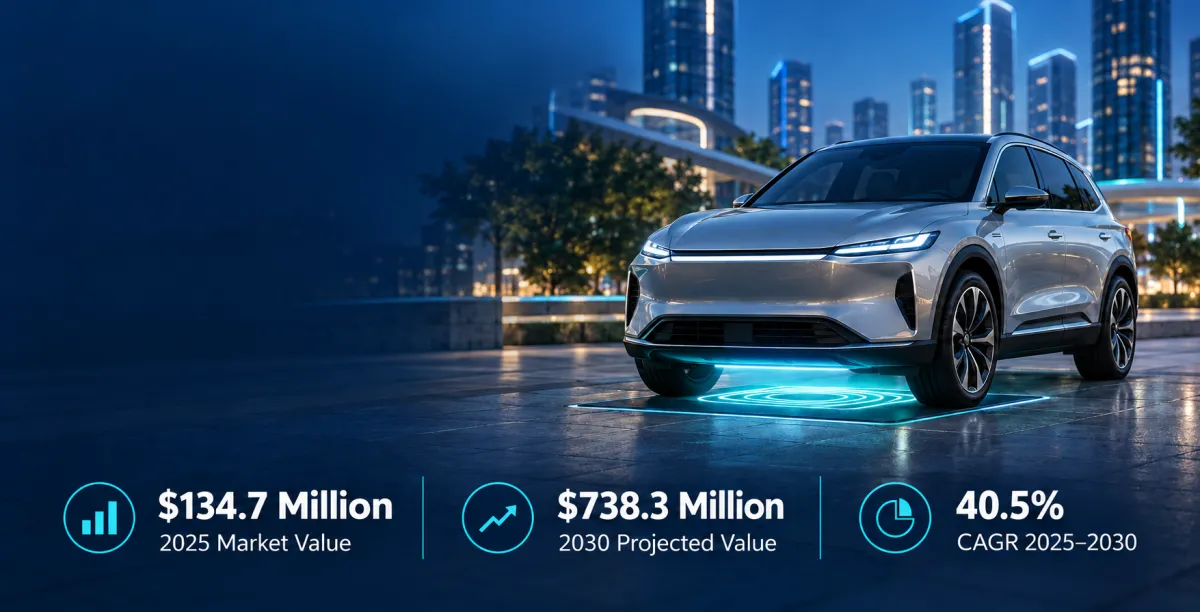
The global market for wireless electric vehicle chargers (WEVC) was valued at $134.7 million in 2025 and is expected to reach $738.3 million by the end of 2030, at a compound annual growth rate (CAGR) of 40.5%.
The growing adoption of electric vehicles (EVs) and demand for convenient charging solutions are accelerating the development of wireless electric vehicle charging (WEVC) technologies. Wireless charging enables cable-free power transfer, improving convenience, safety, and operational efficiency for vehicle owners and fleet operators. The technology is gaining momentum across passenger vehicles, commercial fleets, and public transportation, supported by innovations from companies such as WiTricity, Electreon, and HEVO. As the technology matures, automotive manufacturers are increasingly evaluating wireless charging as part of future EV charging architectures. For example, Porsche introduced its Porsche Wireless Charging system for the all-electric Cayenne, with the system beginning its rollout in 2026. The inductive charging system can deliver up to 11 kW and enables charging to start automatically when the vehicle is positioned over a dedicated floor plate. Porsche has also stated that the system can achieve efficiency of up to nearly 90%, highlighting the increasing commercialization of wireless charging technology in the passenger EV industry.
GROWING IMPORTANCE OF WIRELESS ELECTRIC VEHICLE CHARGERS
The importance of WEVC is increasing as EV adoption expands and the market shifts toward more convenient, automated, and connected charging solutions. Wireless charging can eliminate manual cable handling and support efficient charging for passenger vehicles, commercial fleets, and autonomous vehicles. For example, in August 2026, HEVO announced the issuance of U.S. Patent No. 12,700,758 B2 for systems and methods for dynamic roadway charging. The patented technology covers wireless power transfer to EVs while driving, emphasizing the potential for continuous or opportunity charging. Such technology could reduce the frequency and duration of charging stops, extend vehicle operating time, and improve fleet as well as vehicle utilization.
MARKET DYNAMICS AND TRENDS
Global EV car sales exceeded 20 million units in 2025, accounting for one in four new cars sold worldwide, and this growing adoption is increasing demand for advanced charging technologies that offer greater convenience and operational efficiency. WEVC enable cable-free power transfer and can reduce manual handling, connector wear, and charging downtime. These benefits are particularly relevant for commercial fleets, buses and autonomous vehicles, where vehicles require frequent and reliable charging. In August 2026, Clearmind Medicine Inc. a Canadian clinical-stage biotech company, announced an agreement to acquire a 51% stake in an intelligent wireless EV charging company that develops cable-free charging systems for automated parking and autonomous mobile platforms. Its technology supports continuous charging of up to 10 kW, with smart communication and dynamic energy management. This development shows that WEVC is expanding into automated parking and autonomous mobility, where hands-free charging can improve vehicle utilization, reduce manual charging requirements, and support the development of smart urban transportation systems.
INDUSTRY RESTRAINTS
High system and installation costs remain a primary barrier WEVC market relative to conventional plug-in chargers, particularly for public infrastructure. Wireless charging can also experience efficiency losses when the vehicle is misaligned with the charging pad. Additionally, dynamic in-road charging requires extensive civil works and grid upgrades, increasing project costs. These challenges can limit WEVC adoption in cost-sensitive markets and large-scale public deployments.
MICROECONOMIC FACTORS IMPACTING THE WEVC MARKET
The market is influenced by component costs, infrastructure investment, and customer adoption decisions. Wireless charging systems require power electronics, coils, semiconductors, transformers, control systems, and communication components. Prices of copper, aluminum, steel, and semiconductor components fluctuate due to changes in global supply-demand scenario, raw material availability, and geopolitical disruptions. Economies of scale and improving technology are expected to gradually reduce these cost pressures. Furthermore, higher production volumes can lower the cost of charging pads, power electronics, and installation. Fleet operators can achieve stronger economic benefits as wireless charging can reduce manual handling, charging downtime, and maintenance requirements. For example, automated wireless charging for buses, ride hailing vehicles, and commercial fleets can improve vehicle utilization by enabling frequent opportunity charging.
REGIONAL INSIGHTS AND EMERGING MARKETS
Asia-Pacific dominated the global WEVC market, accounting for 47.7% of the global market in 2025. China was the largest market in the region and is projected to grow at a CAGR of 37.6% through 2030, supported by government initiatives for EV adoption, charging infrastructure, and smart mobility. India is expected to be the fastest-growing market, with a CAGR of 46.8%, driven by rising EV adoption, infrastructure investment, and demand for automated charging solutions.
North America accounted for 19.1% of the global WEVC market in 2025 and is projected to grow at a CAGR of 43.8%, led by the U.S., which generated $22.7 million in market revenue. Europe represented 27.7% of the market in 2025, with Germany leading the region at $11.5 million, supported by favorable regulations, government funding, and its strong automotive industry.

Source: BCC Research
CONCLUSION
Wireless EV charging is expected to gain wider adoption as EV penetration increases globally, driven by demand for convenient, automated, and intelligent charging solutions. Pilot programs for wirelessly charged buses in Europe and dynamic charging roads in the U.S. are in the development phase. Original equipment manufacturers (OEMs) are testing WCSs for upcoming EVs. Short-term growth is expected to come from electric fleets and premium electric passenger cars. Over the long term, dynamic charging and autonomous mobility are expected to drive adoption, making wireless charging a key part of future EV infrastructure.